
Steps to Start Your Own Marketing Agency: A Practical Guide for 2026
A step-by-step guide to starting a marketing agency, covering demand, setup, client acquisition, tools, and common pitfalls.
January 23, 2026
.avif)
Key Points
- A marketing agency is a business that helps other companies or people promote their services or products.
- To start your own marketing agency, choose your niche, define what services you’re going to offer, establish a basic business setup, market yourself, and build a process you’re going to be able to replicate and scale.
- Consider your existing connections when looking for new clients. Don’t forget to talk about your new agency publicly.
- Some of the most common mistakes new agencies make are overpromising on services, not establishing strong positioning, and not having a repeatable process.
If you’re in marketing, the idea of starting your own marketing agency can be both appealing and overwhelming. Like any business, it comes with real decisions that are easier to make when you understand what’s involved.
In this article, I’ll cover what a marketing agency is, why they’re still in demand, how to launch your own, and what mistakes to avoid.
What is a marketing agency?
First of all, let’s cover some theoretical knowledge. What is a marketing agency? What kinds of marketing agencies are out there?
A simple definition
A marketing agency is a type of business that helps other businesses or individuals promote their products or services. This can include planning marketing strategy, creating campaigns, producing content, managing ads, or analysing results.
Everyone needs marketing, but not every company can afford to have an in-house marketing team. So, instead, they work with agencies to achieve their marketing goals.
Traditional vs digital marketing agency
Needless to say, marketing predates the internet. So traditional marketing agencies use offline channels like print advertising, TV and radio, direct mail, billboards, and event marketing. Conversely, a digital marketing agency works with online channels. This includes search engines, websites, email, social media platforms, online advertising, and analytics tools. Digital agencies tend to be more data-driven and measurable, making them especially popular with startups, online businesses, and companies focused on performance and ROI.
There are also hybrid agencies that work both online and offline.
Common types of marketing agencies
Marketing agencies don’t just vary by the channels that they use but also by the scope of the work that they do.
- Full-service agencies. They handle a very wide range of marketing activities like strategy, branding, execution, and reporting under one roof. Whenever a business needs to outsource all of its marketing needs, they turn to a full-service agency.
- Specialised agencies. These focus on a particular aspect of marketing, rather than covering everything. Some of the most common types of services specialised agencies offer include SEO, email marketing, social media, branding, PR, and many other things that fall under the marketing umbrella. These agencies are often hired to address a particular issue.
Why start a marketing agency in 2026?
Unsure if starting a marketing agency is right for you in this day and age? I hope this section helps you make up your mind.
Why demand is still there
Tools marketers use may evolve (like going from analogue to digital), but the need for marketing itself isn’t going anywhere. If anything, many companies rely more heavily on external marketing support as competition grows and the number of channels grows exponentially. This is especially true for digital marketing.
According to research by Mayple, as many as 45% of companies outsource their marketing needs. What’s their motivation, you ask? It’s flexible, time-saving, and more cost-effective.
I started a global branding and digital marketing firm 24 years ago, before Facebook or AI were on the radar. From the start, we did anything a marketing department, ad agency, market research shop, or PR agency did on an as needed outsourced basis. The tools and technology have changed, but we continue to help our clients find the right words and pictures to create interest for their products and services.
{{Paige Arnof-Fenn}}
Marketing agency vs freelancer
Moving from freelancing to an agency means switching focus from personal output to building a business. That includes thinking about operations, taxes, delegation, and growth beyond your own time and capacity. And this isn’t unique to marketing, of course. This is true for any transition from freelancing or solo practice to a more structured business.
After leaving a senior management position at an agency, I started this venture as an agency founder rather than just a freelancer because I had acquired substantial business development and operational experience I hadn't had earlier in my career, and which I could leverage to aim larger.
The business part of it was (and is) still the hardest part of running a business. Doing the work, no problem, but managing my team, handling more finances than before, and focusing on business growth for the organization as a whole is quite different than winging it from contract to contract as a freelancer. Learning when to not work and let the team handle tasks also took some getting used to.
{{Alexander Nachaj}}
How to start a marketing agency in 2026: 8 steps
If you’ve decided that launching your own marketing agency is the logical next step for you, follow these eight practical steps to get started.
Step 1: Choose a niche and target audience
Before you do anything, you need to think about your positioning and targeting. Trying to appeal to “any business that needs marketing” is not a good idea because you risk being vague and inconsistent.
Instead, try to choose a niche you understand. It doesn’t mean it’s forever, but it’s a good starting point. For example, if you mainly worked on social media marketing as a freelancer, it might make sense to focus your new agency’s efforts on that, too. The same goes for clients. You don’t want to spread yourself too thin!
In 2024, I started a boutique digital marketing agency, focusing on offering Google Ads management, SEO, and content creation. Since then, we've also branched out to focus on AI Search/AEO and more general digital marketing consulting.
I've worked in a freelance capacity on and off for close to 20 years, doing pretty much the same things my agency initially focused on offering.
{{Alexander Nachaj}}
Step 2: Define your services and packages
Clear services and packages make it easier for clients to understand what they’re buying and for you to deliver consistently. Now that you’ve defined your niche, think about what you’re going to offer. A smart way to go about this is to offer bundles rather than individual tasks. That might mean a monthly retainer, a defined project, or a limited set of packages built around a specific outcome. Basically, you don’t want a list of disconnected services.
Step 3: Set your pricing and basic business setup
Now, this step is kind of tricky. And this is where many people who want to start their own agency stumble, as evidenced by a cursory browse of online forums.
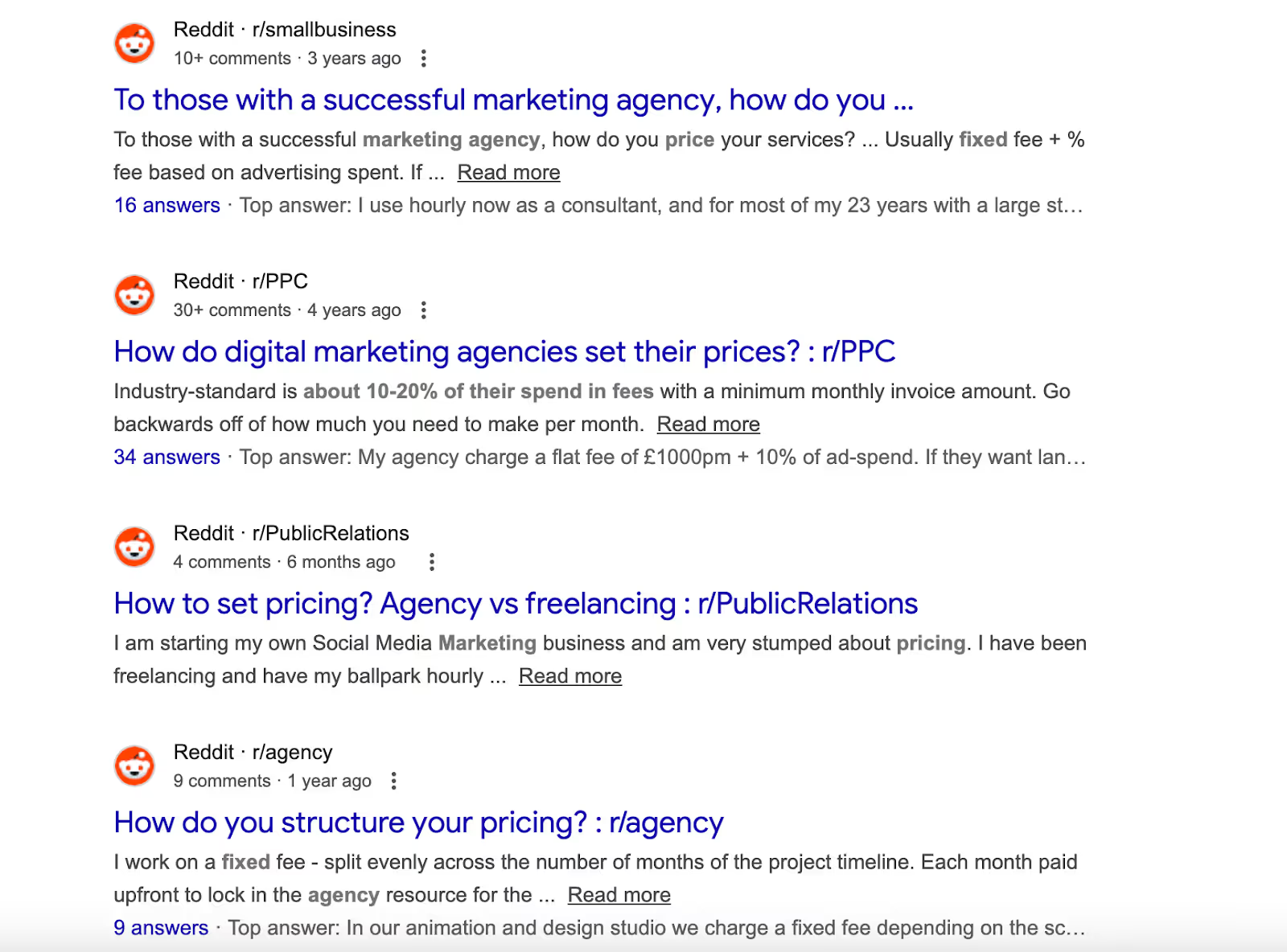
As you can see, there seems to be no right answer, and different agencies use different pricing models, such as retainers (which we mentioned already), fixed fees, or a percentage of ad spend. Confusing, right?
You don’t need to copy someone else’s model. Start by working backwards: how much do you need to earn? How many clients can you handle? How much time and capacity does each engagement require? From there, you can choose a pricing structure that supports your business.
Since you’re just starting out, simplicity is key. You don’t have to commit to your very first pricing model forever, and you can switch to something more complex once your business grows.
Step 4. Make it a business
Running a business is different from working as a freelancer or independent contractor, from the point of view of bureaucracy. At this stage, that usually means registering your business, separating personal and business finances, and setting up basic invoicing so you can charge clients professionally. Requirements are different in every country, so make sure you read up on your local laws!
Step 5: Build your brand and online presence
The next step is branding and building your online presence. Which is… marketing yourself.

To paraphrase the great American entertainer RuPaul, if you can’t market yourself, how are you going to market somebody else?
You don’t need to be present on every social media network ever. At a minimum, your agency should have a simple website that explains your services, your focus, and how to get in touch. Beyond that, think back to your target audience and where they tend to spend their time. That might be LinkedIn, industry-specific platforms, Instagram, or even email. Meet your audience at their level.
Step 6: Create a simple marketing strategy for client acquisition
Our first clients were referrals – either from past contacts coming back or people who knew people I worked with, reaching out on a recommendation. One of the first clients also came from having seen a LinkedIn post I made about starting my own agency, and that kickstarted the conversation.
{{Alexander Nachaj}}
So, your website is ready, and you’ve created profiles on social media websites your target audience frequents. Now is the time to engage them and get new clients.
When you transition from freelancing to launching your own business, client acquisition often starts with existing relationships, referrals, personal outreach, or just talking about your new project publicly. As long as your approach matches where your target audience already spends their time, you don’t need an elaborate strategy.
My first client came from a talk I gave to a professional networking group. Someone from the audience came up to me after and made an introduction, which resulted in my first project a few weeks later. It was a 1-year agreement for a 6-figure engagement, which felt great that my talk was so well received and generated meetings and referrals as follow up. I knew I had a real business. I still give lots of talks, and it is a great way to generate leads and business.
{{Paige Arnof-Fenn}}
Step 7: Deliver services with repeatable processes
When you’re working for yourself and by yourself, you can get away with a little chaos and living from contract to contract. Running your own business is different, and your goal should be to move away from the ad-hoc vibe of freelancing and towards a repeatable process that makes sure everything stays consistent. And it shouldn’t matter who on your team is doing the work.
Here, checklists, workflows, and templates make much of the difference. The aim is to reduce dependence on you personally.
It stopped feeling like freelancing when clients were buying the firm, not me, and when delivery, sales, and fulfillment could run without my daily involvement. That's the real transition point.
{{Nate Nead}}
Step 8: Grow and scale
When you’re freelancing, you’re the jack of all trades. Thankfully, running an agency (and growing it) means being able to hire professionals to take some of the tasks like admin, accounting, strategy, or sales off your plate. These people can either be a part of your team or contractors.
Since you already established a repeatable process, you should also be able to scale it as your agency grows.
[It stopped feeling like freelancing and started feeling like an agency] the moment I brought other people into the picture, and started paying them. Can't pretend you're a solo freelancer anymore after that. Bring in at least one person to help with the sales and business development side of things from day 1. It's difficult to grow a business while also being focused on client relations and project tasks. Get a dedicated specialist to score leads and optimize your offers.
{{Alexander Nachaj}}
Best tools for new marketing agencies
You don’t need a massive tech stack as you’re just starting out. In fact, limiting the number of tools you use may be a smart idea: these costs do stack up! Let’s cover some of the basic software that’ll help you stay organised. And, before we dive in, a word of caution. When selecting your tools, make sure they talk to each other. Integrations will save you even more time and reduce manual work.
Tools to deliver client work
At the most basic level, you need software that’ll help your team manage timelines and collaboration. This could be a project management tool like Asana or Trello, shared documents in Google Workspace, or a communication space such as Slack.
Beyond that, think about the services your agency offers. For example, if you’re in email marketing, you’ll need an email service provider. Think MailChimp or Klaviyo. Meanwhile, an SEO-focused agency would need a subscription to Ahrefs or Semrush. And if you’re in content marketing, I suggest you check out our guide on the best content marketing tools out there!
Tools to get (and keep) clients
To bring in clients consistently, you need a way to track conversations, follow up properly, and avoid losing leads in your inbox. This is where customer relationship management (CRM) systems come in. Tools like HubSpot or Salesforce could take care of that and more.
When it comes to outreach, many agencies start simple, like using Gmail or Outlook before moving to tools like Lemlist or Apollo when volumes increase.
Tools to prove results
Most agencies rely on analytics tools like Google Analytics or Google Search Console to track performance, depending on the service they provide. For paid media, this may mean reporting directly from ad platforms, while SEO and content-focused agencies often combine multiple data sources.
Artificial intelligence tools
Artificial intelligence tools are ubiquitous nowadays. And they could definitely help your agency save time. With generative software like Claude or ChatGPT you can outline content, draft ads or emails, and get started on internal documentation. For deeper research, I’d recommend Perplexity. Besides, many of the tools mentioned in this section have AI features. Another new interesting field is AEO (Answer Engine Optimisation). These days, people don’t just look things up online, but they use ChatGPT or Google AI overviews when they need answers. So, AEO is all about creating clear, well-structured content that these tools can easily pick up and reference.
But don’t forget: AI tools are just that: tools. They can’t replace strategy, responsibility positioning, or your unique process. While it’s true that AI can design logos or websites, write copy and devise strategy, using them without human discernment is a terrible idea. This is how low-quality output, known online as AI slop, is born. You shouldn’t try to attract new clients by advertising AI itself, but rather your unique point of view and the systems you use to turn tools into measurable results.
Tools for admin
Since you’re running an agency, you’re also in charge of keeping track of admin. Not very glamorous, I know! Getting this right early helps you look professional and avoids awkward payment or paperwork issues later.
When it comes to accounting or invoicing, there is a huge variety of tools out there, and they can automate much of the bureaucracy for you.
They include software like QuickBooks or Xero. Don’t like these? Have a look at our selection of the best accounting tools. You’ll also have to pay your staff, and this is where payroll providers come in.
For documents and contracts, shared tools like Google Workspace or Notion are often enough to start.
In general, for admin, it doesn’t really matter what tools you’re using, as long as you pick a method and stick to it, so nothing falls through the cracks.
Common mistakes when starting out
So far, everything in this article focused on what to do when starting a marketing agency. Well, here’s what not to do.
Overpromising services
One of the fastest ways to get into trouble is offering more than you can realistically deliver. This often comes from trying to win clients by saying yes to everything, like extra channels or impossibly tight deadlines. Protect your sanity and your reputation by establishing honest expectations and a clear scope from the get-go.
Weak positioning
We have already discussed the importance of strong positioning. So what happens if you don’t really establish one? Well, it makes it hard to attract the right kind of clients (or any clients), and might lead to you focusing on the wrong channels. In other words, when your agency sounds generic, even solid outreach and content can fall flat.
My first clients came from direct relationships, referrals, and doing real work publicly — publishing content, sharing results, and being opinionated. What didn't work as expected was broad outbound and generic networking. Without sharp positioning, those channels wasted time.
If I were starting again today, I'd niche down faster and productize sooner. Generalist agencies struggle. Clear positioning and defined offers accelerate everything.
{{Nate Nead}}
Keeping the wrong people too long
Hiring is often treated as a later-stage problem, but early HR decisions can have a serious impact. Holding onto the wrong team members, whether out of loyalty, convenience, or optimism, can drain momentum really easily. Firing people isn’t easy, and it doesn’t feel good, but as a business owner, you’ll have to make tough decisions.
My biggest mistake was not realizing sooner that the people you start with are not always the ones who grow with you. The hardest lesson I learned when I started my company was not getting rid of weak people earlier than I did in the first few years of my business. I spent more time managing them than finding new customers. I knew in my gut they were not up to snuff, but out of loyalty to them, I let them hang around much longer than they should have.
As soon as I let them go, the culture got stronger and the bar higher. "A" team people like to be surrounded by other stars.
{{Paige Arnof-Fenn}}
No process = inconsistent delivery
If you don’t have clear processes in place, you’re risking being inconsistent in delivering good work. Seeing as you’ve got several people working for you, and that you have different kinds of clients, everything should be standardised and repeatable.
The hardest part was turning marketing skills into a repeatable business model. Delivering results is one thing; pricing correctly, scoping work, hiring, and building systems that don't depend on the founder is much harder.
{{Nate Nead}}
To wrap it all up
Going from a freelance marketer to having your own marketing agency is not so different from starting any other kind of business. Think about your niche, the kinds of clients you want to attract, set your prices, build your brand, and hire the right people for the job. I hope your new marketing agency grows and scales in no time!
FAQ
Can I start a marketing agency with no experience?
In theory, you can. But it’s much harder and slower than starting one with hands-on marketing experience. Most successful agency founders begin as freelancers, in-house marketers, or specialists who already understand how the business functions.
How do I get my first clients?
Many new agencies use existing connections to find clients. This can include past colleagues, former clients, people you’ve worked with before, referrals or contacts who already trust your work. Beyond that, market yourself through relevant channels like LinkedIn or industry-specific platforms and reach out to people directly.
Do I need to specialise?
You don’t have to, especially if your goal is to run a full-service agency. But it does usually help, particularly when you’re starting out. Clear specialisation makes it easier for potential clients to understand what you do and remember you.
.avif)




I’m a bilingual writer and content strategist working across SaaS and digital media. I cover topics like marketing, tech, and the occasional niche curiosity.
Learn moreI am the founder & CEO of global communications firm Mavens & Moguls based in Cambridge, MA and my clients include Microsoft, Virgin, The New York Times Company, Colgate, venture-backed startups as well as non profit organizations. I graduated from Stanford University and Harvard Business School, serve on several Boards, am a popular speaker and columnist who has written for Entrepreneur and Forbes.
I am the CEO of Marketer.co and SEO.co, a performance-driven digital marketing firm focused on measurable growth and long-term customer acquisition strategy.
I'm the founder of Acorn Digital Consulting, a boutique digital marketing agency. I've been in the digital marketing space for close to 20 years, working with brands big and small in North America, Europe, and Asia. I also have a doctorate in a completely unrelated field (History and culture).
We are here to ease your working routine
Whether you're freelancing or a full-time contractor, we simplify the working process, putting you in control.
Try it free

Gusto and Deel both help companies manage payroll and HR, but they serve different business needs. Gusto is a better fit for US-based small and midsize businesses that need simple payroll, tax filing, benefits, onboarding, and basic HR tools. Deel is better for companies hiring internationally, managing global contractors, or using Employer of Record services. This comparison breaks down their key differences in payroll, compliance, pricing, integrations, benefits, contractor management, pros and cons, and best use cases to help businesses choose the right platform in 2026.

Compare the best Deel alternatives for global hiring, payroll, EOR, and contractor payments. See pricing, coverage, pros, cons, and best use cases.

Running payroll for one employee still means tax calculations, filings, forms, and deadlines — so the cheapest option isn't always the best value. This guide compares affordable payroll services for a one-person business, breaking down real monthly costs, what's included, and which choice fits how you actually pay your worker.
