
Freelancer vs Independent Contractor: Differences Explained for Solo Workers
Freelancers and contractors work in different ways, even if the legal side looks similar. Knowing the difference matters.
January 2, 2026

Key Points
- Freelance workers and independent contractors are similar in legal terms, but the day-to-day realities of their work are quite different.
- Freelancers have a lot of control over how they work. That freedom comes with low predictability and irregular income.
- Independent contractors have more stable working arrangements, but in exchange their clients want more structure and availability.
- Either way, you’re the one responsible for taxes and other admin.
- The biggest risk for all self-employed folks is misclassification as a regular employee.
Are you self-employed already or just considering it? If so, you may be wondering whether you’re a freelancer or an independent contractor. Sounds overwhelming, right? Spoiler alert: they’re not actually that different, especially from a legal standpoint. The main difference lies in how they structure their work.
In this article, we’ll cover where freelancers and contractors differ, the main legal and tax obligations, and what to watch out for.
What is a freelancer?
If you’re on this website, I’m pretty sure you know what a freelancer is. But let’s define it one more time just in case. A freelancer is someone who works for themselves (aka, self-employed) and gets hired by clients for specific tasks or projects. One of the biggest benefits of freelancing is that it gives you a lot of freedom to work the way you want. You choose whatever projects you want to take on, and you do it on your own schedule. There are no fixed hours or long-term contracts.
Since freelancers choose their own workload, they usually work with several clients at the same time. Sometimes, these clients are very different from each other. You could be working for a small business or a startup and for a big corporation at the same time. What I mean to say is, flexibility is an important part of being a freelancer. Clients hire freelancers when they need skill, speed, and flexibility without bringing someone onto their payroll.
The downside of freelancing is having to handle everything yourself. That means finding clients, agreeing on scope, setting prices, sending invoices, and staying on top of your admin.
The most common types of freelance work
Freelancers show up in every field and in every niche, but some industries rely on them more heavily. Let’s have a look at some of the most common areas:
- Creative: writing, design, illustration, video, photography
- Tech: web development, UX/UI, app design
- Marketing: social media, email marketing, ads, SEO
- Education: tutoring, creating courses
- Business support: admin help, bookkeeping, and general project support
One of the main reasons these industries hire freelancers is because the workload changes from month to month.
Setting your own rates, schedule, and workflow
If you’re freelancing, you’re kind of your own boss. This means that you’re the only one who decides how much you charge and how you work. Different things work for different people, for example, some people set hourly rates, others prefer fixed project fees. It all depends on the kind of clients you want to attract. The same goes for your schedule. The main reason freelancing works for me is because I’m most productive during anti-social hours, such as 6 a.m. or late in the evening.
Most freelancers can also establish their own working routines. Some plan their week around deadlines, others devote a single afternoon just for admin. For example, I prefer to work intensely in short bursts.
Taxes and self-employment responsibilities
When you work for yourself, you’re responsible for handling your own taxes. Unlike traditional employees, freelancers don’t have taxes automatically taken out of their pay.
Of course, all tax matters are heavily dependent on where you’re located. In most countries, you don’t need to officially register a business to start freelancing. Sometimes, you can just begin working and report your earnings when tax time comes. However, some places require you to notify the tax authority or to register as self-employed individual once you start earning independently, so it’s worth checking local rules early on.
The amount of tax you pay also varies a lot in different countries. Some countries offer low tax rates for small independent earners, while others, like the United States, require freelancers to pay additional self-employment taxes.
What is an independent contractor?
Much like freelancers, independent contractors are also considered self-employed individuals providing services to a client. So, from a legal standpoint, they are very similar. The main difference lies in practice. Contactors are typically more integrated into a client’s work than freelancers, and their work tends to be more structured. Basically, if a freelancer is brought on to do lots of short projects, contractors are hired for a specific role, a period of time, or an outcome.
Imagine you’re running a small business and your IT setup starts causing you problems. Instead of hiring a full-time employee to resolve this, you bring in an independent contractor for six months. Or, if you’re launching a new product, you take on a designer for this period of time.
Here’s an important distinction: even though contractors agree to a clearer scope, timeline, or set of responsibilities, they are not regular employees. The contractor decides how to do the work, while the client dictates their expectations on things like availability and communication.
In many countries, people doing this type of work operate as “sole proprietors” (or “sole traders” in the UK and Australia). What this means is that this is simply the most common legal structure for running a one-person business without forming a company.
Typical contractor services and project types
Independent contractors usually take on bigger or more structured responsibilities than freelancers. Unlike freelance work, which usually entails quick or one-off tasks, contractors’ responsibilities often look like ongoing support, long-term projects, or dedicated part-time roles within a team.
In terms of industries, there is some overlap with freelancing, but the projects tend to be longer-running and structured. You might be managing a product area, leading content strategy, handling monthly accounting, offering consulting, running operations, or providing steady technical support.
I've worked in both setups. Early on, freelance gigs were quick, scrappy jobs I picked up to keep myself afloat after leaving agency life. Longer contractor work showed up once clients trusted me with wider responsibilities. They wanted consistency, and I wanted predictable revenue, so it lined up naturally.
{{Vincent Carrié}}
How contractor work is managed day to day
This is a very important difference between the ways independent contractors and regular freelancers operate. When you work as an independent contractor, the client often has more say in how and when you work. You might be asked to attend recurring company meetings, keep certain hours, or use your client’s workflows or processes. This doesn’t make you an employee, but it does mean contractors usually operate closer to the client’s day-to-day operations.
Many people do appreciate the stability and clear direction that comes with being an independent contractor at a company. However, the line between “independent” and “acting like an employee” can blur pretty quickly. It’s unfortunate, but it does happen: the boundaries are unclear, the clients start expecting more and more control over your time than they’re entitled to as per your contract. Unlike a traditionally employed person, as a contractor you don’t get benefits or employment rights! You don’t want to be caught in a situation like that.
Contractor clients think they own you. I've been asked to join team-building activities, gotten passive-aggressive messages about not updating my Slack status, and had one client try to stop me from taking on other work even though my contract explicitly allowed it. Freelance clients treat it more like a transaction, which, honestly, I prefer. The second you start acting like someone's employee without the paycheck and healthcare to match, you've already lost.
{{Nirmal Gyanwali}}
Taxes, business registration, and legal obligations
Just like freelancers, independent contractors are responsible for paying their own taxes, reporting their income, and tracking expenses. In many countries, you can operate as a one-person business without forming a company, but you may still need to register with your tax authority or file certain forms once you start earning.
As time goes on, many independent contractors choose to set up a formal structure. In the United States, the most common starting point is an LLC (limited liability company), which offers basic personal protection without changing how you’re taxed. Some people later choose an S-Corp tax status to reduce their self-employment taxes. However, doing so only makes sense once you’re earning enough to cover stuff like payroll costs and extra admin.
Other countries have similar structures and regulations, so be sure to read up on local laws before you end up owing millions to tax authorities!
Freelancer vs independent contractor, compared
At this point, you might be thinking that being a freelancer and an independent contractor is very similar. And to be honest, from a legal standpoint, they are pretty similar. So, let’s compare the specific differences between the way they work, such as how these arrangements start, client expectations, and how working relationships tend to be structured.
How they’re hired
Most of the time, freelancers are hired directly by a client to work on a specific task, be it writing an article, designing a logo, or fixing a website. The relationship is simple and one-on-one: the client needs something done, the freelancer comes and does it. Because of this, there is no need for a complex hiring setup, and freelancers are often employed through open and informal channels. Clients may find them on freelance marketplaces like Upwork or Fiverr, through personal recommendations, on social media, or by reaching out directly after seeing someone’s work online. This also explains why freelance contracts tend to be simple and straightforward.
Independent contractors, on the other hand, are more likely to be hired through formal hiring channels, like HR agencies, recruitment firms, professional networks, or sometimes by reaching out directly for a particular role. As we’ve already established, this is because contractors provide ongoing services over a fixed period of time rather than working on a single particular task.
And contractor contracts tend to reflect that difference, too. They are usually longer-term and set out responsibilities, duration, payment terms, and expectations from the start. In larger companies, this process often involves HR, legal, or procurement teams rather than a single manager.
The size of the job and how long it takes
Speaking practically, when you’re freelancing, the work usually focuses on a specific task, result, or outcome. Sometimes it can be as small as fixing a landing page or writing a couple of emails. Contract work is different. What I mean by that is that it’s not just defined by output, like freelance work, but also by time. Contractors are brought on by their clients for a set period of time or capacity. The risk of such an arrangement? Scope creep.
Workload-wise, freelancing feels like controlled chaos if you're good at managing it. You can juggle multiple projects, set odd working hours, and move around freely. Contractor roles are steadier, but they can start to feel like a job in disguise.
{{Vincent Carrié}}
Flexibility and level of client control
When it comes to flexibility, freelancers have much more control over their schedules. As long as you deliver your work on time, it doesn’t really matter if you’re doing it in the middle of the night, from your desk, or from a tropical beach. In general, in arrangements like these, clients tend to have more of a hands-off attitude.
The opposite is true for contractors. Clients often expect more availability, regular communication, or participation in internal processes, and these things are often listed in the contract. Contractors can also expect to have to work on-site or at least be online for the same time zone as their client. This doesn’t automatically make it a bad arrangement, and in fact, some people do like the structure it provides, but you do have to be wary of clients starting to treat you like a regular employee.
The tone of the clients shifts a lot between the two. Freelance clients usually keep it very task-focused — "here's what we need, send it when it's done." Contractor roles pull you into their world a bit more. You're suddenly weighing in on strategy, sitting in recurring meetings, and dealing with team politics you never asked for.
{{Vincent Carrié}}
Rates, invoicing, and payment structure
Freelancers are usually paid per project or per task. This is how it usually goes down, a client needs something done, the freelancer quotes their price, and the payment is usually tied to delivery. The exact ways freelancers charge differ. Some prefer to do it hourly, but also fixed project fees are very common (for projects with a clear scope).
It’s also common for freelancers to ask for upfront payment, or milestone payments, which are tied to stages of the project. This protects the freelancer’s cash flow and their time. Invoicing also tends to be simple.
When it comes to independent contractors, the situation is usually different. They’re more likely to be paid on a regular schedule. Instead of one-off invoices that freelancers would use, contractors may work on day rates, weekly rates, or monthly retainers, especially when the engagement runs for several months.
Benefits, equipment, and business expenses
Generally speaking, neither freelancers nor independent contractors are entitled to any job-related benefits like paid time off, health insurance, or retirement contributions the way traditional employees are. They are also responsible for covering their day-to-day business expenses, like their laptop, any software subscriptions, phone, internet, and workspace. If a freelancer or a contractor has to travel for work or buy something for a particular project they’re working on, this expense might be reimbursable, but it’s best to check with the client beforehand and get their written approval.
The good news here is that many of the general work-related expenses can be deducted for tax purposes, depending on local laws.
Taxes and income reporting
Because freelancers and contractors are both considered self-employed, their tax situation is usually similar, both have to keep track of their expenses and payments, report their income and actually pay their taxes themselves. The exact schedule and cadence depends on where you live, of course. The most well-known example is that of the United States, where taxes are due in April.
So, as admin-heavy as it is, doing your own taxes is not rocket science. However, things get a bit more complex if you start to mix business structures, like filing both as a self-employed individual and a company owner. If this is you, make sure you plan properly! In any case, if you’re ever in doubt, hiring a bookkeeper to have a look at your account is always a good idea for all matters tax-related.
Are you a freelancer, an independent contractor, or an employee?
Up to this point, the difference between freelancing and contracting may have sounded fairly harmless. However, there is another side to this conversation, which is far more important and, honestly speaking, pretty nefarious.
We already saw examples of self-employed individuals being treated as employees earlier in the article. Unfortunately, this happens often. Some companies unintentionally push responsibilities and expectations onto freelancers or contractors that look a lot like regular employment, but without any usual benefits.
The most problematic cases are those where companies deliberately hire independent contractors to avoid payroll costs or to circumvent local labour laws, while still expecting full-time work and complete availability.
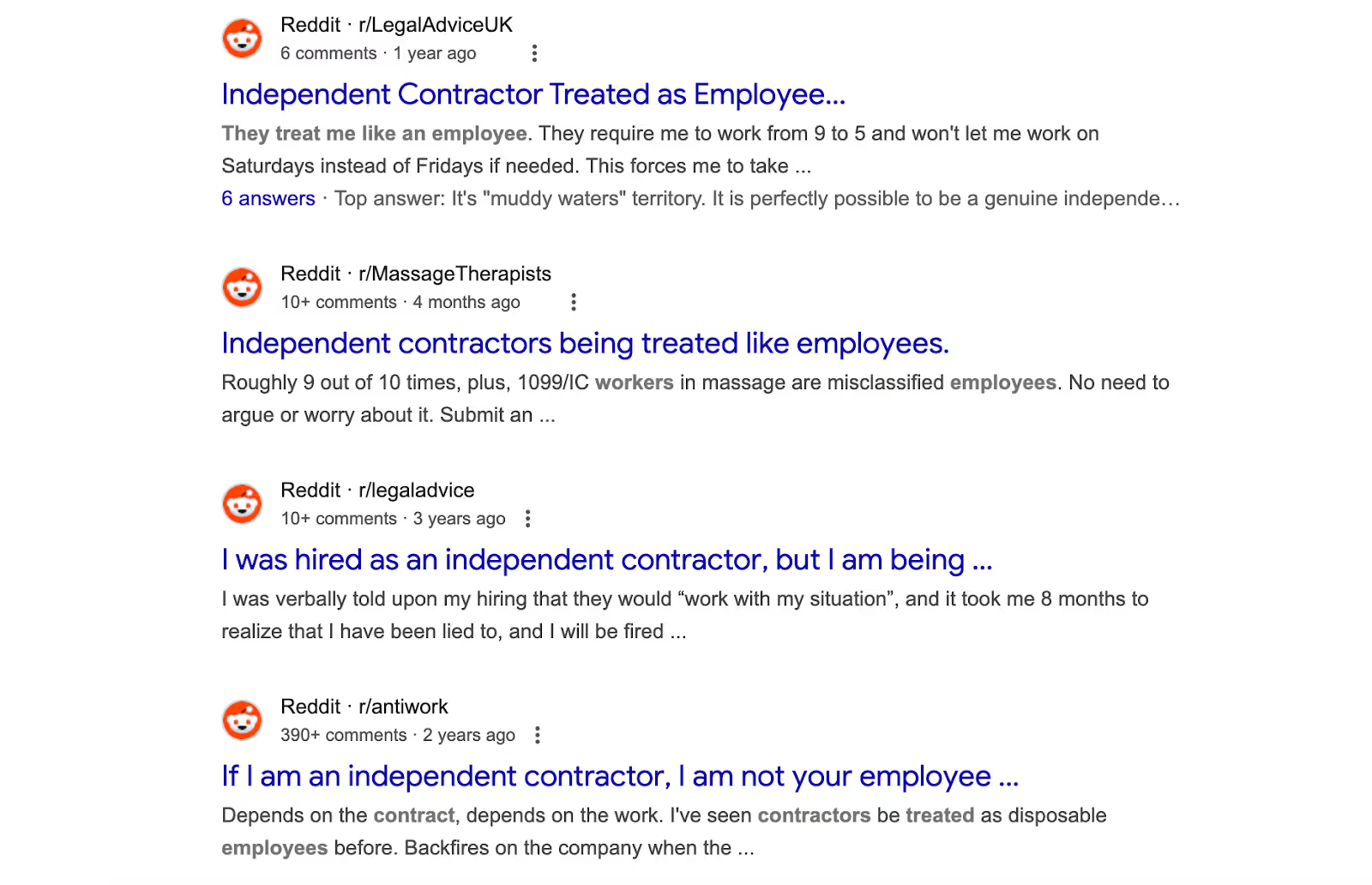
So, the purpose of this section is to help you determine if you’re a freelancer, an independent contractor, or are actually being taken advantage of by your client.
Quick classification checklist
In simple terms, the question here is, are you generally working independently, or are you being treated as an employee in everything but the name? Here are some questions that can help you pinpoint the difference.
- Do you control your own working hours and schedule?
- Can you take on other clients at the same time?
- Do you use your own equipment, or do you use your client’s?
- Are you paid a fixed salary, or are you paid per project, invoice, or on retainer basis?
Why the difference matters for taxes
Like I said already, the tax situation is similar for freelancers and independent contractors since they’re both considered self-employed. The situation for traditional employees is different, though.
Misclassification like this hurts both the self-employed person and their client. Companies can be forced to pay back taxes and fines if the situation comes to light. Meanwhile, workers end up paying higher taxes, missing out on employee benefits, and carrying extra admin and legal responsibility.
The classification issue that actually matters isn't freelancer vs. contractor—it's whether you're truly independent or misclassified by a client trying to avoid payroll taxes.
{{David Fritch}}
Tips for self-employed individuals
I hope I didn’t scare you off self-employment just now! Here are some more tips and tricks to help you make better choices and protect your work.
Deciding which structure is right for you
If you don’t know if freelancing or being an independent contractor suits you better, try to step back from the labels and think what you want your days to look like. Some people thrive on variety, switching between clients and projects. If that’s you, freelancing might be the right choice. On the other hand, if you prefer consistency, routine, and being a part of the team, you should consider being an independent contractor.
In any case, don’t worry about this too much. It’s not like you have to decide once for the rest of your life. Many freelancers end up working as independent contractors and vice versa!
For anyone unsure how to position themselves, think about the kind of workday you want. Freelancing suits people who like change and independence. Contractor roles fit those who enjoy plugging into a team and settling into a rhythm. Honestly, most people drift from freelance into contractor work once they've shown they can do more than knock out one-off tasks.
{{Vincent Carrié}}
Tracking your income and taxes from day one
This piece of advice applies both to freelancers and independent contractors. As soon as you start working for yourself, you absolutely need to make sure you’re keeping track of everything money-related. It’s much easier to do it in the moment than to scramble when tax season comes.
I worked with a contractor who made $140K his first year but kept zero records—no mileage log, no receipts, just bank statements. We salvaged maybe 40% of his actual deductions because the IRS requires contemporaneous documentation.
{{David Fritch}}
There are many ways you can make this easier for yourself. First of all, there’s a plethora of accounting platforms out there. They can help you keep track of your income and your spending, automate invoices and even show you how much tax you may owe. Some also come with features that allow you to take photos of receipts. But you don’t actually need some fancy software. Plenty of self-employed individuals manage using apps like Google Sheets (you can find plenty of templates online) and Dropbox to store photos of receipts. Also, you’ll be pleased to learn that Solowise has a ready-made invoice tracker which is totally beginner friendly. Be sure to check it out!
Using contracts to protect your work
This is literally the first rule of being self-employed. Never, ever work without a contract! At a minimum, it should spell out what you’re responsible for, how and when you’ll be paid, and what happens if the scope changes or the relationship ends early.
For freelancers, contracts help prevent endless revisions, surprise add-ons, or late payments. For contractors, contracts can establish boundaries around working hours, availability, exclusivity, and notice periods.
Before you overthink it
Being self-employed, whether you’re freelancing or are an independent contractor, can be very rewarding. Whichever one of these options is right for you depends on how you prefer to work and your temperament. And since they’re pretty similar legally, you don’t need to decide once and for all. Just make sure you have a contract, keep track of all your expenses, and protect yourself from being taken advantage of by your client. I hope this article helped you make a bit more sense of everything and decide whether you want to be a freelancer or an independent contractor!
FAQ
.avif)




I’m a bilingual writer and content strategist working across SaaS and digital media. I cover topics like marketing, tech, and the occasional niche curiosity.
Learn moreI spent 10 years as a senior web designer for agencies and startups before launching my own web design studio 15 years ago. I've worked every arrangement possible and made every mistake you can think of, some of them twice.
I operate Purple Media, a creative agency specializing in performance-based marketing with artificial intelligence solutions. I have worked as a freelancer and consultant while building teams throughout Europe and Southeast Asia.
I'm David Fritch, attorney and CPA with 40+ years managing payroll for my law firm and CPA practice, plus I help small business clients steer payroll compliance through my legal practice in Indiana.
We are here to ease your working routine
Whether you're freelancing or a full-time contractor, we simplify the working process, putting you in control.
Try it free

Gusto and Deel both help companies manage payroll and HR, but they serve different business needs. Gusto is a better fit for US-based small and midsize businesses that need simple payroll, tax filing, benefits, onboarding, and basic HR tools. Deel is better for companies hiring internationally, managing global contractors, or using Employer of Record services. This comparison breaks down their key differences in payroll, compliance, pricing, integrations, benefits, contractor management, pros and cons, and best use cases to help businesses choose the right platform in 2026.

Compare the best Deel alternatives for global hiring, payroll, EOR, and contractor payments. See pricing, coverage, pros, cons, and best use cases.

Running payroll for one employee still means tax calculations, filings, forms, and deadlines — so the cheapest option isn't always the best value. This guide compares affordable payroll services for a one-person business, breaking down real monthly costs, what's included, and which choice fits how you actually pay your worker.
