
What Is a 1099 Employee?
Learn what “1099 employee” means, compare contractors with W-2 employees, and see how to classify workers and handle W-9 and 1099-NEC paperwork.
November 27, 2026
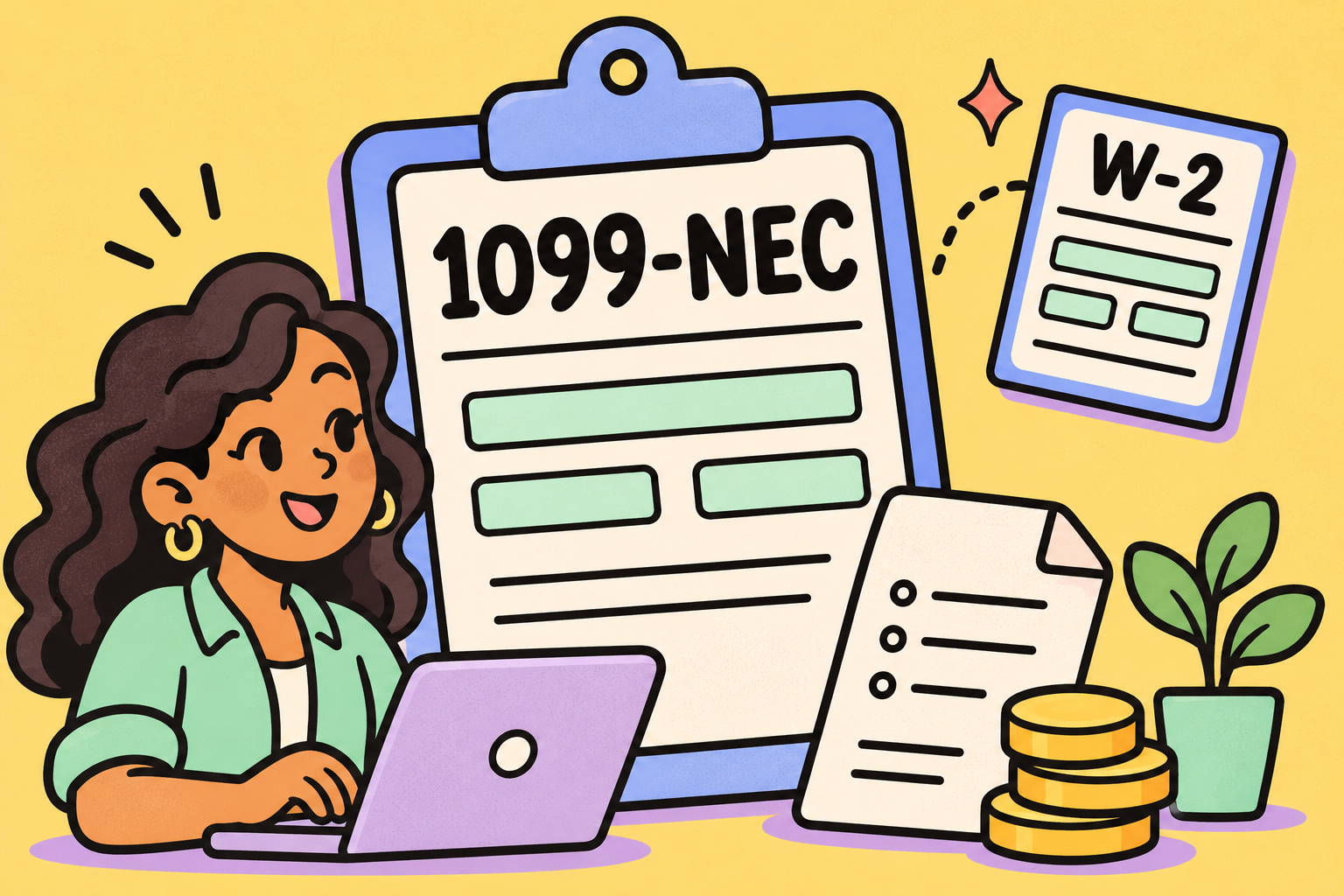
Key takeaway: “1099 employee” is an informal term for an independent contractor. It can cause confusion about the worker’s employment status, which depends on how the working relationship operates in practice.
What “1099 Employee” Means
Businesses use Form 1099-NEC to report qualifying payments to independent contractors. Employers use Form W-2 to report employee wages and tax withholding.
For a business bringing in help, the classification decision comes first. Look at how the person will actually work, including who directs the work, how payment is arranged, and what the relationship looks like over time. Those facts help determine which tax, payroll, and labor obligations apply.
1099 contractor vs. W-2 employee
The differences show up in day-to-day work and at tax time. A contractor might agree to deliver a finished website for a project fee. An employee might maintain the company’s website as part of an ongoing role, with priorities and work procedures set by a manager.
These differences are useful starting points. Hourly pay, for example, can appear in either arrangement. Consider the facts together before deciding how to classify a worker. If you determine the role is employment, see our small-business payroll setup checklist.
How to classify a worker
For federal employment tax purposes, the IRS looks at three categories of evidence.
- Behavioral control. Who has the right to decide how the work gets done? A client might set a deadline and specify what a finished deliverable must include. Requiring the worker to follow prescribed methods, attend training, or obtain approval at each stage can indicate more control.
- Financial control. Who provides tools, covers expenses, and bears the financial risk? A worker who sets rates, invests in equipment, and can make a profit or take a loss shows signs of operating an independent business.
- Type of relationship. Is the work tied to a specific project or expected to continue indefinitely? Does the business provide employee-type benefits? How central is the work to the business? A written agreement is one piece of evidence alongside what happens in practice.
The Fair Labor Standards Act addresses a separate question for federal wage and hour purposes. Its economic reality analysis considers whether the worker is in business for themselves or economically dependent on the business for work. The Department of Labor’s 2026 final rule on worker classification takes effect on January 22, 2027. State laws can apply their own standards. Check the rules that apply to the worker’s location and the obligation you’re evaluating.
What happens if a worker is misclassified?
A business that treats an employee as a contractor may owe employment taxes it should have paid or withheld. Depending on the circumstances, it may also face claims for unpaid minimum wages or overtime, penalties, or other obligations under state law.
If the facts are unclear, document the actual duties, working arrangements, and payment terms. Either the business or the worker can submit Form SS-8 to request an IRS determination for federal employment tax and income tax withholding purposes. The IRS says a determination can take at least six months. For a wage and hour question, contact the Wage and Hour Division or consult a qualified adviser.
When to engage an independent contractor
Contracting can make sense when a business needs a defined deliverable and the person providing it runs their own business. An employee arrangement may make more sense when the business needs someone to take on ongoing responsibilities under its direction.
Consider two businesses hiring for graphic design:
- A product launch. A designer agrees to deliver six launch assets by a set date for a fixed fee. They use their own software, decide how to produce the work, and serve other clients. Those facts support contractor status.
- Ongoing design support. A designer works a schedule set by the company, takes daily assignments from a manager, and follows required production procedures. The relationship has no planned end date. Those facts warrant reviewing whether the designer should be classified as an employee.
If an engagement changes, revisit the classification. A short project can turn into an ongoing role with closer supervision, and the original agreement may no longer reflect how the person works.
How to engage and pay a 1099 contractor
- Review classification before work starts. Record how the work will be assigned, who controls the methods, and how the contractor will be paid. Resolve any uncertainty before setting up payments.
- Put the scope and payment terms in writing. Document deliverables, deadlines, fees, invoicing, and how scope changes will be handled. If a consultant charges by milestone, specify what each milestone includes and when payment is due. Our freelance contract guide explains what to include in a written agreement.
- Request Form W-9. For a U.S. contractor, collect Form W-9 at onboarding to obtain the payee’s name, federal tax classification, and taxpayer identification number. Keep it in your records. Check the IRS backup withholding rules if the contractor fails to provide a taxpayer identification number or the IRS notifies you of a problem.
- Pay invoices and keep records. Save the agreement, invoices, and payment confirmations. Record how each payment was made so you can identify which amounts are reportable at year-end. For examples of invoice schedules, see our guide to freelance payment terms.
- Check whether Form 1099-NEC is required. For payments made in 2026, the IRS generally requires reporting when a business pays a covered nonemployee $2,000 or more for services during the calendar year. Exceptions apply based on the payee and payment type. If you withheld federal income tax under the backup withholding rules, file regardless of the amount. Payment card transactions and certain third-party network transactions fall under Form 1099-K reporting rules, which place the reporting obligation on the payment settlement entity where applicable. Exclude those payments from the company’s Form 1099-NEC total.
- File the form and furnish a copy to the contractor. The company must file Form 1099-NEC with the IRS and furnish a copy to the contractor. The federal deadline for Form 1099-NEC is generally January 31 of the following year. If that date falls on a weekend or legal holiday, the deadline moves to the next business day. For payments made in 2026, the company must complete both steps by February 1, 2027. Check for any separate state filing requirements.
Example: A business hires an independent consultant for a two-phase project. It agrees on the deliverables and fees, collects a W-9, then pays and records each milestone invoice. At year-end, it totals the reportable payments and checks whether it must file Form 1099-NEC.
FAQ
Can a 1099 contractor work full-time hours?
Yes. Hours alone do not determine worker status. If someone works full-time hours for one business over a long period, look at the broader relationship, including how much direction the business provides and how independently the person operates.
Do 1099 contractors receive employee benefits?
Independent contractors generally do not participate in a client’s employee benefit plans. Their contract can specify fees, expense reimbursement, and other agreed terms. If the worker is legally an employee, review the benefits and protections that apply to that employment relationship.
Can a 1099 contractor work for multiple clients?
Yes. Serving multiple clients can indicate that someone operates an independent business. Working for a single client can also occur in a contractor arrangement. Consider that fact alongside control, financial independence, and the nature of the engagement.
Who pays taxes on contractor income?
Independent contractors generally report their business income and pay their own income and self-employment taxes. They may need to make estimated payments during the year. They generally must report taxable income even if a client does not issue a Form 1099-NEC.
What can I do if I’m unsure how to classify a worker?
Document how the work is assigned, who controls the methods, and how the worker is paid. The business or worker can submit Form SS-8 for an IRS determination on federal employment taxes and income tax withholding. For wage and hour questions, contact the Wage and Hour Division.

I’m a bilingual writer and content strategist working across SaaS and digital media. I cover topics like marketing, tech, and the occasional niche curiosity.
Learn moreWe are here to ease your working routine
Whether you're freelancing or a full-time contractor, we simplify the working process, putting you in control.
Try it free

Use this U.S. launch checklist to test your idea, estimate startup costs, choose a business structure, check permits, and find your first customers.
Find out who must file IRS Form 945, when the return and deposits are due, and how to report nonpayroll withholding and submit the form.

Compare gross pay and net pay, calculate hourly and salaried earnings, and see how taxes and deductions affect take-home pay with a worked example.
