
How Much Do No-Code Developers Make in 2025?
Discover how much a no-code developer makes, get insights about the career and its market, and get tips from specialists on how to get started.
December 18, 2025

Key Points
- Proficiency affects how much you earn, so it is important to find a platform of your choice and delve into it as much as possible.
- Freelance jobs have a higher earning potential, but you have to be able to sell your work. Highly-skilled no-code developers who fail at networking or showing the value of their work will likely make less money than average-skilled ones who excel at this other aspect.
- SaaS, financial and healthcare industries, as well as startups and companies looking to optimize their internal processes, are the ones who offer the most opportunities right now.
- No-code platforms and AI are walking side-by-side, and being able to integrate AI into your work is a career accelerator.
Stressed out with your current career and thinking about a change of air? As usual, the tech market shows promise, with software development jobs expected to grow around 17% until 2033. Even if you don’t know how to write code, there is a way: no-code development. A no-code developer is a professional who builds platforms, applications, websites, and automated workflows without writing code. They utilize graphical interfaces, user-configurable tools, drag-and-drop builders, and other tools instead of traditional programming languages.
Interested? I got you. In this article, we will share more about the average salary of a no-code developer, the factors that affect it, how to get started, and discuss the market, providing specialist insights along the way.
Factors that affect no-code developers’ salaries
Many factors affect how much a no-code developer earns – format (contractor or freelancer), experience, specialization, location, and industry. A disclaimer: the data provided here comes from reported salaries on Glassdoor and No-code Alliance, or from values reported by the specialists who contributed to this article. The US market will be used as a reference point.
Experience
Money-wise, I’ve seen freelancers get anywhere from “rent money” to $8–10k/month, especially once you niche down (e.g., “automation for agencies”). For contractors or in-house no-coders, the payment I’ve seen is usually $60k-120k a year, but there is less upside.
{{Damilola Ademuyiwa}}
As usual, the salaries grow with time. No-code developers who are just starting might find themselves spending more time making workable demos before they can score a job. The graph below shows the average salary for a no-coder working with Bubble, one of the most famous platforms used for no-coding development. As you can see in the graph below, payment can vary deeply according to one’s experience:
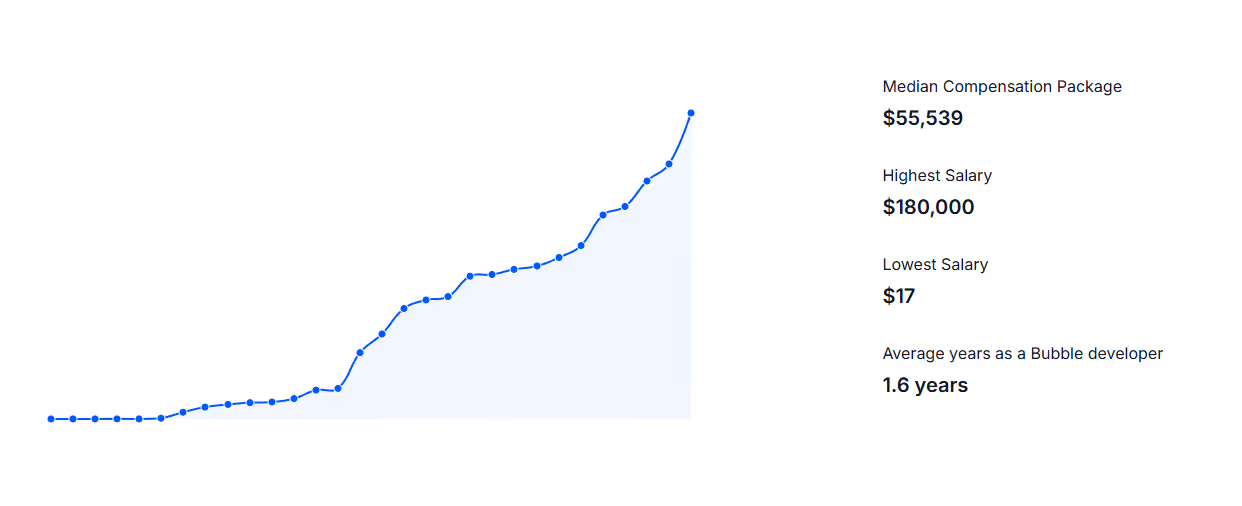
For further reference, a recent job posting for Webflow (a no-coding platform focused on building websites) is offering compensation between $3,000 to $5,000 for a developer. No-code devs may also find themselves earning slightly different rates depending on their platform of choice, as most of them are targeted at different solutions (website building, automating workflows, applications, and so on).
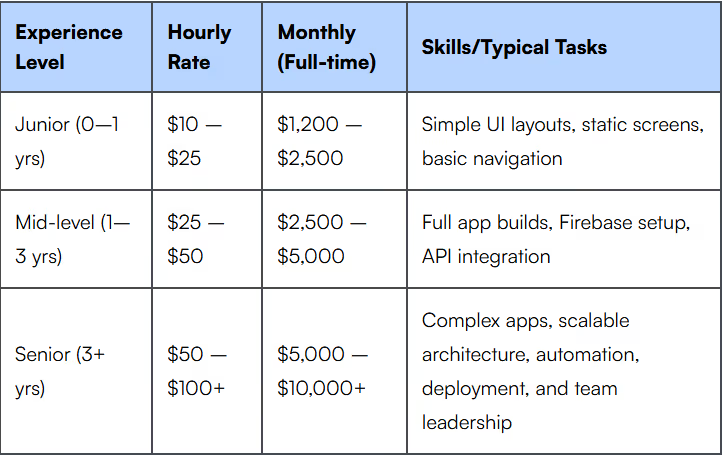
alt = A table showing no-code developers’ salary range from Junior to Senior level, ranging from $1,200 to $10,000 monthly, depending on experience.
Caption: A senior-level no-coder can earn up to five times more. Source: SolGuruz
Proficiency and niche
You don’t have to be a one-trick pony, but you will earn more if you dominate what you do. While there is a benefit to understanding and working with multiple no-coding platforms, make sure you stand out. To do so, you will eventually have to focus on the one(s) you feel more comfortable with and delve deeper.
Learning platforms such as Coursera or Udemy offer a multitude of courses, and no-coding platforms such as Bubble or Webflow have their own academies, so make sure you use all the available resources. The more you know about a platform, the better you will earn.
Two main things will affect your salary range, and one of them is your technical proficiency. The other is your ability to demonstrate the value of your work. In terms of proficiency, being able to deliver projects from end to end will increase your earnings. That means understanding the needs of a customer, implementing complex features, and proper integrations. Your knowledge and experience of your chosen tool will also affect your pay. When it comes to a niche, from my personal experience, I think websites are faster projects, take fewer hours to deliver a final result, and enable you to make more money. Apps are more difficult and have a longer duration, so there is a smaller margin. If you go that way, you might be able to make good money, but with a higher volume of work.
{{Lucas Weinmann}}
Salaries differ according to niche. MVP builders are being offered up to $25 per hour at Upwork. Meanwhile, another listing is offering $3,500 for a freelancer to build a SaaS app with API integrations and real-time dashboards. Looking at the website niche, an Indeed job listing offers a salary of up to $31,200 per year for a part-time Webflow developer. Also at Indeed, a SharePoint developer job listing has a salary of up to $65 per hour.
A Flutter/Flutter Flow senior developer job offering for an AI-powered mental care company is listing a salary of up to $125,000 a year on the same platform, also for building an MVP. No-coding platforms and niches go hand in hand, mind you – Webflow is used for websites, Bubble or Flutter Flow for apps, and so on.
Industry
In my career, I observed that you are going to find medium to high tickets in SaaS, start-ups early early-stage, and companies looking to speed up their processes. Regardless of industry, jobs involving the integration of no-coding with AI features are the ones with the highest budget.
{{Lucas Weinmann}}
No-coding, other than creating apps, is also used to facilitate life in the corporate world. A developer who is capable of designing solutions that change and improve internal workflow stands to find more opportunities, as there seems to be a consensus among professionals that the SaaS (Software as a Service) industry is one of the best-paying in the market.
Industries that pay more: SaaS, agencies, ops-heavy businesses, basically, anywhere you kill manual spreadsheet hell.
{{Damilola Ademuyiwa}}
A job in the healthcare industry offers pay of up to $32 an hour at Indeed. Another job listing at a religious organization in the social industry offers up to $115,000 yearly for a no-coder to develop a new app with AI integration. At Upwork, a job listing for a senior Webflow developer in the Marketing industry is offering up to $40 hourly. In the Art & Design industry, another job listing pays $4,000 for a freelancer to develop a niche-focused MVP search engine.
A real estate company is offering $2,500 for a new website, and there are many other job offerings that involve auditing, consulting, troubleshooting, migration, or entire app-building, with prices to be negotiated. Some of the industries that appear more often are Marketing, SEO, healthcare, social services, and fintech. According to Roland Jakob, who built systems and automations that facilitated internal processes for many businesses, healthcare, logistics, fintech, software, and e-commerce are some of the best-paying industries. This is driven by their need to handle large datasets, their reliance on automation, and the urge to implement better internal tools.
Location
From my personal experience, American and European markets are still the best-paying ones. There are other interesting markets, such as Australia and Canada, which have consistent and higher-than-average salary ranges. I started my journey working for a Brazilian dev shop whose clients were American startups early age. I started making six times more working with US companies. I have also been in touch with an Australian dev shop that paid similarly, and now I have a client in Canada that pays even more.
{{Lucas Weinmann}}
Location, like in many other jobs and fields, also plays a part. No-coders who work in tech hubs are likely to receive more but also spend more due to a higher cost of living. Likewise, countries in bigger commercial centers are able to offer more competitive rates. You’ll likely find more jobs in places teeming with new startups, as well, although that doesn’t equal better pay.
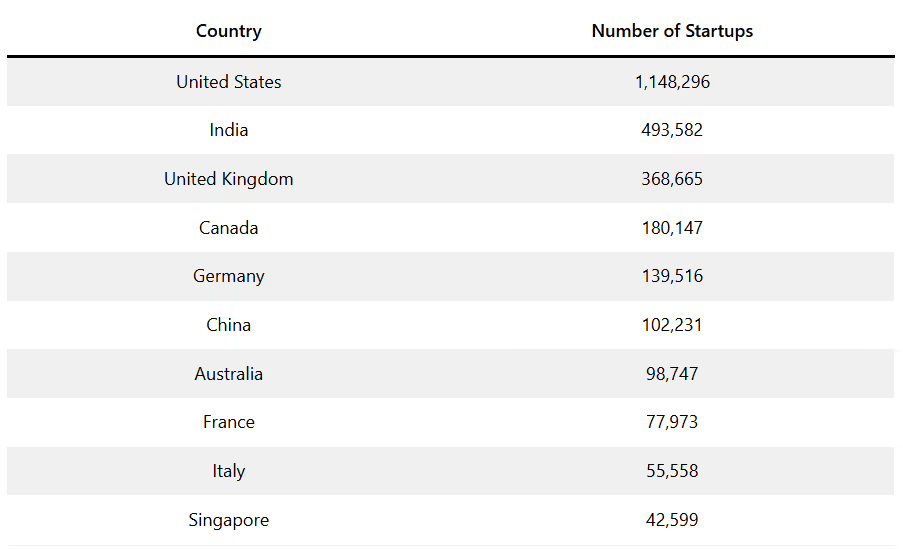
For payment comparison, a job in the Philippines is offering an hourly AU$6 (nearly $4) compensation for a Webflow designer. Another one in Poland lists a salary of $3,000 to $5,000 – a much higher value. A Webflow design for a Lebanese company is being offered a bit less, $2,000 to $3,000. A full-time Webflow developer at an American company can make up to $25 per hour. Finally, a company in India looking for a Webflow/WordPress developer is offering a monthly salary of up to ₹60,000, an equivalent of $673,48 a month, which shows that having a huge number of startups doesn’t mean great salaries.
Format
As a freelancer, you can make more money, but from my experience, that hinges on your ability to deliver value. That means understanding the requisites of a job and being able to come up with a good product for the end-user. The higher your level of autonomy, the better the pay. The freelancer market pays better, even though it depends on your ability to keep finding work. Contractor jobs pay less by the hour, but you tend to find more financial stability.
{{Lucas Weinmann}}
A no-code developer can find freelance jobs, work as a contractor or in-house, and the payment also differs. In general, freelancers who are just starting will make less, but as they get more experienced and specialize, they can have more upside. Ups and downs, as with any freelance work, are to be expected. Earnings depend on your ability to carry out a project fully, and at first, you might find smaller jobs, such as bug fixes, feature implementations, and the like. Meanwhile, working as a contractor will provide stability, but you are not the one deciding what to charge, nor when to work.
Both formats have their benefits and drawbacks. A contractor job can be good in two ways: financial stability and acquiring more no-coding experience while working. Still, as you specialize and find ways to develop good solutions for companies, you will be able to earn good money on a project-to-project basis. As we mentioned before, companies are offering $4,000 for a no-code dev to build an MVP, which is higher than the average salary of a contractor. If you can deliver certain freelance projects within a month and find yourself other ones, you are already earning more.
Getting started as a no-code developer
Salary discussion aside, how does one start in this career? There are a few important factors: understanding what no-coding is used for, learning how to work with a platform, building a portfolio, and then using that portfolio to get jobs, all while doing proper networking throughout the process.
Understand the concepts of no-code development
It is vital to understand, right away, why no-code is used. Here’s a video from a professional, established no-coder, explaining no-coding in detail:
To further complement the video, here are some common features of no-coding tools:
- Drag-and-drop interfaces
- Pre-built templates
- Integrations and APIs
The most common applications of no-coding in 2025 are:
- Improving internal processes (data entry and eliminating spreadsheets, among other things)
- Automating workflows
- Building websites and landing pages
- Project management
- Data management (again, eliminating spreadsheets)
- Prototyping or product development (especially for companies on a tighter budget or looking for a quicker solution, as developing a product using regular coding takes more time)
Based on your background and needs, selecting the best tool for what you do is vital. If you want to work with websites, try something like Webflow. In case you are going for web applications and systems, a platform like Bubble is more adequate. Once you figure out the platform, dive deep to acquire the proficiency you need to carry on a project from start to finish. You’ll need to:
-Understand clients’ needs
-Transform them into workflows
-Build solutions using your chosen tool
-Deliver something functional, for real users, that works in real case scenarios
When you can do that, you are hirable.
{{Lucas Weinmann}}
Pick a platform
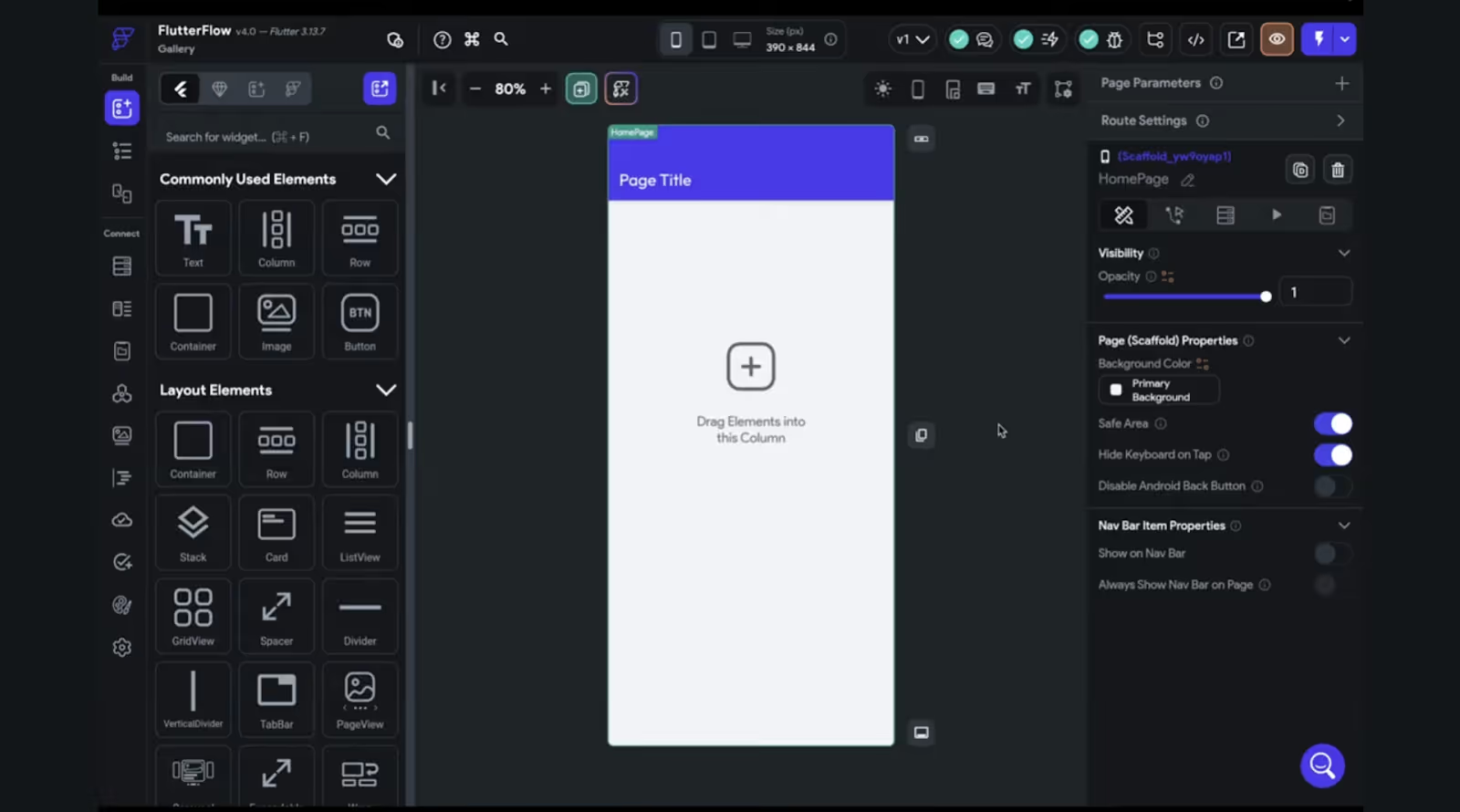
Given that the “I can’t code and I don’t want to learn programming languages” excuse is out of the way, what you actually need is to find the right platforms for you and start learning. Here is a list of the most prominent ones:
- Code Conductor - for website and app building
- Wix - for website and app building, famous for its comprehensive offer of templates
- Squarespace - another famous website-building platform
- Webflow - the most prominent website-building platform, which features more sophisticated features
- Jimdo - a good starting tool for simple website creation, recommended for beginners
- Bubble - one of the most powerful no-code platforms for app building, with many complex functionalities and advanced features
- Flutter Flow - a powerful drag-and-drop no-code platform used for building mobile, web and desktop applications
- Air Table - a cloud-based, no-code platform focused on data management and workflows
- Zapier - an automation platform used to create and connect automation workflows without the need for code
- Make - an AI-powered no-code platform used to build and connect automations
- Framer - another website builder, more focused towards design, and simpler than Webflow in terms of learning curve
Take your time to read reviews and check which platforms fulfill your needs and, more importantly, the needs of your potential customers. There are many no-code communities, such as Zerocoder or No-code Alliance, where you can learn more, share resources, send projects, and find job listings. As you learn the ropes, finding your niche (or the things you are more comfortable doing) will come naturally.
Build a portfolio
My journey into no-code came from trying to fix bottlenecks inside companies. I always spotted slow processes and looked for ways to simplify them. My first builds were simple Chrome extensions that helped teams automate small tasks, collect data, or streamline daily work. Those early projects taught me how to create tools that feel natural to use and how to turn ideas into working products without waiting on long development cycles.
{{Roland Jakob}}
Most no-coders who are already established will tell you the same thing: learn a platform and try to build a portfolio of working products – you won’t score your first job until you have something to show.
To initiate the no-code field, you start with small experiments. I discovered it myself when I created internal automation with applications such as Zapier and Airtable throughout project cycles. The quickest route is to select a single platform, learn paid projects on marketplaces, and develop three to five portfolio projects that simulate actual client requirements.
{{Rahul Jaiswal}}
It is vital to monitor job postings and try to execute what is needed yourself, even if that means spending extra time not earning anything. Consider it part of the learning process and an integral part of what will help you earn extra money in the future. Once you have a few working prototypes or MVPs (minimum viable products are early versions of a working product, built with the intention of gathering feedback for improvement or validating their business idea), you will start finding work opportunities.
Get your first job
I kinda fell into the “no-code dev” lane by accident. I was doing SEO + marketing for small B2B teams and got tired of waiting on devs, so I learned just enough Make/Zapier/Airtable/Webflow to fix my own problems, then clients started paying me to fix theirs. How to start? Pick one stack (say Webflow + Make + Airtable), then clone 2–3 templates, rebuild a real workflow for a friend/client (leads → CRM → email), and document everything like you’re teaching it.
{{Damilola Ademuyiwa}}
Getting your first job is going to hinge on a few factors:
- Having a portfolio and being able to prove you have the skills for what’s needed
- Proper networking
- The platform you chose and the niche you went for
- Your willingness to start small
What I’d recommend is acquiring enough experience and knowledge to carry out a project, and then investing in networking. I showed my portfolio and how I solved real, common problems. At first, the idea is not to sell anything, but to find leads – people who need to solve those problems, or people who can recommend you. By the way, building a network that can recommend your work will follow you throughout your no-coding career, and it requires constant effort.
{{Lucas Weinmann}}
Many job offerings require simple solutions and offer low payments, but they might be instrumental in building experience and reputation. For instance, a listing at Upwork is offering $20 for a bug fix. At the same time, building rapport with other developers and making friends with potential hirers or people who know them will be very helpful in finding your first job.
The career of a no-code developer
You have taken the time to learn a platform and its ins and outs, you have built a portfolio, and you scored your first gig. Where do you go from there? Well, all our specialists will tell you the same thing: find a niche, specialize, work on networking and lead generation, and put yourself in a position to earn more by working on bigger projects – you will only be able to do that with time, experience, and extensive knowledge of your no-coding platform.
Career and income progression
What helped me grow the most was learning how to combine tools and think in systems. Clients did not come to me for a single automation. They came to me because I could take a messy process, understand the real issue, and build something that works every day without babysitting. That mix of curiosity, practical problem-solving, and willingness to experiment is what moved my career forward and helped me build solutions that scale.
{{Roland Jakob}}
Even though experience plays a part, your time on the market is not the only defining factor. Being suitable for many jobs can help you find work, but the best-paying ones tend to be the most specialized. The logic is pretty simple: if not many people can do what you do, you can charge more. Figuring out what the market needs and delivering that is essential.
In my experience, the highest income unlocks are productized offers (e.g., “CRM in 7 days for X niche”), retainers for maintenance, and, later, training a company's team instead of just building stuff for them. It’s much less “career ladder” and more like “build your own weird path.”
{{Damilola Ademuyiwa}}
Once you have a big enough portfolio, years of experience, and a good command of no-coding tools, there’s the opportunity to spread that knowledge and train other developers as well. In case you still want to develop applications, working with AI seems to be a profitable path.
Most no-code job offerings I see nowadays have some AI component, which includes:
-Advanced automations (Make, Zapier, generative models)
-Feature creation using AI APIs
-Intelligent workflows inside Bubble apps
-Entire products that depend on AI as a core feature
Entering the AI niche is definitely a career accelerator, once you have enough proficiency and know how to sell your work.
{{Lucas Weinmann}}
Given that AI is ubiquitous in the tech world nowadays, learning how to work with it is vital. The biggest tech companies in the world have already integrated AI tools into their software or platforms, and independent companies are following suit. Another option is developing an app that features those AI solutions for clients.
At first, I relied heavily on Airtable, Supabase, Retool, and my own internal prototyping setups. I also tested platforms like Replit and Emergent, but they fell short once projects got serious. Instead, I built a network of local AI agents that support my workflow. Claude Code and OpenAI Codex help with structure and debugging, and I run n8n on a small Raspberry Pi at home so I can control my automations without hitting platform limits.
{{Roland Jakob}}
Other possibilities include:
- Delving into more advanced no-coding methods, such as machine learning or data analysis, and being able to work with larger datasets
- Developing no-code solutions for certain industries (finance, education, healthcare, e-commerce)
The other big factor is how you market yourself and your work. It is important to take the time to find communities and dev hubs, get in touch with other developers, and build a professional network – it will help you get more jobs in the future.
Benefits and challenges
No-code work gives you a fast path from idea to product, lower barriers to entry, and a wide variety of projects. The main challenges come from platform limits, security concerns, client expectations, and the need to keep learning. You must balance creativity with structure and be ready to support what you build throughout the full life cycle of a project.
{{Roland Jakob}}
If you are looking for a change of careers, no-coding is a really viable option for a few key reasons:
- You are entering an industry on the rise (The global low-code/no-code application development platform market size was estimated at USD 24.8 billion in 2023 and is projected to reach USD 101.68 billion by 2030, according to a study by Grand View Research)
- You don’t need to learn programming languages
- A lot of the platforms are user-friendly and enable you to start developing quite quickly
- You can work remotely
At the same time, software development is constantly changing as new technologies arise, so you have to stay on your toes. Another factor, although one that is inherent to the job, is that the products you make are yours to maintain – as a no-code app/website designer, you are expected to provide support and troubleshooting.
What’s next for no-code developers
I’d say that the no-code market is growing, and the rise of AI is transforming the way digital products are created. This year, I worked as a freelancer for a client who needed AI for image analysis, and I delivered an integration with Bubble and AI that made this analysis and generated detailed reports. Through that experience, I got in touch with a Dutch company that had a similar demand, and now I’m working for them full-time, which was a personal goal. AI is making that market growth exponential, as it can potentially transform any person into someone capable of creating software – it is a facilitator for beginners and a difference-maker for professionals who already work with no-coding platforms.
{{Lucas Weinmann}}
One thing is for sure: no-coding isn’t going anywhere. While it is impossible to predict with certainty where, how, and which technologies will evolve, it is safe to say that AI and no-coding will walk side-by-side. Hyperautomation and improving internal processes are likely to make the demand for no-coders grow, as no-code apps are also more viable for companies with a constrained budget. A report by InfoWorld on a study made by Gartner attests that users outside of formal IT departments will account for 80% of the user base of low-code/no-code platforms, and sales for such technologies are expected to reach $44.5 billion by 2026.
The whole no-code/low-code market is also expected to grow substantially:
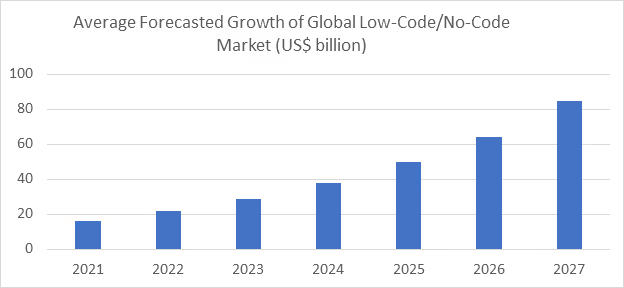
No-coders who keep learning new tools, mastering the ones they know, and finding their niche of specialization are likely to thrive – as the numbers and forecasts show, it will be a market filled with opportunity.
Conclusion
No-code development is a promising career and a great option for people looking for a change or individuals seeking to incorporate more into their competencies. It might be a good idea to have a financial reserve, so you can invest your time and resources into learning a platform and creating a portfolio. You will not make a lot of money right away, but market forecasts show a lot of potential, especially if you specialize and learn how to get the best out of AI.
We hope the tips, data, and explanations provided in this guide help you make the best possible choices. Good luck in the no-coding world, and welcome to the tech industry.
FAQ
How much time does it take to become a no-code developer?
You can learn the ropes in a few months (we advise you look for a course on platforms such as Udemy or Coursera, but many apps also offer in-depth tutorials or have an academy, as is the case with Bubble). Once your first course, you will probably be able to develop something simple within weeks, but mastery is a different thing, and it might take many years.
What can I do as a starting no-code developer?
It depends on what you want to work with, but a nice solution would be to implement something that facilitates internal processes. Let’s say your current company needs a solution to prevent extra work – for example, creating forms for documents, too many spreadsheets, and so on. You can then develop an application on a no-code platform to solve that problem. This is the best-case scenario, as you start a portfolio and also deliver a solution to a real-life problem.
Where can I find jobs?
First of all, learn a tool and build a portfolio. Then, find no-coding communities to start building a network. Here’s a list of communities to get you started:
A lot of jobs will come from networking, but in case you are looking for job listings, searching for “Platform + developer jobs” will net the best results. For example, “Bubble developers” is likely to help you find job ads, while “No-code jobs” isn’t.
Is it easier to be a no-code developer than to write code?
It is definitely easier to start. With the help of AI and user-friendly platforms, any person without knowledge of coding can get started and learn how to create apps, sites, and automated workflows that don’t require programming language. Once you reach a high level of proficiency, challenges such as dealing with large user bases will make your job much harder than when you started, but that’s part of the drill.






I'm a journalist, translator, language teacher, marketing content writer and part-time music producer. Happily married and owner of four beautiful pets, I find it very hard to stand still - whether because I've got a lot to take care of, or because I simply can't anyway.
Learn moreI’m a Founder and Lead Developer at Praxica, where we build AI-powered platforms and automation systems for founders who want to move fast and build right. I have 15+ years of experience driving growth and product strategy across industries.
I’m a designer & no-code developer building with clarity, speed, and care. I work from idea to revenue, in the intersection of strategy and execution. With a background of 15+ years as a designer, I've worked as a UX/UI and product designer, project manager, and product owner. Now, as a dev, I build highly designed websites and apps with tools like Bubble, Webflow, Framer, Zapier, and more.
I'm an SEO strategist with over 7 years of hands-on experience helping brands, from local businesses to global SaaS companies, scale their organic visibility and outrank competitors through performance-driven SEO and link-building systems. At the core of my work is a strong focus on ROI: I build SEO frameworks that aren’t just optimized for rankings, but for business growth.
I’m an experienced Managing Director with a demonstrated history of working in the computer software industry. Skilled in E-commerce SEO, Google Analytics, Google Adwords, Online Lead Generation, and Online Marketing. I’m also a writer and have a keen interest in technology.
We are here to ease your working routine
Whether you're freelancing or a full-time contractor, we simplify the working process, putting you in control.
Try it free
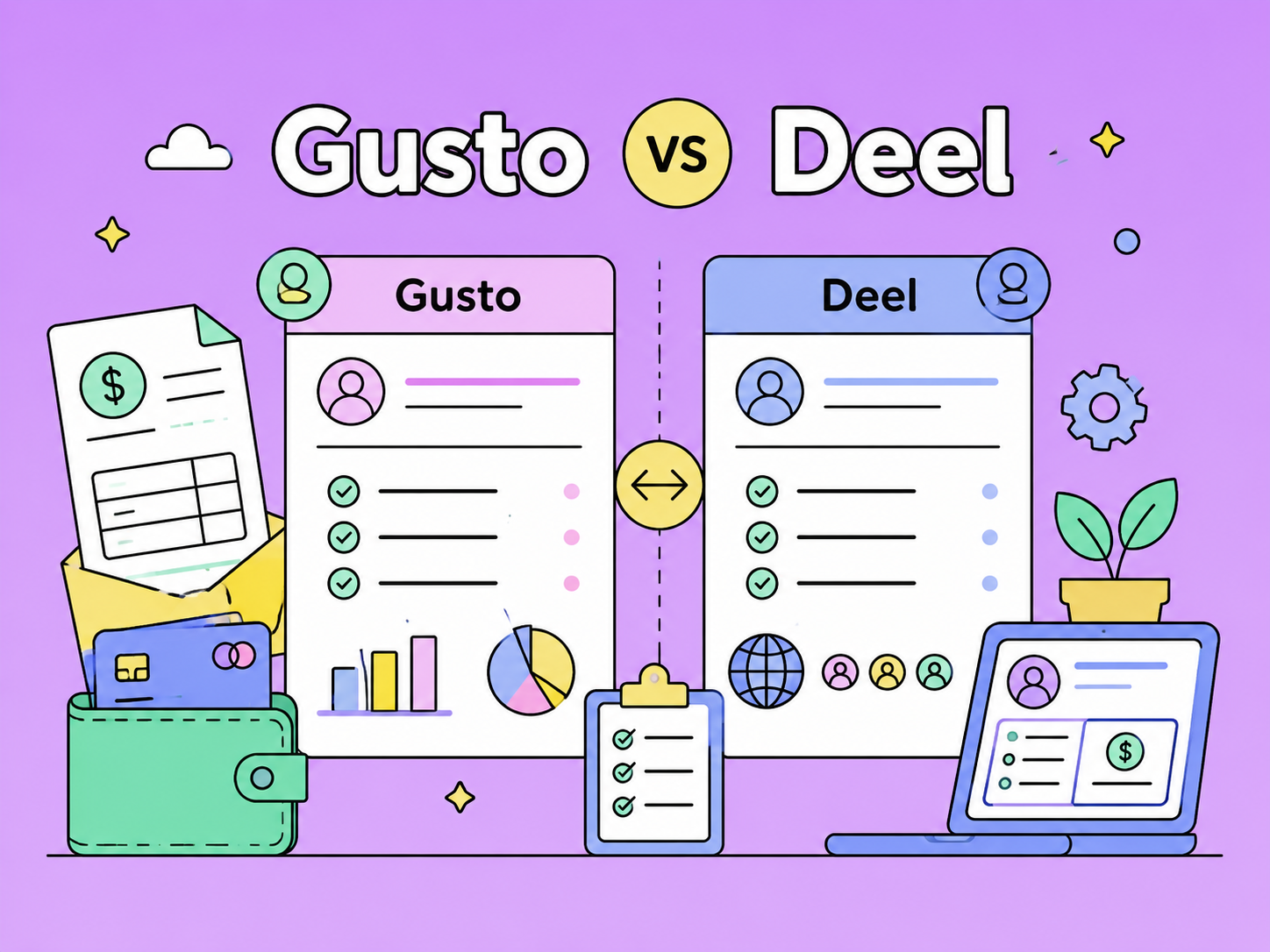
Gusto and Deel both help companies manage payroll and HR, but they serve different business needs. Gusto is a better fit for US-based small and midsize businesses that need simple payroll, tax filing, benefits, onboarding, and basic HR tools. Deel is better for companies hiring internationally, managing global contractors, or using Employer of Record services. This comparison breaks down their key differences in payroll, compliance, pricing, integrations, benefits, contractor management, pros and cons, and best use cases to help businesses choose the right platform in 2026.
Compare the best Deel alternatives for global hiring, payroll, EOR, and contractor payments. See pricing, coverage, pros, cons, and best use cases.
Running payroll for one employee still means tax calculations, filings, forms, and deadlines — so the cheapest option isn't always the best value. This guide compares affordable payroll services for a one-person business, breaking down real monthly costs, what's included, and which choice fits how you actually pay your worker.
