
How Much Do Media Buyers Make? Here’s What You Need to Know
Learn what media buyers do, average salaries in 2025, global rates, payment models, and how to increase your income in this role.
December 12, 2025

Key points
- A media buyer is a marketing professional who runs paid ads for their clients, and also monitors campaign performance
- There is a lot of variation when it comes to how much they can earn, as it depends on experience, niche, and location
- Media buyers use various payment models, including fixed fees to percentage-of-spend
- To earn more as a media buyer, build up your tech skills, showcase your social proof, and use automation and reporting tools
Wondering what the average salary for a media buyer looks like in 2025? You’re not alone! It’s an in-demand job, and pay can vary a lot depending on experience, niche, and where you work.
In this article, we’ll break down what a media buyer actually does, how much they can expect to make around the world, the payment models used across the industry, and practical ways to increase your income if you’re working in this field.
What does a media buyer actually do?
Media buying falls under the umbrella of marketing. This job entails running paid advertising campaigns and making sure they perform, testing different approaches, and tweaking things until campaigns hit their target numbers. Broadly speaking, there are two kinds of media buying: traditional (like TV, newspapers, billboards, radio) and digital, which is placing ads on platforms like Meta, Google, or TikTok. In this article, we’ll focus on the latter because the salary data, expert insights, and payment models below apply to digital roles.
A typical day for a media buyer includes checking results, launching new tests, adjusting targeting or bids, and deciding which campaigns to scale or pause. They also prepare simple reports, explain what’s working, and plan the next round of experiments. To put it simply, media buying involves a lot of analysis, problem-solving, and experimentation.
Traditionally, in pre-digital days, media buying also included a lot of negotiating: the buyer would contact reps at TV or radio stations, newspapers, etc. and negotiate prices. And it still shows up in some niches today, for example, when a media buyer deals with vendor contracts, fixed-fee agreements, or industry-specific platforms. But in most digital advertising, prices are set by automated auctions, not manual negotiation.
Media buyer vs. media planner
These two roles sometimes get mixed up, but they’re not the same. Media planners map out where ads should run and why. Media buyers use that plan to run and optimise campaigns.
Let’s imagine that a brand wants to promote a new product. The media planner decides where the ads should appear. For example, how much budget goes to Meta, Google, or TikTok, and which audiences to target. The media buyer then takes that plan and turns it into live campaigns: setting everything up inside the advertising platforms, testing creatives, adjusting budgets, and optimising performance day by day.
In small teams, one person does both. In bigger teams, the roles are separate.
A bit of theory
This article contains a lot of technical marketing terms, so let’s define them before really diving in.
ROI: Return on Investment is a percentage that shows how efficiently a campaign turns money spent into profit. Let’s imagine that you spend $1 on ads and make $3. This means you earn a profit of $2, which makes your ROI 200% because you earned twice what you spent.
UTM: stands for an urchin tracking module. It’s a small tag you add to the end of a link (or URL) so you can see exactly where your traffic and leads came from. You add UTM tags to links in ads, emails, social posts, or anywhere else where you share a URL. This helps you track which ad, platform, or audience performed best.
CPL: cost per lead is how much you pay for one potential customer (a lead). If you spend $340 and get 10 leads, your CPL is $34.
CPA: cost per acquisition is how much you pay to get one actual customer or completed action (like a purchase, booking, or subscription). Often more meaningful than CPL.
ROAS: return on ad spend is how much revenue you earn for every unit of money spent on ads. For example, if you spend $100 on ads and make $400 in sales, your ROAS is 4:1, meaning that you earned four dollars for every one dollar spent.
Attribution: this is a process of figuring out which marketing touchpoint actually led to a result (like a lead or a sale). It’s important because people often see multiple ads, search for a brand later, or convert days after clicking something, so attribution helps you understand which step of this journey deserves the credit. For example, someone might see a TikTok ad, Google the brand later, then buy a week after that. Attribution helps you understand which touchpoint influenced the conversion.
A/B testing: this is a method where you compare two versions of something, such as two ads, two images, or two headlines, to see which one performs better. You split your audience into two segments, show one of them option A, the other one option B, then keep the one that gets better results.
Curious to learn more about the ins and outs of becoming a media buyer? Check out this video:
How much does a media buyer make in 2025?
Salaries vary depending on several things. In the US, however, the median annual salary for media buyers is around $72,627, with most professionals earning between $62,000–$84,000 depending on experience, location, and company size, based on the info from Salary.com.
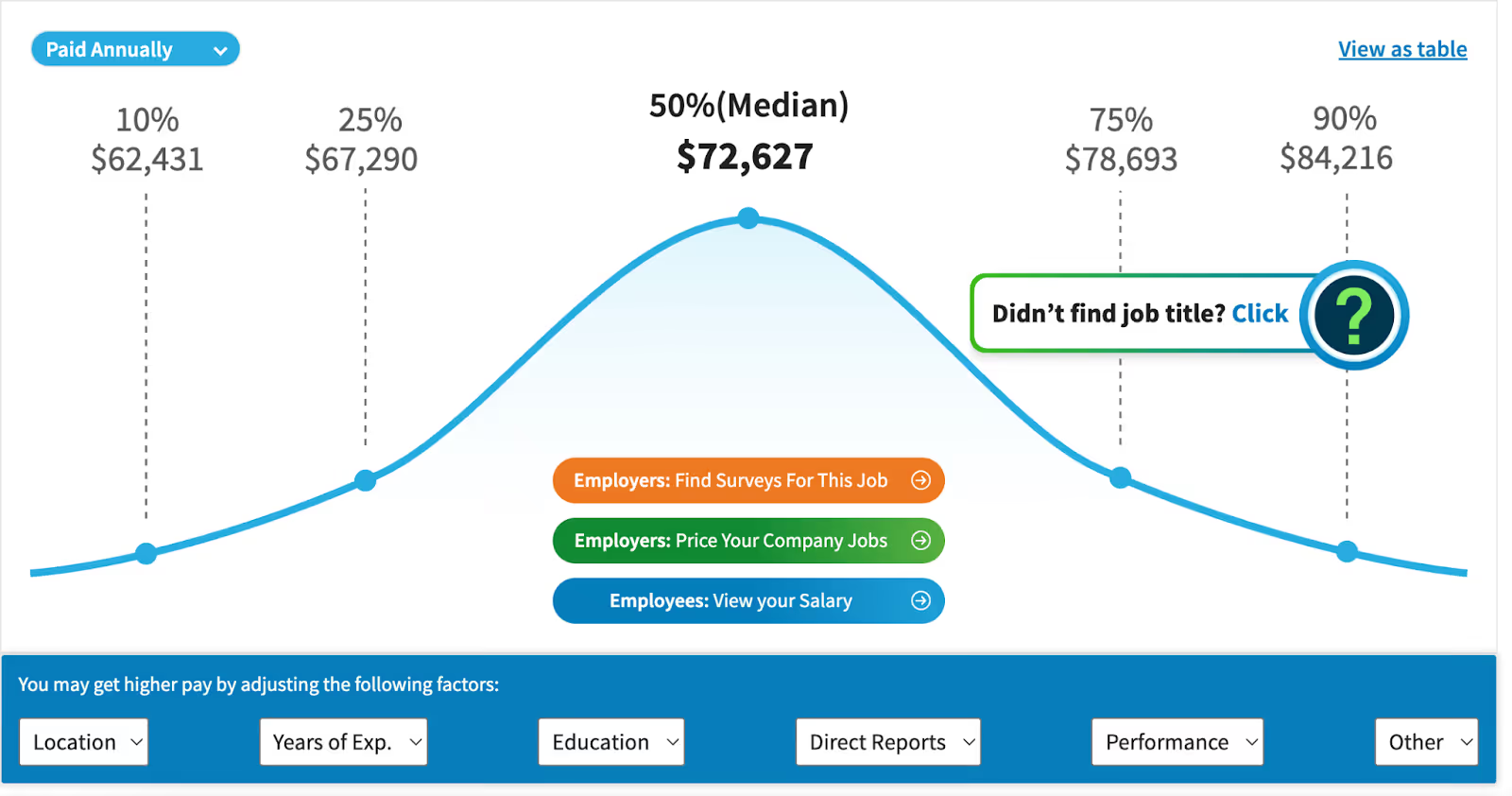
Typical salary range by level
As with most jobs, typical salary ranges for media buyers depend on many things, including their experience. Most public salary charts (including the one above) show what’s called a normal distribution, which is basically the middle of the market. The graph focuses on the 10th–90th percentile, meaning that the lowest earners and highest earners aren’t shown.
In real life, however, outliers exist. They include groups like:
- Junior hires who start below market rates
- Senior marketers who earn way above the median
- Freelancers with a proven track record
Usama, who’s a staffing CEO with years of experience placing media and marketing talent, describes this pattern:
Entry-level media buyers typically earn $45K-$60K/year, mid-level buyers $70K-$90K, and senior buyers with proven ROI $100K-$140K+, depending on agency size and region. Freelancers can exceed this with high-performing campaigns.
{{Usama Chaudhry}}
Full compensation packages
Another thing to bear in mind is that for many media buyers, salaries are more than just the base number. Many full-time roles also include extras that can increase total annual income significantly. This includes performance or annual bonuses, commissions, benefits, or stock options.
Media buyer salaries around the world
All the numbers we covered so far are applicable to the United States. How much do media buyers earn internationally?
Here’s a table of average media buyer salaries per year and per hour all over the world, according to data provided by Salary Expert. I converted all the figures into US dollars for your convenience. Please note that these are just the baseline salaries not including bonuses.
What affects a media buyer’s earnings?
Media buyers’ years of experience and location aren't the only things that affect how much they earn. The good news is that many factors I’m going to list below are totally in your control. Others depend on your company, niche, or industry.
Experience and track record
Obviously, if you’ve been a media buyer for many years, you stand to earn more than someone who just got hired last month. In the realm of media buying, “experience” is also about the skills you’ve picked up and the results you can show, not just about time itself. If you, as a media buyer, can show that you’ve improved performance or reduced costs, you’re bound to stand out.
Gunnar, who is a marketing manager in multifamily real estate, did just that through implementing UTM tracking and using analytics to demonstrate which channels were the best at bringing new leads.
UTM tracking implementation increased our lead generation by 25% and proved which channels deserved budget. When I could walk into vendor negotiations showing "your platform generated 847 qualified leads at $34 CPL versus the benchmark $52," I got better rates and more services. Concrete attribution data is your leverage — I used it to cut our cost per lease by 15% while increasing qualified leads by 25%.
{{Gunnar Blakeway-Walen}}
Niche and industry
Where you work matters just as much as how long you’ve worked, as different industries have different budgets, customer values, and expectations.
Some niches are growing so fast that the need for buyers has pushed rates up. Short-form video is ubiquitous in 2025, so unsurprisingly, buyers who can run high-performing video campaigns on platforms like Instagram and TikTok are in demand and often earn more.
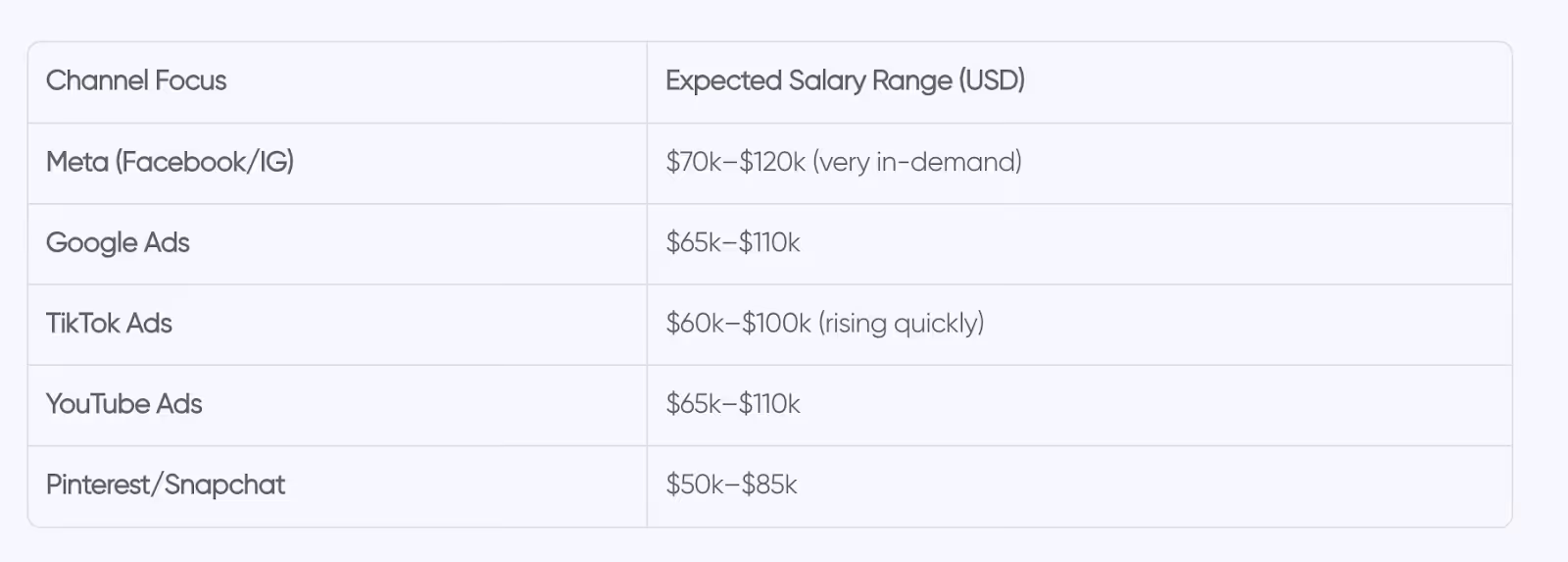
The industry you’re in matters just as much as the channels where you’re buying ads. According to Raincross, video marketing is just one of the trending niches for 2025. Others include mobile gaming, because mobile gamers engage daily and respond well to rewarded and in-app ads. Privacy-sensitive industries like finance, healthcare, and SaaS also tend to pay more because ads cost more to run, the rules are stricter, and accurate measurement is harder.
Skills, tools, and automation
The more you can analyse performance, run experiments, interpret data, and automate routine work, the more valuable you become. We saw an example of this earlier: Gunnar used UTM tracking to prove exactly which channels were generating the best leads. Technical skills like these help buyers make smarter decisions, waste less money, and get better deals.
Certifications also play a role, but they’re not the main factor. If you’re just starting out, certifications like Meta Blueprint and Google Skillshop show verified platform expertise and can help your CV stand out. Once you’re past the beginner stages of your career, however, real results matter more.
Skills and certifications: advanced skills in analytics, attribution, A/B testing, creative optimization, and ROAS management. Certifications like Meta Blueprint, Google Ads, and TikTok Ads add credibility, but demonstrated results matter most.
{{Usama Chaudhry}}
As with many sectors, automation is becoming a big part of media buying. Doing everything manually is becoming impossible because modern ad campaigns run across multiple platforms and constant algorithm changes. Performance systems, scripts, and testing frameworks are an important part of this.
Here’s a real-world example from Renzo Proano, the founder of Berelvant, who oversees media buying teams and builds performance systems for clients. Instead of testing ads randomly, he uses automation and structured testing to learn faster. When a certain type of ad performs well, he uses that insight to improve all future ads, allowing him to scale with ease.
I run 40-60 creative variants per month across paid social and search, but the system that matters is how you capture why something won, then feed that insight into the next batch. One forex client was stuck at $180 CPA until we isolated that testimonials from regulated professionals (certified public accountants, attorneys) converted 3x better than founder stories. We rebuilt the entire creative pipeline around credibility signals and dropped CPA to $94 in six weeks.
{{Renzo Proano}}
Payment models for media buyers
There are several ways media buyers are paid. The model depends on the type of work a media buyer does, the industry, and whether they’re in-house, agency, or freelance: each of these factors influence overall earnings.
Base salary + percentage of profit
Some companies offer a stable salary, plus a percentage of the profit generated by campaigns. This is common in teams where performance can be tracked easily. This includes industries like e-commerce or direct-response marketing.
Pure profit share
Pure profit share means the media buyer gets paid only when the business earns profit from the ads. There’s no salary or retainer, so it’s considered a rare, high-risk model. It only works when the product already converts well, and both sides have transparent reporting. While it can be very profitable during strong months, it also means the buyer can go weeks doing intense optimisation work without earning anything if sales slow down.
Let’s visualise this with an example. Imagine you’re a media buyer and you agree with a client to earn 20% of whatever profit their ads generate. If your client spends more than $10,000 on ads, and the campaigns bring in $25,000 in revenue, the total profit is $15,000, and your share is $3,000. But if the next month the client invests the same $10,000, but only earns $11,000, the profit drops to $1,000, and your payment would fall to just $200.
Safety net
Some companies mix performance pay with a guaranteed minimum, often called a safety net or a cushion. This means the media buyer earns a predictable base amount each month, even if profits are low. In a way, it’s the opposite of the base salary+performance bonus model, where the salary is the primary compensation and the profit share is a small bonus. With a safety net, performance pay is the main structure, and the guarantee simply protects the media buyer from income swings during seasonal drops or slow sales cycles.
Percentage of ad spend
Charging a percentage of ad spend is one of the most common freelance pricing models. The buyer takes a cut of whatever the client spends on ads each month.
Here’s what this model looks like in real life: imagine your client wants to spend $10,000 on ads in a month. If you charge 20% of ad spend, your fee for that month is $2,000, regardless of how much money the ads make. If the client decides to pause ad spending, the media buyer earns nothing.
This model works well when the buyer is responsible for ongoing optimisation, testing, creative, and reporting.
The percentage of spend only works when you're also accountable for efficiency. I charge 12-18% of managed spend but tier it inversely—clients pay less as spend scales because I've already built the system. The deal includes monthly cost-per-acquisition targets written into the agreement. If I miss by more than 15% two months running, they can renegotiate, or I eat the performance gap.
{{Renzo Proano}}
Fixed fee
Some industries don’t use the methods above at all. Media buyers working in sectors like real estate, SaaS, or B2B are often paid a fixed monthly fee or annual retainer.
This setup makes sense for these industries because the media buyer is trying to keep the quality of leads steady, rather than increase budgets more and more. In fields like real estate or SaaS, one good lead can be worth a lot, and the sales cycle is long. So, because of that, companies care more about steady costs and consistent performance than aggressive scaling.
In multifamily, we don't typically use percentage-of-spend models. I negotiate fixed monthly fees or annual contracts. For our portfolio, I secured master service agreements by showing historical performance data, which let me reduce costs while adding perks like annual media refreshes. Fixed fees work better when you're optimizing for cost-per-lease rather than pure ad spend.
{{Gunnar Blakeway-Walen}}
And what about freelancers?
Freelancers use the same structures, too! Some charge percentage-of-spend, others prefer fixed monthly retainers or project fees.
Freelancers usually charge 10-20% of ad spend, flat retainers ($2K-$10K/month), hourly rates ($50-$150/hr), or per-campaign fees. The model often depends on client size, campaign complexity, and results history.
{{Usama Chaudhry}}
How to increase your media buyer income
Start by mastering one platform deeply, tracking and documenting every campaign's results, and focusing on becoming a revenue driver, not just an ad executor. Networking and building a portfolio of verifiable wins is critical to growth and higher rates.
{{Usama Chaudhry}}
Usama’s quote has a lot of actionable advice, so let’s have a look at every aspect in greater detail.
Grow into a strategic role
As you gain experience, one of the easiest ways to increase your income is to take on more strategic responsibilities. That means understanding why a campaign is performing the way it is, helping clients choose the right channels, advising on budgets, and spotting opportunities before they appear in the data.
Specialise by platform or industry
Some niches pay more than others, and some require specialised knowledge. While most media buying happens on platforms like Google or Meta, there are some industries that rely on a completely different set of tools. Mastering the tools your niche actually uses makes you far more valuable.
I run digital campaigns primarily through Digible for paid search and geofencing, plus heavy ILS (Internet Listing Service) spend on platforms like Apartments.com and Zillow.
{{Gunnar Blakeway-Walen}}
Use automation and BI tools
We’ve already covered the importance of automation earlier in the article. It allows you to save the time you’d usually spend on reporting, audience updates, or routine optimisation, and spend it on strategy and your clients. Business intelligence tools, like Looker Studio or Power BI, also help you save time by making patterns easier to spot, allowing you to make better, data-driven decisions.
Build case studies and social proof
One of the easiest ways to increase your earning potential is to document your wins in simple case studies. That can be as basic as a one-page breakdown showing the goal, what you changed, and the final results. Screenshots of dashboards, before-and-after metrics, or short Loom videos also work as social proof. Think of it as your portfolio, basically.
Create digital products or assets
Media buying is a pretty hands-on job, but as you become more and more experienced, you could also earn passive income. Many seasoned media buyers create digital products that can be sold repeatedly. This includes things like mini-courses, templates, ad swipe files, UTM frameworks, reporting dashboards, or even starter ad libraries for specific industries.
Conclusion
It’s hard to estimate how much media buyers earn on average because there are so many factors that affect salaries. However, the pattern is simple. If you’re a media buyer looking to increase your earnings, make sure you understand your niche, have strong technical skills, and can demonstrate your performance clearly.
FAQ
What’s the difference between in-house, agency, and freelance media buyers?
In general, there are three types of media buyers: in-house, agency, or freelancers. In-house buyers work at one company and run campaigns for that brand only. They usually have stable salaries and clear routines. As the name may suggest, agency media buyers work at marketing or advertising agencies that manage ads for many different clients. They usually handle several accounts at once, often in different industries, and work with bigger budgets than in-house buyers. Freelance media buyers choose their own clients and pricing models. They get the most flexibility and earning potential, but also carry all the risk.
Is media buying a profitable career in 2025?
It can be! Depending on your skills, location, and niche, media buying remains a very profitable career.
What’s the future of media buying?
Advertising isn’t likely to disappear altogether, so media buyer jobs are likely safe. But like every field, it is evolving. Automation and strategy are becoming more important aspects of the role. Privacy rules are also changing how targeting works, which means first-party data and accurate measurement are becoming essential skills.
Do you need any certifications to become a media buyer?
No, you don’t (but they help). Certifications like Meta Blueprint, Google Skillshop, or TikTok Ads can make your CV look stronger and show you understand the basics of each platform, especially if you’re just starting out and don’t have a proven track record.
Can beginners get into media buying with no experience?
Of course, everyone starts with no experience at some point in their lives. Not all media buyers come from a marketing background, either. It’s a good choice for people who like data, testing, and problem-solving. Beginners usually learn by managing small budgets, helping with basic optimisation tasks, or running simple campaigns for a local business or side project.
.avif)




I’m a bilingual writer and content strategist working across SaaS and digital media. I cover topics like marketing, tech, and the occasional niche curiosity.
Learn moreI'm the founder of Berelvant. I've managed over $300M in digital ad spend across financial services, SaaS, GovTech, and e-commerce, building performance systems for brands like Microsoft, Cartier, and StoneX.
I'm the CEO of a staffing company with years of experience placing marketing and media professionals across agencies and in-house teams. I work closely with media buyers to understand market rates, career paths, and the skills that drive success.
I'm a Marketing Manager at FLATS(r) where I manage $2.9M+ in annual marketing spend across 3,500+ multifamily units in Chicago, San Diego, Minneapolis, and Vancouver.
We are here to ease your working routine
Whether you're freelancing or a full-time contractor, we simplify the working process, putting you in control.
Try it free

Gusto and Deel both help companies manage payroll and HR, but they serve different business needs. Gusto is a better fit for US-based small and midsize businesses that need simple payroll, tax filing, benefits, onboarding, and basic HR tools. Deel is better for companies hiring internationally, managing global contractors, or using Employer of Record services. This comparison breaks down their key differences in payroll, compliance, pricing, integrations, benefits, contractor management, pros and cons, and best use cases to help businesses choose the right platform in 2026.

Compare the best Deel alternatives for global hiring, payroll, EOR, and contractor payments. See pricing, coverage, pros, cons, and best use cases.
Running payroll for one employee still means tax calculations, filings, forms, and deadlines — so the cheapest option isn't always the best value. This guide compares affordable payroll services for a one-person business, breaking down real monthly costs, what's included, and which choice fits how you actually pay your worker.
