
5 Strategies for Handling Difficult Clients Every Freelancer Needs to Know
Explore how to recognize and handle difficult clients with confidence — learn practical strategies for dealing with challenging behavior and discover how to avoid difficult clients before problems start.
January 2, 2026

Key Points
- Difficult clients can present themselves in a number of ways — payment issues, unclear expectations at the start, shifting goals in the middle of a project, poor or inconsistent communication, boundary pushing, and disrespectful behavior.
- Universal approaches like staying calm, active listening, empathy, and solution-focused communication tend to work in most challenging situations.
- Ultimately, the best way to prevent these problems is to clearly define your ideal client profile and decline projects that don’t align with it.
Working as a freelancer always involves maintaining relationships with clients — it’s just a given. And while this can be a great, productive, and rewarding experience, it can also be one of the biggest stress points in your career. If you've been in this industry for a while, you've probably met some difficult clients along the way. Most freelancers eventually run into the ones with unrealistic expectations, constantly shifting deadlines, sudden disappearances, or endless revision requests.
And dealing with difficult clients can cost you much more than money. According to a survey, 45% of freelance creatives reported a decline in their mental health, citing client behavior — bullying, late payments, ghosting, and such — as a major contributing factor. With a few practical strategies, you can handle these situations with confidence and calm. You've come to the right place, because this article will cover exactly that. Let's dive in!
What makes a client difficult?
Well, as Muhammad Ali said, "Different strokes for different folks." Perceptions of difficulty can vary, and what you find extremely challenging might be quite easy for another freelancer to handle. However, there are some common traits or behavior patterns that can make it difficult to work and maintain a healthy relationship with certain clients. And keeping a strong client relationship is one of the most important things for many freelancers.
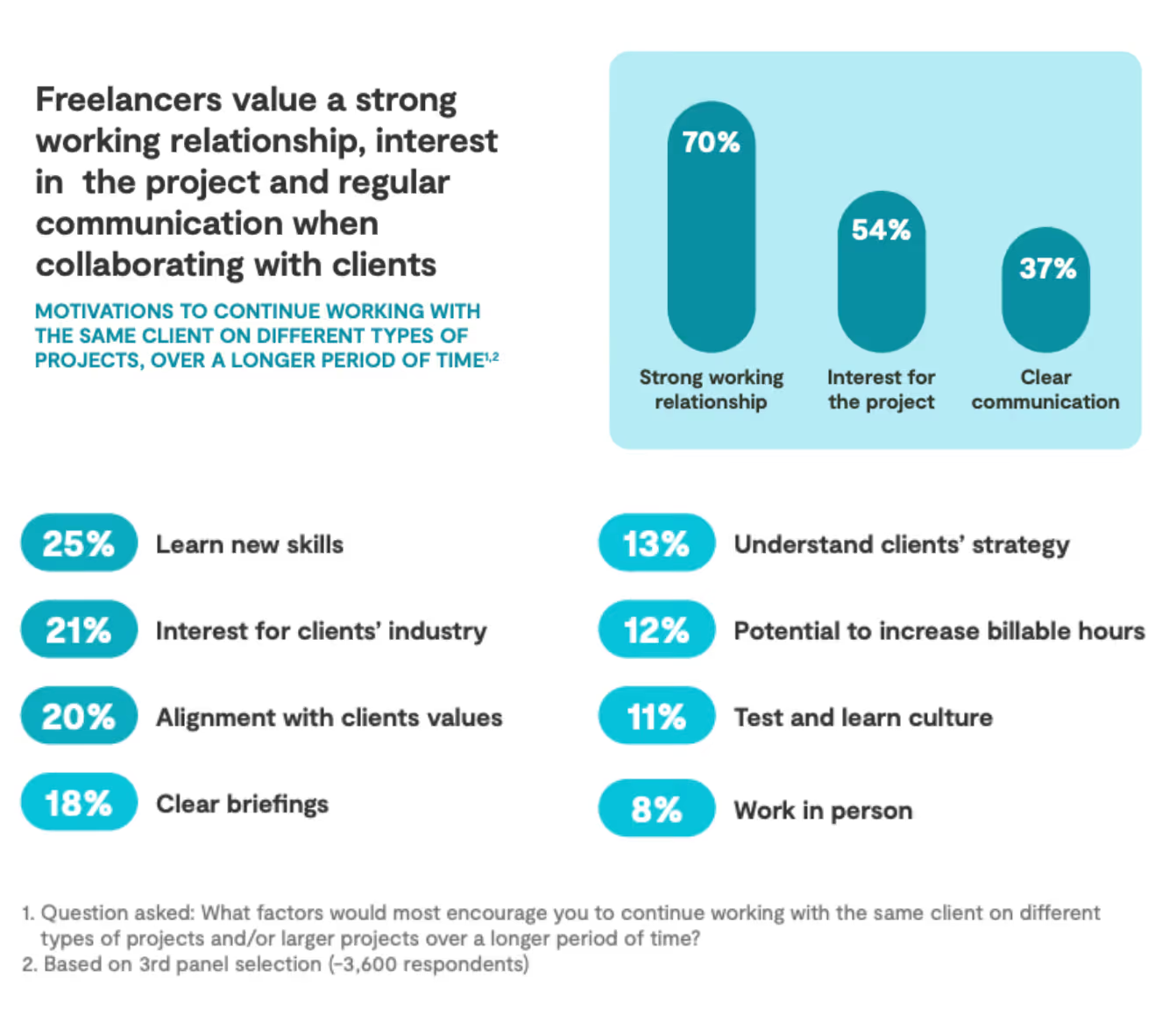
A difficult client is not necessarily a bad person — it's just someone whose work style, boundaries, or respect for professionalism may clash with yours. And it’s best to recognize this miscommunication as soon as possible. We’ve written a guide to spotting red-flag clients earlier this year, covering 10 warning signals to watch out for.
Let’s walk through some of the most common patterns behind difficult client behavior.
Payment issues
This is probably the most significant predictor of a difficult client. A 2025 Flexable study found that 58% of freelancers experience payment issues at some point — delays, partial payments, or no payment at all. Don’t get me wrong — price negotiation is a normal part of the business process. However, when someone consistently asks for discounts, requests free samples, or delays payments, it's a clear sign of trouble. Even a polite client who truly loves your work can become difficult to work with if they are unreliable with money.
When a client has a small budget but expects a lot — high quality and fast delivery — they usually don’t understand, or don’t want to understand, how an illustrator’s work is structured and how much real effort is required to complete their requests. If, during the project, the client starts asking for more than what was agreed, I usually assess the situation. If the collaboration is pleasant, the client is polite, and the extra work would only take two or three hours, I might do it. It’s not a big effort for me, and the client may remember it positively and come back in the future. But if the client is clearly asking for a significant amount of additional work, it’s important to set boundaries and guide them back to the original agreement, tactfully reminding them that the terms were different. If you’re willing and able to take on the extra work, you can calculate the cost and let them know the timeline for completing it.
{{Natalia Shuvalova}}
Here's a video that explains some techniques to help you deal with a client who is not paying:
Unclear expectations and shifting goals
Industry-oriented reports and guides for freelancers consistently list scope creep as one of the top challenges and sources of conflict. For example, a survey conducted by Remote found that the top challenges included managing expectations with clients (60% of respondents) and receiving briefings correctly (57% of respondents).
This is one of the patterns that can be recognized early on:
- if the brief is unclear;
- if a client doesn’t know what they want yet but could certainly tell you if you did the right thing after you delivered it;
- if a client has a “this should only take 20 minutes” kind of attitude;
- if extra tasks are added and the project’s goals are shifting midway without adjusting deadlines and additional payment.
All of these show that you’re dealing with a difficult client. It is not always a single, large request that causes a project to fail, but rather the gradual accumulation of minor changes that seem endless because the initial expectations were not defined clearly enough.
Most often, I encounter “vague” clients who don’t really know what they want and hope I’ll somehow read their minds without asking too many questions. I take the time to explain everything in detail — whatever raises questions or misunderstandings. It’s easier for me than for beginners because I have a clear understanding of what I do, what I take on, what I don’t, why my work costs what it does, and I can explain each point clearly and logically. I only do this when I’m genuinely interested in collaborating and I can tell the client simply “doesn’t know the ropes” but is willing to work together. If the client is still acting “vague”, even when we eventually manage to reach some agreement on what the work will be, the timeline, and the budget, it usually ends with either dissatisfaction or the project not being completed at all. That’s why, as soon as I sense this kind of vagueness and a lack of real communication, I let them know I won’t be able to take on the project.
{{Natalia Shuvalova}}
Poor and inconsistent communication
Communication issues make working with a client feel difficult even when the project itself isn’t. Ghosting and not responding for weeks, followed by demanding next-day results — all of these actions create tension and uncertainty. Not every client is open to extensive communication, of course. Some people are more private and less collaborative in nature, but every project requires collaboration, and the client plays a crucial role in it. If a client does not actively participate or provide necessary feedback in a timely manner, it can become a real challenge.
Boundary-pushing behavior
In contrast to poor communication, there are situations when a client ignores working hours entirely, demands instant replies, or treats you like an on-call private problem-solver. Disrespects professional boundaries, in short. A client who doesn't see you as an equal partner is very hard to manage and can erode your sense of control over your schedule and workload. This is especially true for new and inexperienced freelancers, who need to keep every client they can get.
So, what actually makes someone a difficult client is not their personality; it’s their behavior: disrupting your schedule, creating uncertainty about expectations, interfering with financial stability, ignoring boundaries, and making you feel uncomfortable, disrespected, or at financial risk.
5 strategies for handling difficult clients
Now that you know the most common types of difficult client behaviors, let's explore some practical strategies that will show you how to deal with them. No matter what "type" of difficult client you encounter, the steps for handling them are more or less the same.
Remain calm, no matter what

I know it's easier said than done, especially when dealing with an aggressive or unpredictable client, but it truly is your best policy in these situations. Staying calm doesn’t mean losing the battle, it means staying in control. You can’t control how a client reacts — but you can control the emotional temperature of the conversation. And your reaction can determine whether the situation resolves or escalates.
According to the Program on Negotiation at Harvard Law School, the first step in resolving any conflict is to learn how to manage your thoughts and emotions. This will give you a better chance of finding a productive solution through negotiation.
Here are some practical steps:
- Don’t reply instantly to a provocative message — give yourself at least 15 minutes to calm down.
- Make all of your responses factual, not defensive.
- Suggest scheduling a phone call to discuss the issue — sometimes, emotions can get lost in written communication, and a personal face-to-face conversation can help to change the tone of the discussion into a more structured one.
The ability to maintain composure when you deal with difficult clients helps you maintain a professional image and regain control of the project, which is ultimately the most important thing.
I actually react pretty strongly to emotional or aggressive clients — they just don’t know it. If an unexpected situation comes up and a client turns out to be “out of control,” starts behaving very unprofessionally, and it triggers strong emotions for me, the first thing I do is go to a chat with my closest friends or my husband. They’re the fastest way to vent and get the emotions out. I take a pause in communication with the client and give myself time to cool off. And only after that do I return to the conversation — polite, calm, and focused on arguments rather than emotions. That said, situations this intense are extremely rare, and more “light” conflicts no longer cause a strong emotional reaction.
{{Natalia Shuvalova}}
Listen and empathize
Sometimes a difficult client just wants to be heard and understood. Let’s face it — not all clients may know all the aspects of your work or accept your decisions straight away. Practice active listening and communicate with empathy, even when the client is being unreasonable in your opinion. Negotiation and Conflict Management Research found that assertive, engaged listening during conflict can lead to better relational outcomes and an increased willingness to cooperate. You may even uncover the underlying issue behind the original client complaint.
Here are some practical steps:
- Acknowledge their feelings, even if you strongly disagree with the complaint itself.
- Reflect back what you hear to confirm you’ve heard and understood.
- Ask clarifying questions when something is unclear.
When clients feel heard and understood, they become more relaxed and calm, and you can move the conversation towards finding a solution instead of just discussing feelings and complaints.
Set clear expectations early on
Some clients can become difficult to work with when both parties don't fully understand what the final outcome of the project is going to be. Unclear scope, vague timelines, and undefined responsibilities can lead to assumptions, which can in turn lead to frustration and conflict.
To prevent this, you should:
- define the full scope of the project in concrete terms — list what exactly is included and what isn’t.
- set timelines and decision points to ensure the client understands when they can expect your results and when they should provide their feedback.
- set strict communication rules — working hours, channels, and response time.
- clarify the revision limits and the terms for the project change rules.
Clear expectations make collaboration more predictable. If a client is being unreasonable or demanding, you can always refer back to the original agreement to prove your point.
I always try to clarify every detail as much as possible. I ask the client to provide examples or references (if they don’t have any initially), create a description, and I can send a list of questions they need to answer for full clarification. Once we reach an understanding of what the client needs, I let them know whether I can do the work, in what form, within what timeline, and at what cost. I always keep a little flexibility, and if something doesn’t work — deadlines, price, or style — I offer an alternative that might suit the client better while still being comfortable for me. This requires knowing yourself well as a professional and being able to communicate that clearly to the client.
{{Natalia Shuvalova}}
Focus on the solution
Conversations with difficult clients often get stuck on what went wrong and who to blame. The most effective way to move forward is to focus on what can be done next. Problem-solving is a crucial skill for any job that involves working with clients, and it's in high demand.
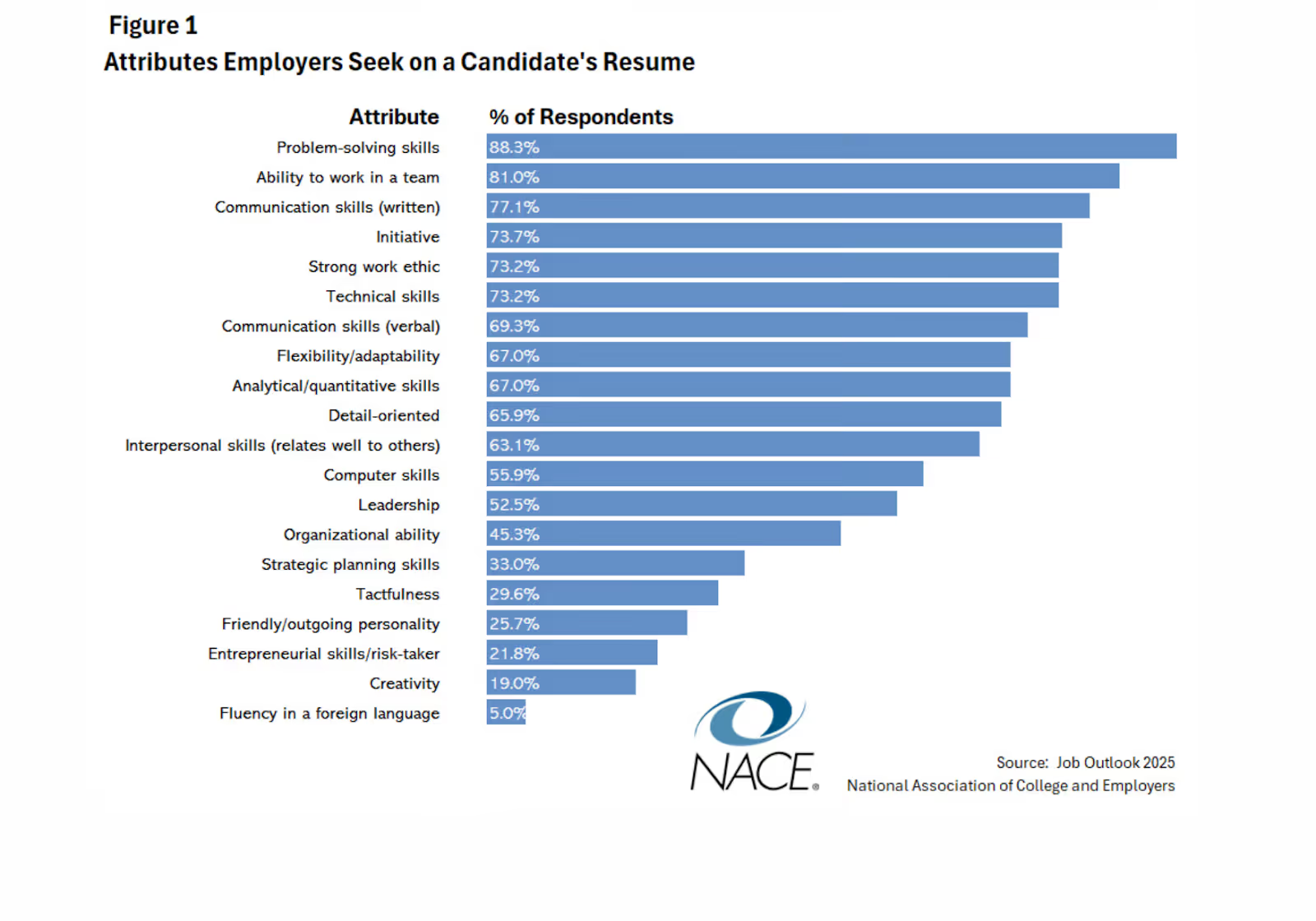
What focusing on a solution looks like in practice:
- If the mistake is yours — own up to it and outline clear steps you'll take to fix it, with a clear deadline.
- If the client is in the wrong — explain the situation in a respectful but firm manner, referring to relevant sections of the contract if needed. If changes in scope are a part of the problem, update the contract or project plan to clarify new timelines and costs.
- If communication broke down — offer a few alternative methods to keep everyone aligned, whether that’s weekly emails, monthly phone calls, or updates through a project management tool.
By approaching each situation with a problem-solving approach, you maintain professionalism and keep projects on track, even when dealing with a difficult client.
First and foremost, the key is to stay within polite, professional communication — without blaming or shifting responsibility. Communicate with clear reasoning, keeping emotions in check. Show that you’re open to finding a solution together and willing to compromise. If the mistake is on my side, I admit it and suggest what can be done to minimize the impact. If the client makes a mistake and acknowledges it, I’m also willing to accommodate if possible. After all, we’re all human — everyone can forget something, make a mistake, or be in the wrong sometimes.
{{Natalia Shuvalova}}
Document everything
And I mean — everything. Take notes after (or during) meetings, sum up all the decisions, and save key e-mails and messages. Memory can be unreliable, documentation can’t. In addition, written communication can be valuable evidence in dispute resolution bodies if the issue escalates.
Here’s what you should keep:
- signed copies of contracts and agreements
- all the amendments made to them
- written approvals for the work done
- email and messenger conversations
- invoices and payment reminders
- delivery documentation
It might seem like a lot of extra work, but consider documentation as an additional part of your project that you do in the background in order to protect yourself in the future.
Precision is everything. Before starting a project, it’s extremely important to clarify as much as possible. If a client consistently blurs the brief, refuses to put anything in a contract, etc., that’s a warning sign. In the end, the law will only protect what’s documented in official agreements — nothing else can be proven. That’s why it’s strongly recommended to draft at least a basic contract outlining what you’re doing, when, and for how much. The more detailed, the better.
{{Natalia Shuvalova}}
How to avoid difficult clients
Now that you know how to identify and manage difficult clients, let's discuss the best approach to dealing with them — avoiding. The warning signs usually show early on, not halfway through a project. Here’s what you can do to make sure difficult clients don’t pass your way:
- Identify your ideal client profile. Set clear expectations for yourself — who you want to work with, and what values, budget, and communication style should they have? When you surely know what’s good for you and what isn’t, it becomes easier to spot who isn’t your match at the very beginning.
- Test expectations before committing. Schedule a call with them, and ask specific questions about the project, the goals, the success metrics, the decision-making process, and the people responsible for it. If they can’t answer the questions that matter to you or avoid this stage of communication overall, they may not be your ideal client.
- Require a deposit. Even a small upfront payment helps to filter out clients who do not value the work. Upfront payment is a sign of commitment on their part. If they refuse to make it, it might indicate that they are not as serious about the project as they seem.
- Trust your gut. Seriously. If something feels off during onboarding, it probably is. And it’s probably going to get worse. Walking away early costs far less than dealing with conflict for weeks.
Situations where it’s better to turn down a client are not uncommon. Most often, this happens early in the communication process, when I realize that either the project isn’t a good fit for me, or I’m not a good fit for the project. The reasons can vary — from mismatched work conditions (unrealistic deadlines, price, style, etc.) to topics I refuse to take on for principled reasons (bookmakers/casinos, scams, info-marketing schemes, etc.). A couple of times, I’ve had to end a collaboration in the middle of a project. When a client repeatedly broke agreements, and attempts at dialogue didn’t lead anywhere, it became clear that it was better to terminate the collaboration and stop than to continue under those conditions.
{{Natalia Shuvalova}}
Conclusion
Working with clients is never completely conflict-free, but dealing with difficult ones can be simply draining. By learning how to spot them early, setting clear boundaries, remaining calm and focusing on solutions, you can easily manage or avoid them completely. Even if you're just starting out on your freelance journey, don't compromise or settle for anything that's not good for you. The right clients will come along — make sure you leave room for them and don't fill your schedule with difficult clients.
FAQ
How do I know if a client is “difficult” or just having a bad day?
We all have bad days from time to time, it’s normal. Doesn’t mean that we should bring our bad mood to our professional life, but it can happen sometimes. And some disputes may arise as a natural part of the process. Also normal. A client becomes difficult when their problematic behavior is consistent — their expectations are always unclear, they are late with payments, and their communication is poor all along the way.
How can I maintain professionalism when a client becomes angry and the situation becomes more intense?
The best thing you can do is to maintain calm and listen. Never take their comments personally, focus on what they’re actually asking for and try to find a solution to the problem. It can be hard to focus on what they’re saying and not how they say it, but this is your best chance to turn the conversation away from conflict and towards resolution.
Is documenting everything really necessary?
Yes, it's always a good idea to document everything, even if you are working with a trusted client. And it is especially important when dealing with difficult ones. Clear records can help prevent misunderstandings and protect you in case of any disputes or disagreements that may arise.
How can I avoid difficult clients in the future?
Pay attention during onboarding and listen to your gut — if you see some warning signs like refusal to make a deposit, vague expectations and goals, or simply don’t feel like taking the project, consider walking away before the real trouble begins.
.avif)


I'm a copywriter, creative lead, and project manager who blends storytelling and strategy to create memorable content. Outside of work, I’m either re-reading favorite books or staying active with sports.
Learn moreI am a digital illustrator and designer. I create characters, book covers, illustrations for packaging, board games, brands, visual identity, and other commercial projects. I love folklore and draw endless inspiration from it.
We are here to ease your working routine
Whether you're freelancing or a full-time contractor, we simplify the working process, putting you in control.
Try it free

Gusto and Deel both help companies manage payroll and HR, but they serve different business needs. Gusto is a better fit for US-based small and midsize businesses that need simple payroll, tax filing, benefits, onboarding, and basic HR tools. Deel is better for companies hiring internationally, managing global contractors, or using Employer of Record services. This comparison breaks down their key differences in payroll, compliance, pricing, integrations, benefits, contractor management, pros and cons, and best use cases to help businesses choose the right platform in 2026.

Compare the best Deel alternatives for global hiring, payroll, EOR, and contractor payments. See pricing, coverage, pros, cons, and best use cases.

Running payroll for one employee still means tax calculations, filings, forms, and deadlines — so the cheapest option isn't always the best value. This guide compares affordable payroll services for a one-person business, breaking down real monthly costs, what's included, and which choice fits how you actually pay your worker.
