
15 Second Jobs at Night From Home
Check our guide about the best side hustles with a list of 15 second jobs at night from home for you to make more money every month.
January 2, 2026

Need to make extra money, but that promotion at work never comes? Perhaps it’s time to use your skill set outside of your regular working hours in more profitable ways: you can work from home at night. Whether you decide to go the part-time contractor or the freelancer path, these activities provide many opportunities to make money with the added benefit of flexibility. Part-time jobs have been trending up since the pandemic, and to many, they have become essential in supplementing income.
In this article, we will discuss the best remote jobs you can do at night, including their salaries and required skill sets, give you tips on how to find them, and help you avoid scams along the way.
The pros and cons of getting a side hustle
I’d say 30% of my income comes from side hustles. Yes, free time or lack of rest can be an issue, so I usually set aside two to three hours each night to focus on my side hustle, so I don’t fall into a routine that demands too much from me. I mostly do freelance jobs, so this helps me keep better control over my working hours and also track how much time I dedicate to each side project. You have to take your current job into consideration before applying for a position that requires a night shift, because it might be too much. With freelancing, it’s easier: when the time I set up is over, I stop and go take care of myself.
{{Julia Zuanella}}
A side hustle at night, after your regular job, has many advantages, but some disadvantages as well. Here are some of them:
Pros
- Flexibility: Unless you are working a remote night shift with a set number of hours, the jobs you get offered allow you to work flexible hours. It is more about how long it takes to finish a task, and efficient professionals might find themselves in a very profitable position.
- Income potential: The possibility of supplementing your regular salary with additional income, especially if you are doing something within your area of expertise, is very enticing. Some night-shift remote jobs also pay more because, well, you have to work at night. At the same time, you don’t have to commute to work for these jobs. Freelance and contractor opportunities can also be financially rewarding in proportion to the number of hours it took to get the job done.
- More focus, fewer interruptions: You will encounter fewer distractions at night. People generally interact less on messaging apps and social media as it gets late. For parents, it might be bedtime for kids, which will make the environment quieter. Furthermore, you won’t have to talk to anyone at the office, so chances are you will likely focus more and be more productive.
- New career opportunities: This one takes more time, but you might find so much success in nightly remote jobs that working from the comfort of your home becomes your main source of income. Teaching online will lead you to open your online language school, or doing social media management on the side will lead you to become a fully-fledged social media marketer. It will take time to build your reputation and profile for a new occupation, but it is possible.
Cons
- A harder routine awaits: Taking on more work means having a professional arrangement with others – they depend on you to be there on time for nightly shifts or to deliver tasks within the agreed deadlines. That means you cannot take a night off, even if you had a terrible day at the office. If you get sick and can’t work any given night, the next one you are available is likely to be much busier. You will have to keep a close eye on your personal schedule so that you don’t overwork or have any semblance of free time.
- Lack of social life: Seeing your friends or loved ones when you are working a 9 to 5 and then doing side hustles at night can be a bit difficult, whether due to tiredness or because most social life happens after regular work hours.
- Health concerns: Late-night shifts or excessive work can disrupt your sleep schedule and negatively impact your mental health if you don’t make time to rest and relax. Excessive screen time may also be a concern.
All that being said, you are in a prime position to decide when and how to get a side hustle after your regular working hours, and all these factors should be weighed in before committing. Only you know how much you can take.
Top 15 remote second jobs to work at night
You are thinking now: What kind of job should I aim for? The video above brings many good choices that pay well. The focus is on certain niche jobs that people don’t usually want to do. Some of those might seem very specific – funeral sales specialist, I’m looking at you – but in the end of the day, you are selling a service. If you are comfortably doing them, there is good money to be earned.
We also have our own top 15 list of best remote jobs to work at night, taking salary (hourly, with the US as reference), flexibility, required skill set, and complexity level into account. Complexity level criteria are as follows:
- Beginner: Jobs that are easy to pick up and start right away, or that can be done properly within a few hours of company training.
- Intermediate: Jobs that require learning skills or software before you can work with it (for example, no-code devs who need to learn Bubble or WebFlow)
- Advanced: Jobs that are more suitable for established professionals in their industry, who are also looking for a side activity to supplement their income, or jobs that require a high level of expertise in a field (such as an editor)
Copywriter
Typical tasks: Copywriters produce persuasive texts for marketing and advertising purposes, usually guided by SEO briefs and following a set of rules on tone and formatting. Their end goal is to sell products or services and show the voice of a brand, while writing for channels such as websites, blogs, email, and social media, among others.
Average pay: A junior copywriter usually earns around $24.62 per hour. Jobs at Upwork vary in payment, with one-time projects ranging from $10 for writing short product descriptions to $600 for finance content writing. Many opportunities fall around the $50 to $100 price range.
Who’s it for: People who have at least some knowledge of SEO and are willing to research and learn about many topics. Requires writing experience, and most jobs will ask for a writing portfolio.
Complexity level: Intermediate.
Language teacher
Typical tasks: Language teachers tutor students towards fluency in any given language. In case you choose to work as a self-employed one, you will have to find clients, prepare classes, teach, and take care of the financial aspect of your business. Another possibility is working remotely for a language school and teaching evening classes (between 6-10 pm), usually following guidelines.
Average pay: On average, teachers get paid $25.87 per hour, but there are many job listings on Indeed offering hourly rates from $40 to $50.
Who’s it for: People with language expertise, patience, and who enjoy teaching others. Required experience depends on factors such as pay and the demographic you are teaching. Some schools offer teacher training, while others require previous teaching experience.
Complexity level: Intermediate.
Video editor
Typical tasks: A video editor takes raw footage and assembles it, creating engaging content. They edit videos for different platforms, focusing on their medium and audience (TikTok, YouTube, YouTube Shorts, Instagram Reels, and so on). You can work under a part-time contract or as a freelancer, earning money per project.
Average pay: Video editors earn an average of $33 per hour. At Upwork, the bulk of job listings offer payment based on delivering a set number of videos per month, but some pay per video.
Who’s it for: People who have a computer powerful enough to run video editing software and are interested in learning how to use it. Understanding internet trends is a differentiator, and so is having a portfolio. A great job for people looking to change careers, but it takes time to learn and master the editing tools.
Complexity level: Intermediate to advanced (skilled editors who have a good workflow will perform tasks faster and earn more money).
No-coding developer
Typical tasks: No-coding development, in simplified terms, is developing apps, websites, automated workflows, or integrations, but without actually using any kind of programming language. It can be done with specific software tailored for your needs, such as Bubble, Zapier, AirTable, or Webflow.
Average pay: The average salary depends on the platform: Bubble developers make around $35 per hour, while most WebFlow jobs pay within the $20-30 range.
Who’s it for: People who have time to learn a new skill and are willing to create a portfolio before scoring a gig. This career has a lot of potential to become your prime source of income as well, but it has a steeper learning curve.
Complexity level: Intermediate to advanced (salary ramps up when you niche down or have a command of your chosen platform).
Social media Specialist
Typical tasks: Social media specialists create content for a brand, trying to drive traffic, follow trends, and ultimately, increase sales and engagement. This can be done in many ways: posts, photo carousels, reels, stories, memes, and much more. They are also tasked with responding to comments and managing the interactions with users.
Average pay: The average pay per hour is $21. You can find job listings offering $18 per hour on Indeed. A 15-20-minute-a-day job is offering $100 per month on Upwork, and there are many other offerings around the $17 to $20 range.
Who’s it for: We recommend this job for tech-savvy people who have experience in marketing or producing written/video content – especially those who have time on their hands, because social media content as a whole is something you have to produce constantly, while also staying on top of trends.
Complexity level: Intermediate.
Technical writer
Typical tasks: Writing manuals, documentation, diagrams, and other types of material that help customers or workers to operate software or machines are written by technical writers. Technical writers talk to engineers and designers, then translate complex information into something that end-users can understand.
Average pay: The average salary for a technical writer is $38.66 per hour. There are many positions offered on Indeed. One is paying between $70-100 per hour of work, another up to $25 per hour plus fringe benefits. A Software technical writer position at Mercor is offering $50-80 per hour for independent contractors.
Who’s it for: Skilled writers with good interpersonal skills. Jobs require a portfolio, and knowing the technical field you are writing for is a big plus.
Complexity level: Intermediate to Advanced.
Resume writer
Typical tasks: Craft, revise, personalize, and optimize job application documents, tailoring them for the position clients want. Resume writers can identify their clients’ best qualities and sell them to companies through clever CV writing and storytelling.
Average pay: The average salary is $18.27 per hour, and this is one of the most flexible side hustles, as you will be doing a lot of freelance work. Specialists might earn up to $100 per resume, and there are many other opportunities with payment ranging from $5 to $60 per CV.
Who’s it for: Skilled communicators and writers who have a good overall understanding of the job market and what recruiters are looking for (including Applicant Tracking Systems). If you are a recruiter or work with HR, this is a great use of your skills.
Complexity level: Advanced.
Search engine optimization specialist
Typical tasks: Search engine optimization specialists work on making websites show at the top of the search results, therefore improving traffic and other important metrics. SEO specialists have to understand how algorithms work and employ a range of techniques to manipulate these algorithms, making sure a website receives organic traffic.
Average pay: SEO specialists make an average of $31.95 per hour, and there are plenty of job offers in the marketing industry. An SEO specialist position at Indeed is offering $25-28 an hour. Another similar position listed on Glassdoor pays $22 per hour.
Who’s it for: Problem-solvers and analytical minds who enjoy digital marketing, technology, and content creation. This is not a beginner-friendly job – you will be judged on results. There are many free resources to help you get started, though, such as Google’s SEO starter guide.
Complexity level: Intermediate to advanced (the better your webpage results, the more you can get paid).
Virtual assistant
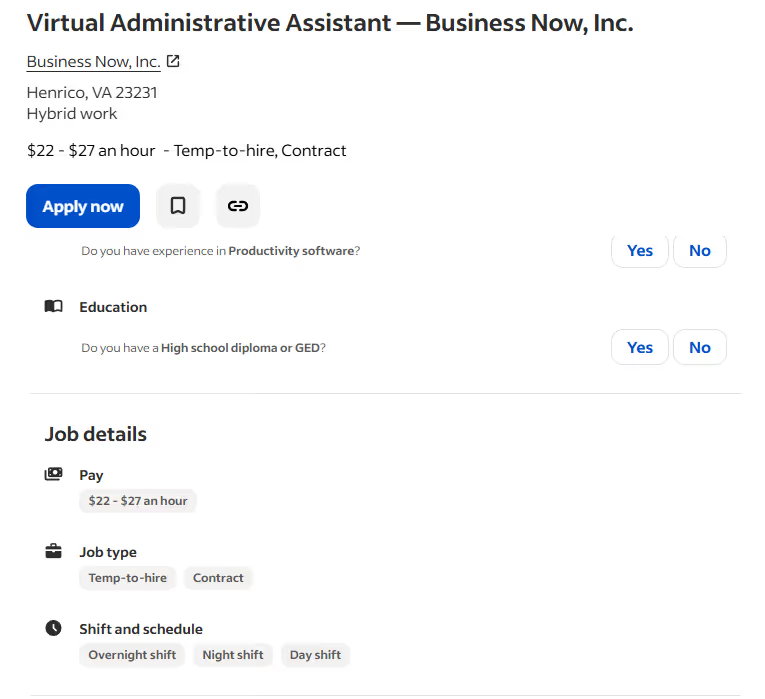
Typical tasks: A virtual assistant is a professional who provides remote administrative services to companies and clients. Their tasks range from managing email accounts to scheduling calls and meetings, or even making travel arrangements, among other things. VAs are there to offer an extra hand from outside the main office, handling outsourced tasks that can facilitate many corporate lives.
Average pay: The average salary is $26.60 per hour, and there are many job offerings, such as this VA for an economic firm:
Who’s it for: Organized people with administrative routine knowledge, and who are willing to work on daily night shifts. As a lot of the jobs just involve daily tasks, the complexity lies in handling them and taking care of everything properly, so this is a more beginner-friendly position that doesn’t require learning new skills, and many companies offer training.
Complexity level: Beginner.
Graphic designer
Typical tasks: Graphic designers create visual concepts, such as logos, websites, art, packaging, and visual identities. Their idea is to communicate a message, sell an idea or product, using their creativity and different techniques to persuade their audience.
Average pay: This is a highly flexible job and usually pays by the hour or per task – the latter is exciting for fast finishers, as they can work on more projects. Graphic designers make, on average, $23.29 per hour. Platforms such as Design Crowd are the best ones for professionals looking for freelance work, with many logo design projects paying more than $100 for delivery. Part-time positions are also available – a job listing on Indeed is offering up to $22 per hour.
Who’s it for: Tech-savvy creative folks willing to learn graphic design software (Adobe Creative Cloud, Figma, CorelDRAW, among others). Good communication and problem-solving skills are a plus. Unless you are working with social media design (in this case, Canva Pro can suit many of your needs), it might take some time before you are comfortable using the graphic design tools you need to build a good portfolio.
Complexity level: Intermediate to advanced (less experienced designers will not score the higher-paying jobs, which usually revolve around the visual identity of a brand).
Editor
Typical tasks: Editors are professionals who ensure a text is ready for publication: they proofread content, offer writing advice, guide writers on tone, formatting, structure, and much more. The kind of text varies as well – it could be a book, an article, news reports, company memos, website content, or any other kind of written piece.
Average pay: The average salary for an editor is $33.11, and you can even find projects paying $50 an hour, such as this one:
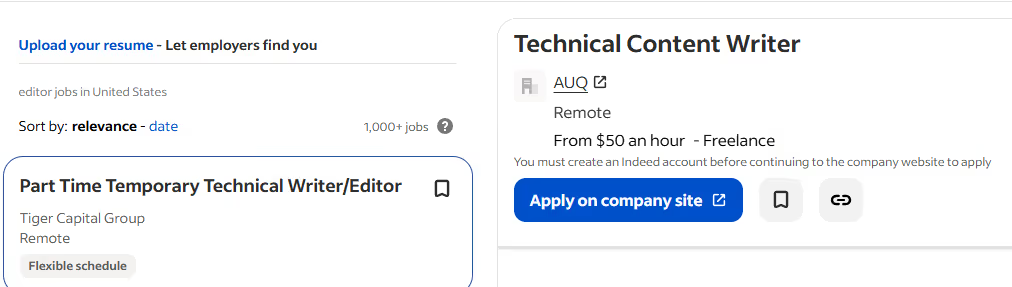
Other ads are offering $20-30 per hour.
Who’s it for: People who have language expertise, good writing, proofreading, and editing skills, who are also able to effectively convey to writers what they need. This is not a job for beginners in the sense that you don’t begin as an editor – you begin as a writer and climb up the ladder.
Complexity level: Advanced.
Data entry clerk
Typical tasks: Data entry clerks are your database specialists. They collect data, create and update databases regularly, review records, and extract information whenever necessary. That data can be later used by many other employees in a company to facilitate or improve internal processes.
Average pay: The average salary is $23.01 per hour. You can find many job openings on platforms such as LinkedIn, Upwork, Indeed, and FlexJobs. Jobs offered on LinkedIn usually pay between $15-24 an hour.
Who’s it for: Fast typists and detail-oriented individuals, especially those who don’t easily lose focus and have some Excel expertise. Other than understanding Excel or other spreadsheet software functionalities, this is not a job that requires so much learning or extra courses, being one of the most beginner-friendly activities in this list.
Complexity level: Beginner.
Translator
Typical tasks: A translator is a communication and language expert who reads, interprets, and then translates content to the desired language. The job can also branch out to localization, where you create versions of the content that are adequate to the culture of a country.
Average pay: The average hourly payment is $26.34, but you are likely to find many job offerings paying on a per-word basis, such as this Spanish document translator opportunity:
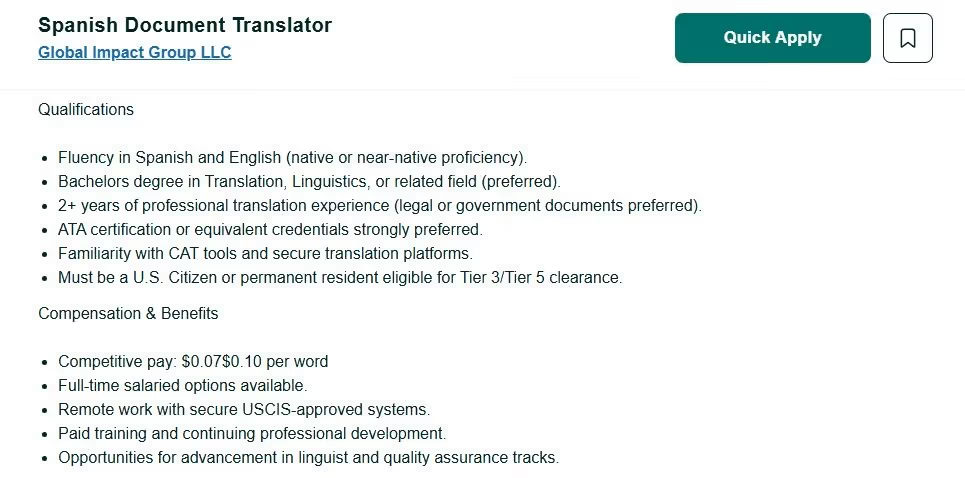
You can find many freelance translation opportunities at Upwork and many other platforms as well.
Who’s it for: Bilingual professionals who are proficient at writing. Self-editing and attention to detail are good qualities to have. It is also very beginner-friendly, especially if you are just translating documents without having to worry about localization.
Complexity level: Beginner to intermediate.
Typist
Typical tasks: Typists transcribe documents, create letters, reports, memos, and many other written items. They mostly use their quick fingers and rely on their good proofreading skills to put things on paper faster than anybody else.
Average pay: The average base salary is $20.57, and there are dedicated platforms for typist jobs, such as Type Whizz. The faster you type, the more jobs you can take, but having a good knowledge of formatting will help, as many positions listed at Upwork also require that.
Who’s it for: Quick typers who can proofread and format a document, and for people who aren’t too keen on learning new skills, but want to make a quick buck.
Complexity level: Beginner.
Customer service representative
Typical tasks: When you have a problem with a product or service and can’t solve it on your own, you contact support. A customer service representative is the person you are going to talk to. The job involves taking calls or emails on behalf of a company, helping clients, taking orders, or redirecting the caller to a more appropriate department.
Average pay: The average salary is $19.48. There are many opportunities in job platforms, including evening or overnight jobs at Indeed or Zip Recruiter. Just a heads-up: these jobs require you to have a good internet connection.
Who’s it for: People who are looking for something more steady, and that doesn’t require learning many new skills. If you are good at following and giving instructions, communicating, and have decent enough hardware to take calls, you are likely to find a position and get trained. Beginner-friendly, but more demanding on your routine.
Complexity level: Beginner.
Comparative table
Regardless of the position you choose, you should always take some important criteria into account: what you already do, the ratio between hours of work and payment, and how flexible the working schedule is. To facilitate your decision-making, here is a comparative table with all the jobs and the most important criteria you should pay attention to:
Living the double shift life
Now that you’ve decided to supplement your income and work at night, it is time to figure out your next steps. I brought a list of professions you could go for, so that’s a start. However, chances are that things won’t happen so easily, and either way, everything works better with planning.
To put it simply, you shouldn’t do things on a whim just to find yourself buried in a sea of work or unhappy with your work/life balance. Moreover, needing that extra income and spending countless hours looking for something, only to feel like you are banging your head against a wall, is also going to be very frustrating, so take a look at the suggestions below.
Identifying your goals
This works from pretty much anything you set out to do in life: why are you doing it? Most people start a side hustle after their regular work schedule because they need more money, but for what? Are you looking to improve your income because you are barely scraping by each month, or because you want some extra money to invest in the future? Are you fed up with your current career and looking for a change of pace?
To illustrate the point, you might decide to study a no-coding platform and move into the tech industry, which could mean diving into a different and more promising market. On the other hand, you won’t learn everything you need to score a gig right away, so if you need extra income fast, that might not be the way to go. This leads us to another question: How willing are you to learn the skills for a new job? If the answer is “not very”, you can go for something like data entry or become a typist.
Getting your first side hustle
Besides signing to multiple platforms, what helped me the most was networking and finding something that related to my actual job. I used my connections in the PR industry to score a translation job, and you can start building upon that by delivering the goods and being referred by other people. In my experience, most freelance jobs that pay well ask for your portfolio, so take time to build one and, more importantly, keep it updated.
A lot of people have this idea that a portfolio needs links, but if you are starting, create your content and store it somewhere. It can be a Google Drive folder, you can build a portfolio page on Canva, and so on. Part of getting that first job is getting over the impostor syndrome that comes every time you check a position’s requirements. Get your portfolio ready and apply, because you might collect valuable feedback along the way, too.
{{Julia Zuanella}}
Whether you want to make more money, change careers, or occupy your night hours with something more profitable, getting your first nighttime job is not always easy. Networking will go a long way, especially if you are looking for extra work inside the industry you already operate in. Talk to friends and co-workers you trust, and look for the job of your choice on different platforms (more on that later). Do you want to be a copywriter? Well, LinkedIn is filled with remote part-time jobs, but your profile needs to match the skills required.
Leveraging your online presence and tailoring it for the positions you want will help you get that side hustle. If you are looking for a translator job, you had better let profile visitors know about your previous experience in this field, your language skills, and so on. It is pretty much like tailoring your CV for the position you want.
Places to find job opportunities
For anyone looking for freelance or remote side hustles, I’d recommend starting with platforms like Upwork, Fiverr, and LinkedIn, as well as niche communities related to your skills. Networking within your industry also opens doors that aren’t always advertised online.
{{Cristian Ovidiu-Marin}}
Certain jobs have their own communities. No-coding has many, such as WebFlow or Bubble. As a typist, Type Whizz will be a great place to find jobs, even though there is an initial payment before you can apply. Graphic designers can take a look at Design Crowd, and so it goes. Find a community and start networking!
Besides that, common job platforms like the ones mentioned by Cristian, or others such as Indeed, FlexJobs, RemoteJobs, and GlassDoor are likely to provide you with plenty of job offerings. Whatever platform you choose, make sure you take the time to set up a good profile, aligned with the job you want – don’t be too generic.
Settling into a routine
My main side hustles involved tasks I could manage remotely, which fit around my routine and gradually helped me build skills that later benefited my career. One key lesson I learned early on is that starting small, being consistent, and leveraging online platforms can make a side hustle profitable without burning out. I’d also advise anyone starting to track time, focus on niches they understand and prioritize gigs with clear deliverables.
{{Cristian Ovidiu-Marin}}
You probably noticed the emphasis on “time management” throughout this guide, and that’s not only because of the nature of each job. Yes, all of them require you to keep track of time and be as efficient as possible, but time management is also about setting a good working schedule for your side hustles, so you don’t burn out.
All that is dependent on what you end up doing: customer service reps have much less leeway regarding work hours than, let’s say, a copywriter, who generally works with fixed deadlines but can take a night off here and there, given they deliver their texts on time. Deciding when or if you can give yourself a break is part of the drill, and finding quality time to spend on your own or with your loved ones might be a little more difficult, but necessary to keep things healthy.
Avoiding scams
I always try to check a client’s background before I accept anything. Essentially, I ask for their profiles on social media, such as LinkedIn, check their reviews on job platforms, and try to work with upfront payment. Not everybody does that, but having a signed contract for the work you accept adds an extra layer of security. Built-in platform payments are a must as well. If possible, do the bureaucratic process through platforms, so that you can at least warn other people in case something happens.
{{Julia Zuanella}}
Unfortunately, remote work is something done online and, most of the time, you are going to be dealing with strangers. While we always presume good intentions, this is not always the case – according to Better Business Bureau’s 2023 Scam Tracker Report, employment scams are the second-highest type of scam and rose 54.2% from 2022 to 2023. Other than the tips from Julia, we recommend taking a look at the video from Upwork’s cybersecurity team to avoid losing money.
Final thoughts
Even though working a 9-to-5 is already demanding in itself, there is plenty of money to be made for people looking to put in a few extra hours each day. Financial stability might be on the horizon, and that extra income can help you fulfill dreams or achieve short-term goals. You might even change careers. Either way, I hope the tips provided here help you find a side hustle that fits your needs and objectives. Good luck!
FAQ
How do I choose a suitable remote night job?
First of all, understand the relation of that job to the activities you already perform, and how far you are willing to learn a new skill. After that, you have to understand what your goals are: supplementing your income, making ends meet, changing careers, or becoming self-employed indefinitely? Finally, check average salaries and the job market itself in terms of opportunities, and how those fit your current routine.
What are the best-paying night-time remote jobs?
From the list in this article, technical writers usually make more, as they have to understand very complex information and put it into simpler words for the general public. That involves gaining knowledge about the subjects they write about, and for that, they have to study and talk to specialists. The average salary per hour is $38.66, which is the highest on the top 15 list.
Why can’t I find a side hustle?
There could be many reasons, but in general, not networking enough and not tailoring your profile on job platforms are big culprits. By that, I mean personalizing your profile to fit the jobs you want. Certain jobs also require you to have a portfolio. In case you don’t, work on building one. If you want a copywriting job but don’t have any written articles, you can write a few at home to demonstrate your skills. No-code developers can build apps, graphic designers can show their work (even if not published), and so on. To summarize: do proper networking in your field of choice, tailor your profile for the job you’re looking for, and have a nice portfolio.




I'm a journalist, translator, language teacher, marketing content writer and part-time music producer. Happily married and owner of four beautiful pets, I find it very hard to stand still - whether because I've got a lot to take care of, or because I simply can't anyway.
Learn moreI'm a dynamic and passionate technology enthusiast, always eager to embrace new challenges. With my extensive experience in IT development spanning several years, I have become an expert in project management, game design, and game development. Throughout my career, I have consistently looked to push boundaries and seek innovative solutions.
I'm a communications and institutional relations professional with over 19 years of experience spanning international organizations, NGOs, and the private sector. With postgraduate degrees in Global Governance and Strategic Communication, I’ve worked at the UN, UNESCO, and WWF, and have led communications teams in Brazil. Throughout my career, I’ve developed a deep interest in sustainability, global governance, and storytelling, as well as in designing meaningful events and campaigns that connect people with purpose.
We are here to ease your working routine
Whether you're freelancing or a full-time contractor, we simplify the working process, putting you in control.
Try it free

Gusto and Deel both help companies manage payroll and HR, but they serve different business needs. Gusto is a better fit for US-based small and midsize businesses that need simple payroll, tax filing, benefits, onboarding, and basic HR tools. Deel is better for companies hiring internationally, managing global contractors, or using Employer of Record services. This comparison breaks down their key differences in payroll, compliance, pricing, integrations, benefits, contractor management, pros and cons, and best use cases to help businesses choose the right platform in 2026.

Compare the best Deel alternatives for global hiring, payroll, EOR, and contractor payments. See pricing, coverage, pros, cons, and best use cases.

Running payroll for one employee still means tax calculations, filings, forms, and deadlines — so the cheapest option isn't always the best value. This guide compares affordable payroll services for a one-person business, breaking down real monthly costs, what's included, and which choice fits how you actually pay your worker.
