
Inform Clients About Raising Your Rates the Right Way: A Simple Guide
A practical guide to raising your rates and communicating the change clearly, professionally, and without unnecessary stress.
January 2, 2026

Key Points
- If you decide to raise your rates, it should be a business decision, not a personal one.
- When communicating it to your clients, clarity matters more than perfect wording.
- Put all the details in writing and use calls only when needed.
- If your client pushes back, it doesn’t mean you made the wrong decision, but it might mean your relationship with this client is no longer working.
- Consistency makes future rate changes easier.
Raising your rates is a normal part of running a freelance or solo business, but communicating the changes to clients often feels harder than making the decision itself.
And indeed, this issue is of importance to freelancers all over the world. Earlier this year, I wrote an article about common reasons behind freelancers failing, and undercharging was one of them. However, a cursory browse through freelance forums and Reddit shows that many self-employed folks don’t know how to raise their rates or how to communicate these changes to their clients.
So, this is what this article is going to be about. I’ll focus on what to consider before raising your rates, how to draft and send your rate increase letter, how to deal with any pushback, and how to strengthen your relationship moving forward.
Step 1. Confirm it’s the right time to raise your rates
Before you tell your clients you’re going to be charging them more, you should first ensure that this decision makes sense right now. So, step back, look at the bigger picture, and confirm with yourself that this decision is sound.
Know your numbers
The first thing to do here is to take an honest look at what’s happening with your business. Ask yourself questions like, how full is my schedule? How often do new proposals turn into paid work? Have your costs (and this could be anything: tools, subcontractors, or even your own time) gone up in recent years?
Once you’ve answered these questions, have a look at your interactions with your clients. For example, if projects are getting approved faster, scopes keep growing, and pricing rarely comes up in conversations, that can be a sign your rates are too low for the work that you are delivering.
I do consulting and marketing strategy as a fractional CMO, mostly for B2B and service businesses that want more predictable revenue.
I last raised my rates this year after I noticed two things: new proposals were getting yeses faster than before, and current clients kept increasing scope without pushing back on price. That was a clear signal I was underpriced.
{{Josiah Roche}}
Understand the value you provide
Whether or not you decide to raise your rates should be based on evidence. Look at how long your clients stay with you, whether they renew early, and how often work expands beyond the original scope. These are all measurable indicators of how your clients value your work. You can also check how often clients refer you to others, how quickly they approve proposals, and whether price comes up as an objection. When clients continue working with you without renegotiating every detail, it usually means the value is already established.
My confidence came from hard results: higher revenue, better pipeline, lower churn, and multiple referrals from the same clients. When a client renews early or refers you, it's proof they see a strong return on what they're paying.
{{Josiah Roche}}
Make sure the increase aligns with your goals and capacity
The last (but not least!) thing you should think about when deciding whether or not to raise your rates is if it aligns with your goals right now. What I mean to say is, think what you want more (or less) of: maybe it’s fewer clients, more predictable work, or higher margins. It’s also important to check your capacity. If you’re already stretched thin, raising your rates can be a way to reduce workload without cutting income. If you’re trying to grow, it can help you be more selective about the work you take on.
Step 2. Prepare your message before you notify clients
So, you had an honest look at the way you work and decided that raising your rates is the right decision. Your next step is getting the way you’ll communicate it to your clients right.
Clarify the reason behind the price increase
You don’t need to explain yourself in excruciating detail, but your clients do need a reason behind this price increase. It should be simple, factual, and easy to explain without getting defensive.
Common reasons include increased demand for your work, expanded scope over time, higher costs, or changes in how you want to structure your business.
Decide how much to raise your rates
Unfortunately, there’s no formula here to help you determine how much to increase. Use your current rates as a starting point and see what has changed since you last set that price. That could be higher demand, bigger or more complex projects, longer engagements, or simply more responsibility than before.
Here’s a trick: many freelancers test their new rates on new clients rather than existing ones. If proposals continue to convert and price doesn’t become the main point of friction, that’s usually a sign the increase is reasonable.
Generally, many freelancers start with a 10–20% increase when adjusting their rates. Start with a 10% raise if you’re testing new pricing, or introducing it gradually to existing clients. Larger increases can be justified if the value of your work, demand, or scope has increased.
Anticipate questions or concerns
Nobody likes to pay more, and this includes your clients, so it’s safe to say that some pushback is to be expected. Even if your relationship with your clients is strong, a rate increase can trigger practical questions: why now, what’s changing, and whether there are alternatives.
Thinking about these questions before you actually communicate the decision can help you prepare. You don’t need to memorise every response by heart, but you should be confident, as well as clear on what you’re willing to offer, where you’re flexible, and where you’re not.
For freelancers nervous about raising prices, I'd say: quantify the value first. Write down wins you've driven that matter to clients (more revenue, more qualified leads, time saved, fewer headaches), choose a new rate that still leaves clear ROI for them, test it only on new clients for a while, then bring legacy clients up slowly with clear notice and options.
{{Josiah Roche}}
Step 3. Choose the right way and time to communicate
This step will guide you through communicating your decision to increase your rates to your clients.
Pick the best communication method
Again, there’s no “best” way to communicate your decision to raise your rates to your client. Think about the way you usually talk to them. It makes sense to inform them of this change via the same method you use to discuss other matters.
That said, having all the details in writing is important here, both for you and your client. An email or letter creates a clear record of the new rate, the start date, and what stays the same. For clients you work with closely or speak to regularly, following up with a call can help explain the context and answer questions that are harder to cover in writing.
I told clients via a short, direct email outlining the new rate, when it'd start, and that existing work would stay on current pricing until a set date. Then I walked through it on our next call so we could link the change to specific results we'd achieved together. The email set expectations; the call handled context and emotion.
{{Josiah Roche}}
Give clients plenty of notice
How much notice you give to your clients about your rates going up depends on your relationship with them, but generally, more is better than less. A few weeks is the bare minimum, while a month or more gives your client the time to adjust to this change. Clear timing also reduces back-and-forth, since clients know exactly when the new rate starts and what happens in the meantime.
Match your approach to the relationship
This is about new clients vs your existing client base. For newer or occasional clients, a clear written notice is often enough. For clients you’ve worked with for a long time, it may make sense to add a short conversation, especially if the increase affects ongoing work. This isn’t because you respect your older clients more than your new ones, but rather about adjusting your level of communication with them to your existing relationship.
Step 4. Write and send your rate increase letter
Everything up until now was theoretical. So let’s switch to practice. This section will teach you all the tips and tricks for writing the perfect letter to inform your client about your decision to increase your rates.
How to explain the increase clearly and confidently
I can appreciate that raising your rates can be an uncomfortable topic for discussion, but the key here is to remain clear and confident. Try to steer away from overexplaining, apologising, or long justifications because that can make it seem that you’re not certain in your decision or that it’s negotiable. Use direct and factual language.
Here’s an idea: acknowledge your relationship with existing clients by expressing appreciation for the work you’ve done together. A warm sentence of gratitude can soften the message without undermining it.
What to include
Now that we’ve discussed the language and the tone of your letter, let’s focus on what to include. It doesn’t need to be overly long, but it does need to be complete, and clients should read it once and understand what’s next.
Here’s a quick list of what to include:
- The reason for the increase. Try to make it brief and factual.
- The new rate itself.
- The date when these changes come into force. You want absolutely no ambiguity when it comes to timing.
- The next steps. This is more relevant to existing clients, such as whether ongoing work continues under your current pricing or not.
If you don’t include the steps above, your client may be confused by your decision and have unnecessary follow-up questions, so it’s always better to be specific upfront.
Use a ready-to-send sample message
If you can’t be bothered to reinvent this every time, you can draft a simple script to use for every client or for future rate increases. Check out this template I drafted and feel free to adjust for your specific situation!
Dear {{client name}},
I’m writing to let you know that starting on {{date}}, my rates will be increasing to {{amount}}. This is due to {{a brief, factual reason. For example, a change in how I structure my work or an increased scope}}. If we have any work agreed before {{date}}, it will remain at the current price.
Please let me know if you have any questions or would like to discuss this in more detail, I’m happy to hop on a call.
Thank you for your continued trust.
{{Your name}}
Step 5. Follow up and handle responses smoothly
So, the hardest part is over! You’ve sent the message to your client! The next step is following up, handling their expectations, and dealing with any pushback.
How to discuss the change if a client wants a call
If a client asks to discuss your decision on a call or in person, don’t be alarmed! In fact, with some clients, it makes sense for you to initiate the call yourself proactively. This is about confirming understanding and addressing practical questions. Go in knowing your key points: what’s changing, when it takes effect, and what options (if any) you’re willing to offer.
Most questions fall into a few predictable categories: timing, budget, or scope. Don’t think of these questions as personal criticism, because they’re not. Keep your conversation calm and focused, acknowledge any concerns your client might be having, and avoid negotiating in real time. If a client needs time to think, give it to them.
When to stay firm and when flexibility makes sense
If a client challenges your decision, there is room for you to be flexible without agreeing to go back to your old rates. In practice, flexibility here means keeping the new price but changing something else. For example, it could be something like reducing the scope of the work, extending timelines, or asking for a longer commitment.
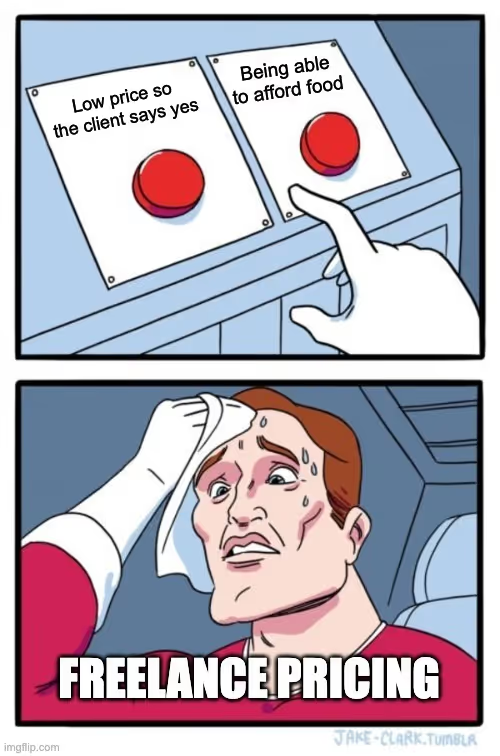
If you keep both the rate and the scope the same, you also need to be prepared for some clients to walk away. But that’s okay, too. Strong pushback can be a red flag that your relationship with this client is no longer sustainable. If a large share of clients leave at once, it may be a sign the increase was too steep for your current situation. If that happens to you, you can either try to reassess your new prices, or focus on finding clients who are a better fit for the new rate.
Some clients did push back. I handled it by offering structured choices: keep the old rate for a few months with a longer commitment, keep the budget but cut scope, or move to the new rate with full scope. If none of those fit, I was ready to wrap up cleanly and leave the door open. A few left, but the ones who stayed were the right fit.
{{Josiah Roche}}
Step 6. Strengthen the relationship after the change
If you’re at Step 6, that means you and your client survived all the difficult conversations about your rates changing. You can actually move forward and improve after this.
Reinforce the value you provide
Once the new rate is in place, the best way to maintain trust is to do exactly what you’ve already been doing well. Focus on the work, deliver consistently, and keep communication clear. Here, you can also be more explicit about results, like sharing progress updates, to make sure your client sees the impact of your work over time. Basically, once your client understands the value they get from you, the rate change awkwardness should dissipate into the background.
Keep communication open
After a rate change, it helps to keep communication steady and predictable. If questions come up later, address them directly instead of avoiding the topic. Treat the new rate as the new normal, and focus conversations on the work itself rather than revisiting the decision.
Build consistency into future rate reviews
Hopefully this isn’t the last time you revise your rates! To make it less stressful over time, don’t treat it as a one-off, but rather establish a habit of reviewing your rates regularly, like once a year. This doesn’t mean increasing how much you charge every year, but rather checking whether your pricing still reflects the work you’re doing, the demand for it, and how you want to structure your work.
Some final thoughts
Before doing anything, make sure this decision makes sense for you and your freelance journey. Then, prepare your message: be direct, clear, and informative. Try to understand your clients’ potential concerns and handle pushback with grace. I hope that the next time you decide to increase how much you charge, the process is hassle-free!
FAQ
.avif)


I’m a bilingual writer and content strategist working across SaaS and digital media. I cover topics like marketing, tech, and the occasional niche curiosity.
Learn moreI'm a fractional CMO and marketing strategist at Silver Atlas, focused on helping founders turn random acts of marketing into repeatable revenue. I live in Australia and work with clients globally.
We are here to ease your working routine
Whether you're freelancing or a full-time contractor, we simplify the working process, putting you in control.
Try it free

Gusto and Deel both help companies manage payroll and HR, but they serve different business needs. Gusto is a better fit for US-based small and midsize businesses that need simple payroll, tax filing, benefits, onboarding, and basic HR tools. Deel is better for companies hiring internationally, managing global contractors, or using Employer of Record services. This comparison breaks down their key differences in payroll, compliance, pricing, integrations, benefits, contractor management, pros and cons, and best use cases to help businesses choose the right platform in 2026.

Compare the best Deel alternatives for global hiring, payroll, EOR, and contractor payments. See pricing, coverage, pros, cons, and best use cases.
Running payroll for one employee still means tax calculations, filings, forms, and deadlines — so the cheapest option isn't always the best value. This guide compares affordable payroll services for a one-person business, breaking down real monthly costs, what's included, and which choice fits how you actually pay your worker.
