
How to Send Money to Brazil in 2026: The Best Methods
Explore the best online transfer services to send money to Brazil. Compare rates, fees, and delivery speeds.
May 26, 2026
You may need to send money to Brazil for various reasons: to support yourself or your family abroad, pay for services, or manage business operations. And it’s not always easy. In this guide, we’ll break down the best ways to send money to Brazil safely and efficiently.
Money transfer regulations in Brazil
Brazil has historically been a country of extreme international money transfer regulations. Until 2022, forex operations, for instance, were considered a crime. A new Foreign Exchange and Foreign Capital Law No.14,286 reduces bureaucracy and makes international transactions easier for both individuals and businesses. It's especially important in the context of the rise of digital careers. However, there are still some key factors to consider:
- The use of Brazilian currency (BRL) is mandatory in the country. The new law allows for exceptions where payments in foreign currency are allowed, such as in foreign trade transactions, transactions with a counterparty abroad, and foreign exchange contracts, as well as indirect exports.
- Only licensed entities authorized by the Central Bank of Brazil are allowed to operate in the foreign exchange market. Until 2022, only banks had full authorization. However, the new law allows non-bank entities such as fintech companies and digital platforms to operate in the country as well.
- Transfers exceeding $10,000 may require additional documentation, such as source of funds, government-issued ID, payment purpose, tax return, or proof of address.
- Opening a foreign currency account in Brazil is a challenge. The Central Bank of Brazil decides who can apply for this type of account, it’s only available for certain segments such as agents authorized to deal in foreign currencies, international credit card companies and insurance companies.
Also, the Brazilian real is a volatile currency compared to Western currencies and the exchange rates can vary a lot from week to week. It’s good to compare and check the rates before sending money to Brazil, especially if it’s not urgent.
Let's see which methods are now available for sending money to Brazil.
International wire transfers

Bank wire transfer allows you to send money directly from your bank account to a bank account in Brazil. It is the most secure and familiar method, but it may also be one of the slowest. It can take up to 5 business days for a SWIFT transaction to be processed (not so swift, when you think about it). Direct bank transfer is also one of the most expensive solutions, as banks typically charge fees for each transaction. The fee may vary depending on the bank and is typically between $20 and $50 in the US. Some banks add a percentage, often around 2-4%, to the transfer amount instead of charging a fixed fee. Let's say you need to send $100 from the USA to Brazil. In this case, the recipient will receive $100-4%=$96. This is great for small transfers, but if you send a larger amount, like $3,000, the recipient will only get $2,880. In that case, it is more beneficial to use a bank that has a fixed transfer fee.
To send a bank transfer to Brazil you need to provide your bank with the recipient’s information: full name, bank name and branch, account number, bank code, BIC or SWIFT code, CPF number (Brazilian tax ID), contact number and the purpose of the transfer. Transfers without a valid CPF will be cancelled, as this is a legal requirement for all financial transactions according to the country’s tax authority. So it’s best to verify ID on the Receita Federal official website before sending money.
Money sent to a Brazilian bank will be automatically converted to BRL unless the recipient has a foreign currency account.

Pros
- Secure and reliable
- Familiar to most people
- Suitable for large transfers
- Officially regulated
Cons
- High fees and commissions
- Slow processing
- Complex requirements
- Unfavourable exchange rates
When working with my clients, I need to provide a lot of information for them to make bank transfers to me. This includes my ID, address, contact number, my bank’s address, and a specific code for international money transfers. A tax ID is only required for exchanges over 10,000 USD. Right now the exchange rate is about 5.66 reals to 1 dollar. It hasn’t been lower than 5 for quite some time, so I usually round down to that figure to avoid any surprises.
{{Paula Ambrosio}}
How to Send Money via Bank Wire (SWIFT)
Best for: large transfers ($50,000+), maximum security, formal records.
What's unique: Real mid-market exchange rate with all fees shown upfront — no hidden markup. Integrates directly with Pix.
The catch: Built-in 5% exchange-rate guardrail — if BRL moves more than 5% during processing, your transfer is delayed or cancelled. Personal-to-personal limit is R$250,000.
Use when: You want the cheapest transparent option for personal transfers under $50K.
- Gather the recipient's details:
- Full legal name
- Bank name and branch
- Account number
- Bank code (código do banco)
- BIC / SWIFT code
- CPF number
- Contact phone number
- Purpose of the transfer (required by Brazilian regulations)
- Verify the recipient's CPF on the Receita Federal website — transfers with an invalid CPF will be cancelled.
- Log into your online banking or visit a branch, and choose "international wire transfer."
- Enter the recipient information exactly as provided. Typos in the SWIFT code or CPF will cause rejection.
- Choose the currency — funds will auto-convert to BRL unless the recipient has a foreign-currency account.
- Review the fees: typically $20–$50 fixed, or 2–4% of the transfer amount. Confirm the exchange rate.
- Submit. Processing takes up to 5 business days via SWIFT.
Tip: For amounts above $10,000 USD, you may also need to provide your own tax ID.
What's unique: The default for very large transfers — fully regulated, paper trail, handled by your existing bank.
Use when: Sending $50K+, or your recipient prefers traditional banking.
Money transfer services
Online transfer services offer one of the easiest methods of sending money to Brazil. People choose them because they are faster, more convenient, usually have competitive exchange rates, and have lower fees compared to banks. You can send money directly from your smartphone to a recipient’s account and see exactly how much you’ll be charged for the transaction. Additionally, many transfer services allow you to receive money directly into Pix — an instant payment ecosystem in Brazil used by 80% of the country's population.

With Pix you can send money through your phone and it doesn’t have any fees for individuals. The money transfers instantly and can be used with any bank in Brazil and I believe it’s possible to use Pix with a Wise account as well.
{{Paula Ambrosio}}
Pix Explained: Brazil's Instant Payment System
Best for: speed — funds arrive in real time once they hit the Brazilian banking system.
Pix is the reason sending money to Brazil has become dramatically faster and cheaper in the past few years. If you're going to send more than once, it's worth understanding how it works.
What it is
Pix is Brazil's domestic instant-payment system, launched by Banco Central do Brasil in November 2020. It runs 24/7/365 — no business hours, weekends, or holidays — and settles in seconds. There are no fees for individuals.
By 2026 it had become the most-used payment method in the country, with 93% of Brazil's adult population using it and 180 million Brazilians active on the system, processing 224M+ daily transactions. It works as a single shared rail across every Brazilian bank and fintech.
Why it matters for international transfers
Pix is the rail behind most modern transfer providers' "instant to Brazil" feature. The flow looks like this:
- You send USD/EUR through a provider's app (Wise, Remitly, Paysend, Western Union, etc.).
- The provider converts your money to BRL.
- The provider pays out via Pix to your recipient's bank.
- Funds arrive in seconds.
This bypasses the SWIFT system entirely, which is why transfers that used to take 3–5 days now arrive in minutes. Pix is not currently able to enable instant cross-border transfers through its infrastructure directly, so you still need a fintech intermediary — but providers like Wise, Paysend, and Remitly have made the integration effectively seamless.
How Pix keys work
Instead of sharing an account number and branch code, Brazilians use a Pix key to receive money. Each person can register multiple keys, all linked to a single bank account:
- CPF / CNPJ — taxpayer ID (individual or business)
- Email address
- Mobile phone number
- Chave aleatória — a random UUID generated by the bank's app, useful for keeping personal info private
- QR code — static (reusable) or dynamic (one-time, with the amount baked in)
When sending an international transfer with Pix payout, you typically need only the recipient's Pix key and full legal name.
Pros
- Fast transfers (usually within minutes)
- Low and transparent fees and commissions
- Competitive exchange rates
- Ability to send money directly to a Pix account
- User-friendly interface and mobile app
Cons
- Not as secure and reliable as bank transfers
- Limits on the amount of money transfers
Below is a list of some of the most popular and reliable services that you can use to send money to Brazil.
How to Send Money via Pix
- Ask the recipient for their Pix key. It can be:
- Their CPF number
- An email address
- A phone number
- A random "chave aleatória"
- Choose a Pix-integrated provider and create or log into your account.
- Select Brazil as the destination and Pix as the delivery method.
- Enter the amount — review the exchange rate and total fees.
- Enter the recipient's Pix key and full legal name. Double-check the key — incorrect entries are the most common reason Pix transfers fail or get returned.
- Choose your payment method (bank debit is usually cheapest) and confirm.
- Done. The recipient receives a notification when funds arrive. Most Pix transfers land within minutes, though some banks take up to 3 business days to release funds.
Wise
The catch: Built-in 5% exchange-rate guardrail — if BRL moves more than 5% during processing, your transfer is delayed or cancelled. Personal-to-personal limit is R$250,000.
Use when: You want the cheapest transparent option for personal transfers under $50K.
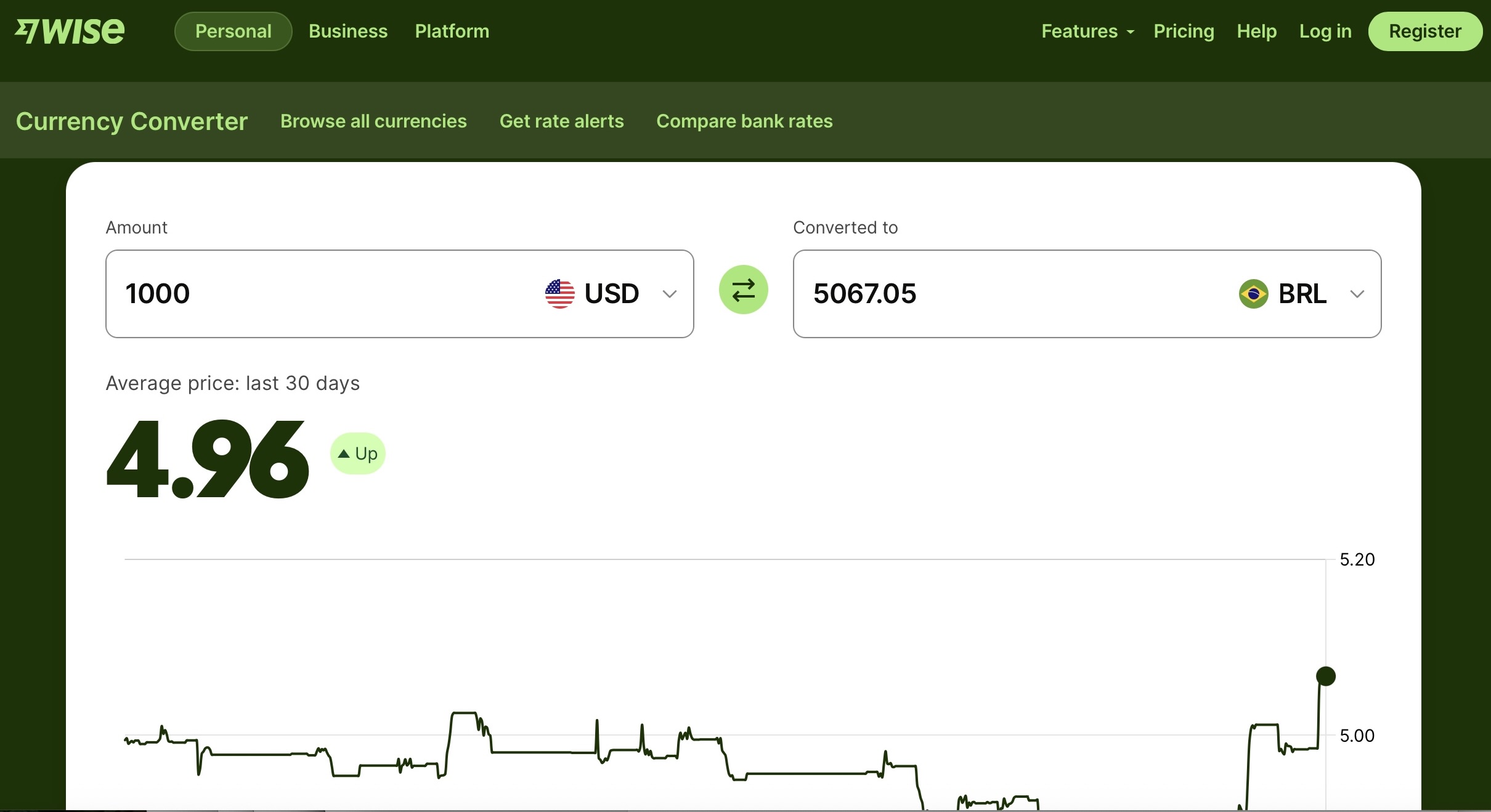
When it comes to transferring money to Brazil, Wise is one of the most trusted online payment platforms, often recommended on forums like Reddit. You can send money directly to the recipient's Wise or local bank account. The platform integrates with Pix and can be used as both a payment and receiving option. There is a limit to the amount you can transfer with Wise. Personal accounts can send a maximum of R$250,000 to other personal accounts and up to $10,000 to business accounts. Business accounts can transfer a maximum of $3,000 to personal accounts and also up to $10,000 to other business accounts. There is a calculator on their website that you can use to estimate the fees. They depend on the payment method. The cheapest option is to use a Wise account to send money, as this will only cost you $0.96 for a transaction of $100, plus an IOF tax of $0.37. The final amount would be $98,67.

If the exchange rate changes by more than 5% during the time the transfer is being processed, it may be either delayed or cancelled. The platform also recommends monitoring the exchange rate to find a more favorable option and offers a daily email subscription to help you keep track and choose the best one.
How to Send Money via Wise
Best for: low fees, transparent mid-market exchange rate, Pix payouts.
- Create an account at wise.com or download the app, and verify your identity.
- Click "Send money" and choose Brazil as the destination, BRL as the recipient currency.
- Enter the amount — Wise shows the exact fee, exchange rate, and final BRL amount upfront.
- Add recipient details:
- Full name (must match their bank record)
- CPF number
- Bank account details or Pix key (CPF, email, phone, or random key)
- Choose how to pay — the cheapest option is a Wise balance transfer (~$0.96 fee on a $100 transfer, plus IOF tax). Bank debit is also low-cost; credit cards are the most expensive.
- Review and confirm. Wise locks in the exchange rate; if it shifts by more than 5% during processing, the transfer may be delayed or cancelled.
- Track the transfer in the app. Most arrive instantly, some within 1–2 days.
Limits: Personal accounts can send up to R$250,000 to other personal accounts; up to $10,000 to business accounts.
PayPal
PayPal remains one of the top choices when it comes to transferring money, and for good reason. It’s fast, easy to use, and operates in more than 200 countries, including Brazil. It can be used for both personal and business purposes. To receive money, the recipient needs to have a registered and verified PayPal account in Brazil. The account must be linked to a Brazilian address and CPF number. An email address is also required due to privacy laws. If you send more than $3,000 to the same person each month, they will need to complete an Autorização de Recebimento (Receipt Authorization) form and email it to PayPal’s customer support team. PayPal transfers are usually instant, but in some cases, it may take up to 5 business days for the money to be transferred. Paula says that PayPal transactions usually take about 1-2 business days to process.
PayPal offers free domestic transfers when you use the service's balance or a linked bank account. However, there is a fee for debit or credit card transfers of 2.9% plus a fixed fee depending on the sent currency. PayPal also charges fees for currency conversion. It's best to check the current exchange rate before transferring funds to avoid unexpected charges.

I use Paypal a lot because it's well-known and gives my clients a sense of security. I find it very easy to use. But if you need to transfer larger amounts, I recommend considering a bank transfer, as it may require additional documentation. PayPal has high fees, and I always factor this into my pricing. While there may be other platforms with better exchange rates, I continue to use PayPal to build trust with my clients and to protect myself. There are many scams out there, especially since the introduction of cryptocurrency, so I am very cautious about trying new platforms.
{{Paula Ambrosio}}
How to Send Money via PayPal
Best for: convenience and trust, especially for freelance/client payments.
- Log into PayPal. Both you and the recipient need verified accounts.
- Confirm the recipient's account is set up for Brazil — it must be linked to a Brazilian address, CPF number, and email.
- Click "Send" and enter the recipient's email address.
- Enter the amount in your local currency. PayPal shows the BRL conversion.
- Choose your funding source:
- PayPal balance or linked bank — lowest cost
- Debit/credit card — 2.9% + a fixed fee
- Review the exchange rate. PayPal adds a currency-conversion markup, so check it before confirming.
- Confirm and send. Most transfers arrive in 1–2 business days, occasionally up to 5.
Western Union
What's unique: Cash pickup at thousands of agent locations across Brazil — useful when the recipient has no bank account.
The catch: Outside the new-customer promo, exchange rates are average at best. Cash pickup costs more than the $1.99 bank-deposit option.
Use when: Your recipient needs to collect cash in person.
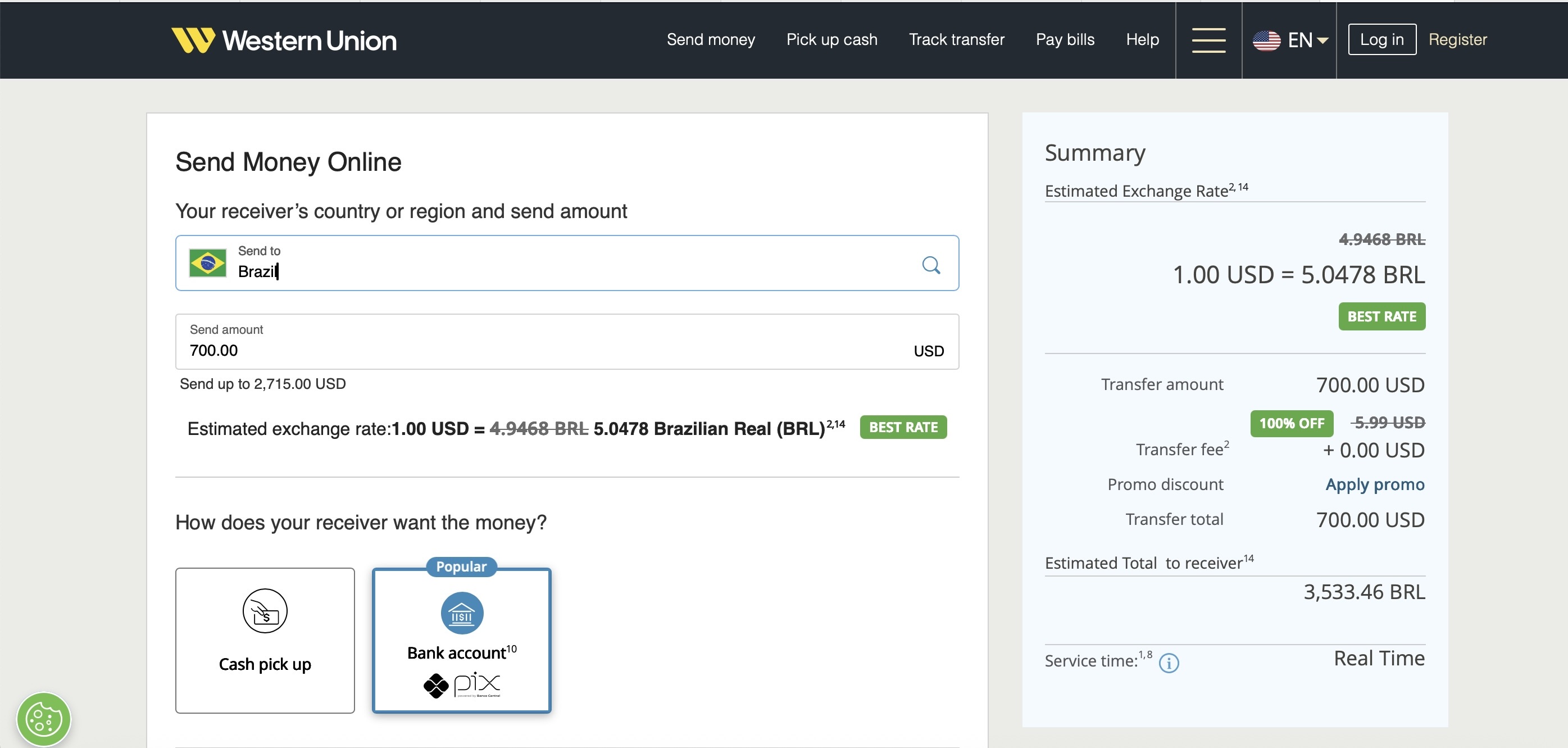
Western Union is a well-established provider that has been operating for 150 years worldwide and is chosen by many Brazilians for its reliability and familiarity. You can send money to the recipient’s bank account, Pix, or a cash pickup point. For safety reasons, Western Union provides a unique tracking number (MTCN) so that you can be assured of the status of your transfer at every step of the process. International transfers are processed within one to five business days. Western Union makes money from currency exchange. There is a new customer offer that provides good exchange rates. However, the overall rates may be close to the market rate or even lower.
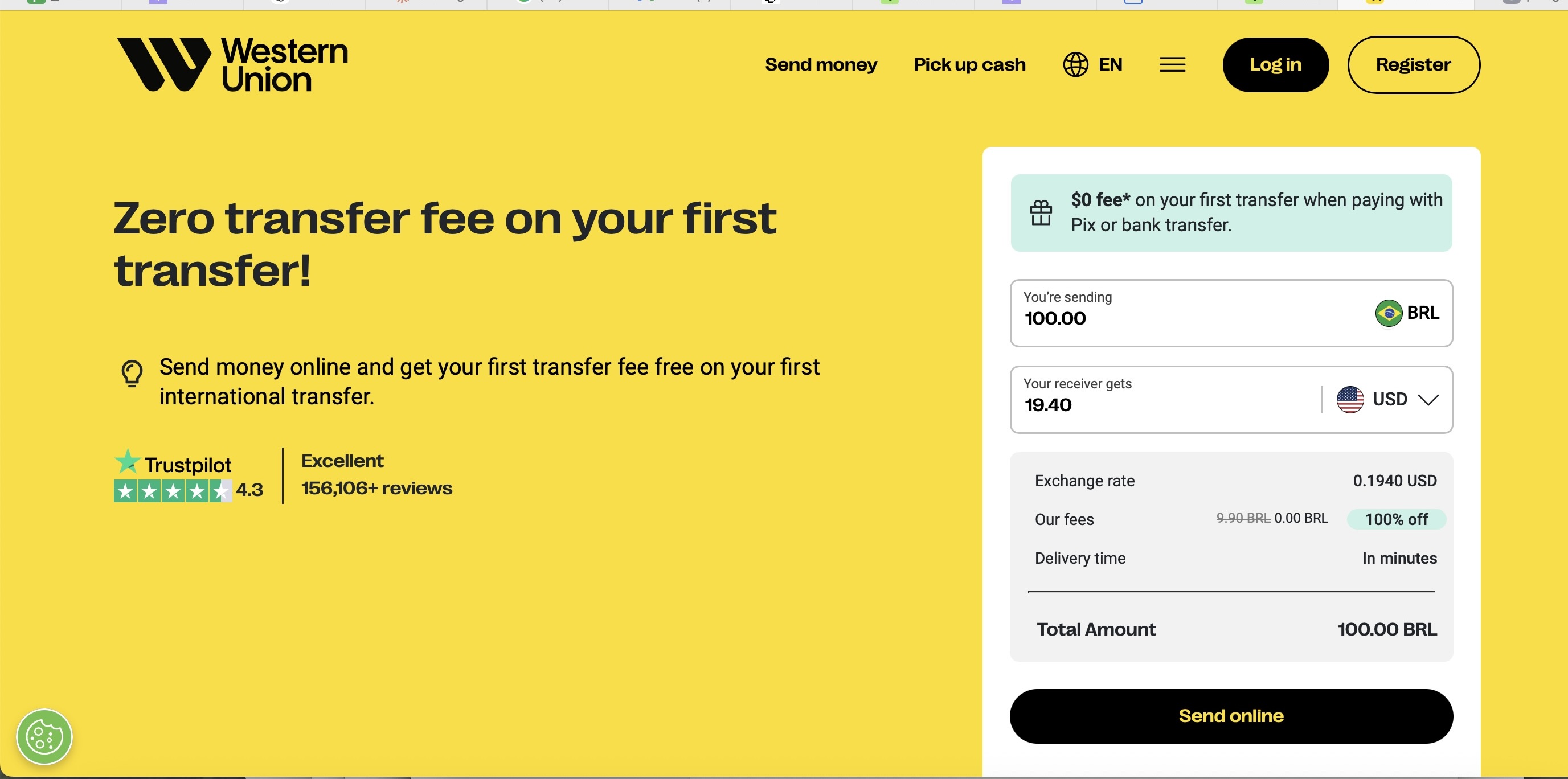
The service charges fees for each transaction, which vary depending on the brand, channel, and location. There is a calculator on their website that you can use to estimate the fees. The cheapest option to send money to Brazil is through a bank account transfer, as it only costs $1.99.
Payoneer
What's unique: Built for freelancers — connects directly to Upwork, Fiverr, 99designs, and 2,000+ marketplaces. Payoneer-to-Payoneer transfers are free.
The catch: $29.95 annual fee if you receive less than $2,000/year. Withdrawals to local bank accounts can cost up to 3%.
Use when: You're a freelancer regularly paid through online marketplaces.
Payoneer is a global payment platform that is often seen as a first alternative to PayPal. It operates in more than 200 countries and territories, including Brazil, and works with more than 2,000 marketplaces, including Upwork, Fiverr, and 99designs, helping those who choose freelance careers to safely withdraw their money. Payoneer has a user-friendly app and a wide range of currency options, and its exchange rates are some of the lowest in the market — only 2%. Most transfers are instant, although some may take up to two business days. The fees depend on the payment method. It's free to transfer money directly from one Payoneer account to another. However, if you're using a credit card, there may be a fee of up to 3.99% plus a fixed fee of $0.49 for some currencies. For example, if you’re sending $100 to Brazil, the recipient will get $96,01. Payoneer may also charge up to 3% for withdrawals, depending on whether the currency being withdrawn is local or not. There is a minimum and maximum amount that can be transferred for each currency. For Brazil, the minimum amount is 82.62 BRL and the maximum amount is 52,391 BRL.
It's worth noting that Payoneer has an annual account fee, which sets it apart from many other payment methods. If you receive less than $2,000 per year, you will need to pay a flat fee of $29.95 to use the service.
Remitly
What's unique: Two-speed pricing lets you trade cost for speed. Strong new-customer promo (recently R$5.8 per $1 with a $0.40 fee). Free Pix transfers for repeat customers.
The catch: Economy is cheap but takes up to 5 days; Express is instant but uses a worse exchange rate. You can't get both.
Use when: First-time senders (lock in the promo) or zero-fee Pix transfers.
Remitly is another safe, efficient, and user-friendly option to send money to Brazil. You can send money directly to Pix or to one of the many Brazilian banks' accounts supported. The transfer speed depends on the destination and the type of service you choose. There are two options: Economy and Express. With Economy service transfer, you can convert money with lower rates, but the transfer may take up to 5 business days. With Express service, funds are transferred immediately, but the exchange rate is less favorable.
Remitly offers promotional rates and fees to new customers. If you're sending money to Brazil for the first time, Remitly will only charge $0.40 in fees for tax purposes and offer a favorable exchange rate of R$5.8 per $1. Please note that the promotional exchange rate is subject to change depending on the time. This rate was valid on 05.06.2025.
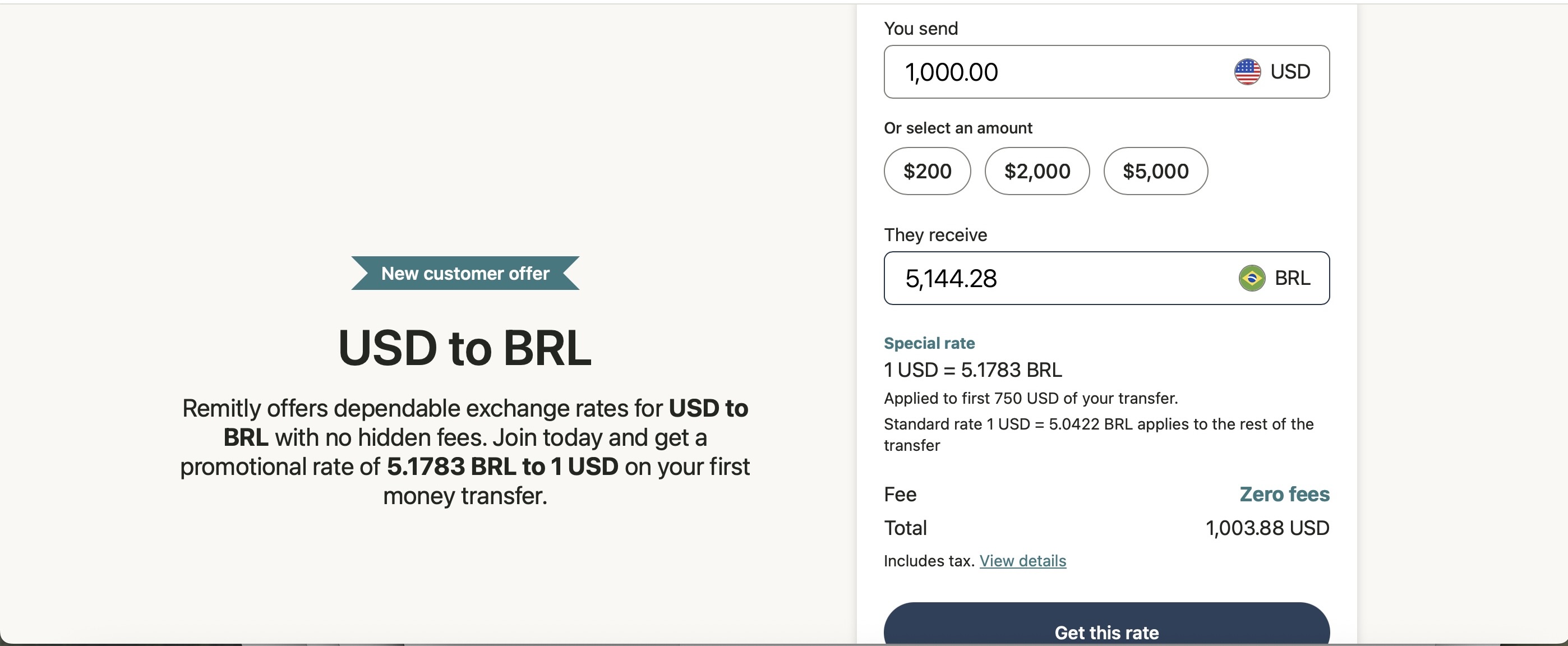
If this is not your first time using the service to send money, Remitly will charge $0 for a Pix transfer and $3.99 for a bank transfer.
Cryptocurrency transfers
What's unique: Lowest fees of any method and settles in minutes to hours. Stablecoins avoid BTC/ETH volatility.
The catch: Scam risk is real — roughly 29% of Brazilians view crypto as gambling. Both parties need exchange accounts, KYC, and a way to off-ramp to BRL.
Use when: Both sender and recipient are crypto-comfortable and want the cheapest non-bank option.
Cryptocurrency is a legal option to send money to Brazil. The market is growing and, according to projections, is expected to generate revenue of $2.8 billion in 2025. Crypto transfers are cheaper than traditional ones and usually take no more than a couple of hours. The most popular cryptocurrency exchange platforms are Binance and Coinbase. Both of them operate in Brazil. Stablecoins, such as USDT, typically have the lowest transaction fees, making them the most attractive option for transferring funds.
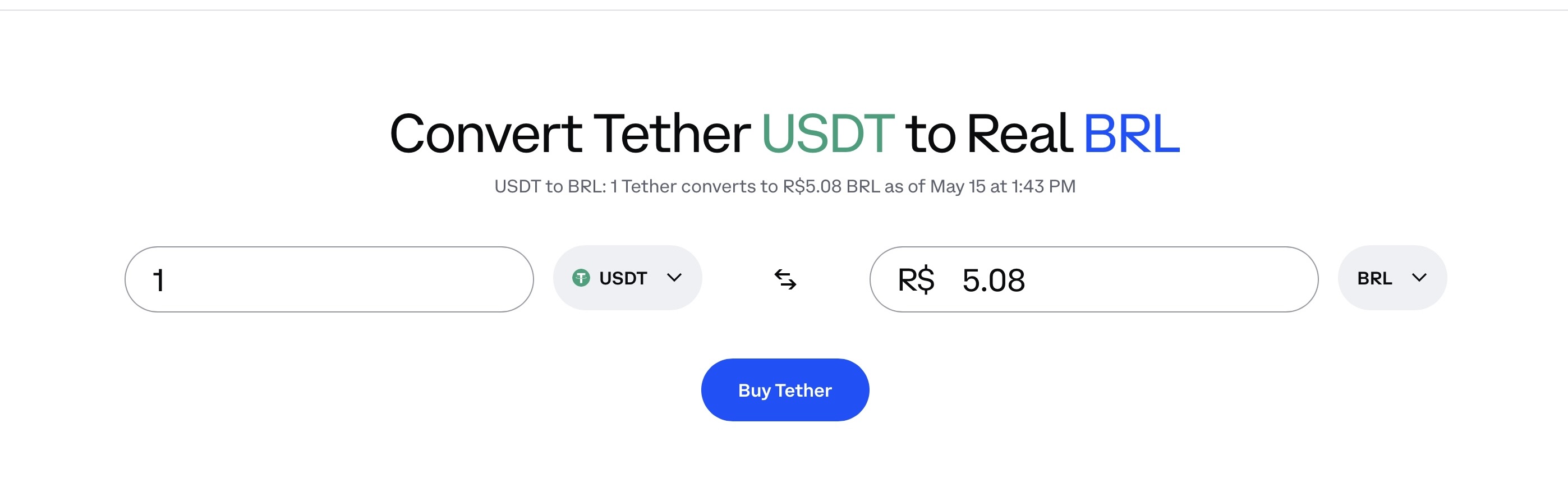
While it's a quick and low-cost option, it's not the safest one. Around 29% of Brazilians see their investment in cryptocurrencies as similar to betting. Paula says that she usually runs away when she hears the word "crypto" and rejects anything related to it, as there are a lot of scams and a general lack of trust in this payment option.
Here's a comparison chart of all the methods we discussed above for your reference.
Tips for sending money to Brazil
To send money to Brazil in 2025, you can use online services that integrate with Pix. These services offer fast transfers, low fees, and are suitable for most transfer amounts. Bank wire transfers are only recommended for larger amounts due to their high cost. While PayPal is convenient, it can also be expensive. Wise and Remitly offer the best balance between speed and fees. If you choose to use cryptocurrency, be aware of new regulations and the associated risks. Always verify your recipient's CPF and compare exchange rates before sending money.
Common Mistakes to Avoid
A few errors come up over and over and can cost you fees, time, or the full transfer amount. Watch for these before you hit send.
1. CPF mismatches
The CPF must match the recipient's full legal name exactly as registered with Receita Federal. Common failure points:
- A single transposed or missing digit — the system rejects the transfer outright.
- The CPF is valid but in irregular status (suspended, pending, or cancelled). Always verify under Situação Cadastral before sending.
- The name format doesn't match — abbreviations, missing surnames, or accents typed incorrectly can trigger rejection.
Fix: Ask your recipient to send you a screenshot of their CPF status page from the Receita Federal site so you know it's REGULAR and the name format is correct.
2. Hidden FX fees
The advertised fee is almost never the full cost. Providers commonly hide their margin in the exchange rate.
- "Zero-fee" services often have the worst exchange rates — you can pay more here than on a service with a visible $5 fee.
- PayPal's currency-conversion markup is one of the steepest in the industry.
- Banks often quote a "tourist" exchange rate that's 2–4% worse than the mid-market rate.
Fix: Before confirming any transfer, check the rate against the mid-market rate on xe.com or the Central Bank of Brazilwebsite. The difference is your real cost.
3. Wrong bank details
A typo in any of these will either reject the transfer or send the money to the wrong person:
- SWIFT/BIC code — must be exactly 8 or 11 characters; Brazilian banks have specific codes (e.g. BCBRBRSP for Banco do Brasil).
- Agência (branch code) and account number — usually entered as separate fields; mixing them up is common.
- Pix key — if you enter the wrong key, the money goes to whoever owns that key. Pix transfers are difficult to reverse.
- Account type — corrente (checking) vs poupança (savings). Brazilian banks treat these as separate accounts.
Fix: Have the recipient send the full details in writing (screenshot or PDF) and copy-paste rather than retype.
4. Scam risks
Common scams targeting international transfers to Brazil:
- Fake Pix QR codes — a scammer sends a QR code that looks like a legitimate payment request but points to their own account.
- Crypto "investment" scams — irreversible, often promoted via WhatsApp or Telegram groups. If a deal sounds too good, walk away.
- Phishing emails impersonating Wise, PayPal, or your bank, asking you to "confirm" a transfer through a fake link.
- Overpayment scams — a "client" sends you more than agreed and asks you to refund the difference; the original payment then reverses.
- Romance/family-emergency scams — urgent requests for money from someone you've only met online or who claims to be a stranded relative.
Fix: Never click payment links from emails — log into the app directly. Verify any new recipient through a second channel (a video call, a known phone number). Be especially cautious with crypto, since transfers are irreversible.
FAQ
1. Does Zelle work in Brazil?
No. Zelle is a US-only service — both the sender and recipient must have a US bank account and a US-registered phone number. There are currently no plans for Zelle to expand to Brazil. To send money to Brazil, you'll need to use an international transfer provider such as Wise, Remitly, Western Union, MoneyGram, or PayPal.
2. How long do transfers take?
Anywhere from a few seconds to 5 business days, depending on the provider:
- Fastest (minutes to a few hours): Wise, Remitly Express, and Pix-integrated services.
- Standard (1–2 business days): PayPal and most debit-card transfers.
3. What is the cheapest way to send money to Brazil?
It depends on the amount:
- Under $10,000 USD — Remitly is usually cheapest, especially with new-customer promos.
- $10,000 – $50,000 — Wise typically offers the best rates and transparent fees.
- Above $50,000 — Specialist FX brokers (e.g. Currency Solutions, OFX) beat both.
- Cash pickup — MoneyGram and Remitly are the cheapest options.
4. Do I need a CPF?
Your recipient does — you don't. The CPF is Brazil's 11-digit taxpayer ID, and a valid one is legally required to receive international transfers.
- Transfers without a valid CPF will be cancelled.
- The CPF must be in "REGULAR" status with Receita Federal; your recipient can verify this under Situação Cadastral on the Receita Federal website.
- For Pix payouts, the CPF can double as the recipient's Pix key.


I’m a passionate writer with a decade of experience in content marketing. I enjoy conducting research and transforming complex information into clear, engaging content. I am proficient in content management systems, SEO tools, and analytics platforms. I excel in data-driven decision-making to enhance content visibility and support strategic SEO plans.
Learn moreI'm an artist and illustrator based in Londrina, Brazil. I am a designer at 99designs who is passionate about making illustrations tell stories.
We are here to ease your working routine
Whether you're freelancing or a full-time contractor, we simplify the working process, putting you in control.
Try it free

Gusto and Deel both help companies manage payroll and HR, but they serve different business needs. Gusto is a better fit for US-based small and midsize businesses that need simple payroll, tax filing, benefits, onboarding, and basic HR tools. Deel is better for companies hiring internationally, managing global contractors, or using Employer of Record services. This comparison breaks down their key differences in payroll, compliance, pricing, integrations, benefits, contractor management, pros and cons, and best use cases to help businesses choose the right platform in 2026.
Compare the best Deel alternatives for global hiring, payroll, EOR, and contractor payments. See pricing, coverage, pros, cons, and best use cases.

Running payroll for one employee still means tax calculations, filings, forms, and deadlines — so the cheapest option isn't always the best value. This guide compares affordable payroll services for a one-person business, breaking down real monthly costs, what's included, and which choice fits how you actually pay your worker.
