
Global Freelancer Earnings in 2026: Detailed Breakdown and Influencing Factors
What you should know about freelancers’ hourly rates and what influences them.
May 26, 2026

Key Points
- Global averages vary widely depending on the source.Most freelancers earn between $25 and $75 per hour, while some reports (like freelancermap) show averages closer to $100+ per hour, reflecting higher-paid specialists.
- In the U.S., freelancers make about $99,000 per year, with most earning between $50,000 and $130,000.
- Freelancer rates vary based on several factors: location, skill level, industry, reviews and past work examples, education level, and more.
- What a freelance professional ends up earning also depends on taxes, platform commissions, and marketing spending.
- Intermediate freelancers can earn up to 5× more than beginners, while experts typically earn nearly 3× more than intermediate professional
- Industry-wise, freelancers earn the biggest amount of money working in banking or finance and offering strategy-related services.
- The higher the education level, the more freelancers tend to make.
When you’re just starting your freelance career or exploring the possibility of freelance work, setting your rate might be confusing. There’s no HR department or managers to dictate your salary, and your earnings depend only on you. To help you navigate freelancing income, we’ve compiled a list of average freelancer rates, broken down by country, industry, and more.
What is the average hourly rate for freelancers?
If you're looking for a quick answer, this section is for you.
Most freelancers earn $25–$75/hour globally, with top professionals charging $100+.In the U.S., annual income typically ranges from $50K to $130K.
Freelancers don’t have a fixed salary — and that’s exactly what makes their income so confusing, depending on the source. Based on freelancermap’s 2025 data, worldwide, freelancers work per hour for an average of €100 (approximately, $116). This could translate to over $200,000 per year in theory, but in practice most freelancers work fewer billable hours.
However, average earnings aren't always helpful. There are many factors influencing how much freelancers earn, from demand to years of experience and location. Keep reading to understand what applies to you.
What impacts freelancers’ rates?
Freelancers’ income depends on several different factors, each of which contributes to the rate:
- Location. Although most freelance professionals work remotely, their salary still depends on where they live. Generally, clients are likely to pay someone from the UK more than someone from Russia, for example.
- Skill level. Freelance earning potential depends on both years of experience and unique skills. Freelancers’ income will typically increase over time, with their expertise and client base growing. For example, AI and machine learning are in-demand skills, and someone who uses them can earn more.
- Industry. Freelancers in IT, as well as in highly regulated industries like legal or medical, can have a higher rate.
- Competition. Industry and unique qualifications affect not only demand but also competition. If there are many freelance jobs but not a lot of specialists, their rates can be higher.
- Reviews and past work examples. Positive reviews and a large portfolio serve as proof and help justify a higher rate.
- Education level. Formal education and a degree or specialized training can convince clients that a freelancer should be paid more.
Other factors that influence freelancer earnings
Rates are not everything when it comes to making money as a freelancer. If you want to calculate your income, you also have to consider these:
- Taxes. As a freelancer, you’ll need to calculate and pay taxes yourself. To make sure you’re still profiting from your freelance projects, account for these detractions.
- Marketing spending. If you invest in ads or any other paid promotion, consider these when you set your hourly rate.
- Freelancing platforms' fees. Freelancing services like Upwork or Fiverr may have commissions that they deduct from users’ earnings.
Average freelancer rates statistics breakdown
A freelance career isn’t a monolith, and even if you work on similar projects as someone else, your earnings can vary. Let’s take a look at the average freelance earnings based on the most important factors that influence income.
Freelancer hourly rates by country
Freelance work in different countries means different average salaries. First, take a look at this region-based chart from Payoneer’s data:
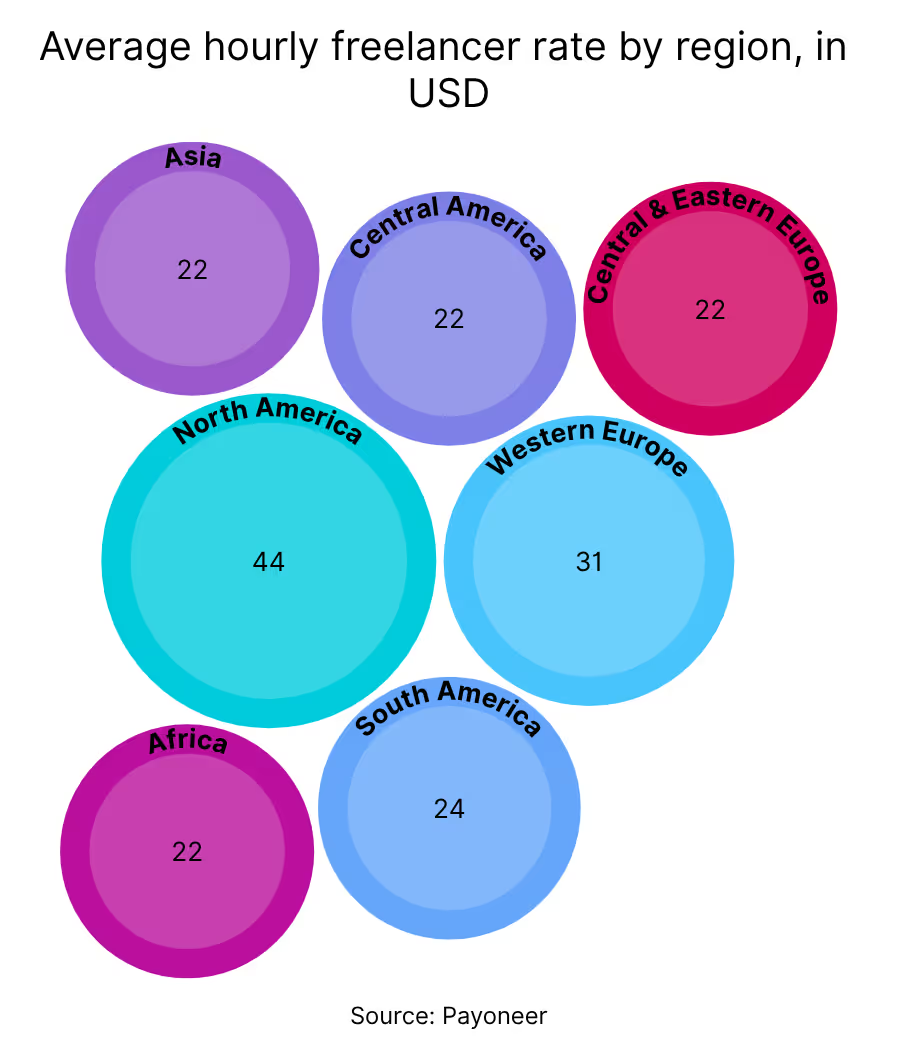
Now, let’s get into more detail. Based on data from ZipRecruiter, freelancermap, and The Data Freelancer, here’s what freelancers earn per hour in the top 10 popular freelancing countries:
Freelancer hourly rates by skill level
Just like in any other sphere, experience influences what freelancers earn. I studied data from Upwork and calculated the average increase in hourly rate across several industries.
On average, intermediate-level freelancing professionals earn from 1.5 to almost five times as much per hour as their beginner colleagues. The average increase in hourly rate is $34.10.
And expert-level freelancers earn 2.44 times as much as intermediate specialists, or an average of $65.40 more per hour.
Average hourly rates vary greatly, depending on the industry and specialization, though. So let’s look at an example. Priyanka is an intermediate accountant. She has a lot of experience, so depending on the complexity of a project, she charges between $36 and $60 per hour. If she works four full work days a week for 48 weeks, her annual freelancing income will be between $55,296 and $92,160.
In comparison, a beginner freelance accountant or bookkeeper typically charges $10 per hour. If they follow the same schedule as Priyanka, their annual income will be $15,360.
Key takeaways
- Growth path: $15 → $75 → $150+ per hour as you move from beginner to expert
- Annual income typically scales from $10K → $80K → $150K+ along the same path
- Experts often work fewer hours than beginners — income grows through focus, not effort
- The biggest jump usually happens between years 2 and 4, when positioning sharpens
Freelancer hourly rates by industry and services
Your earning potential as a freelancer also depends on the industry. Clients from different niches may pay for the same service differently. Here’s what the average hourly rate looks like, based on freelancermap’s data:
The area of expertise or services is another influencing factor. We used YunoJuno’s report to calculate the average hourly rate in USD for the top freelancing disciplines:
Based on this information, freelancers have the biggest earning potential working in banking or finance and offering strategy-related services.
Freelancer hourly rates by profession
What freelancers are earning also depends on their profession. It makes sense that a copywriter and a photographer earn different amounts of money. I chose 10 of the highest-paying freelance jobs to give you an idea of the average hourly rates across various specializations.
The average rates vary based on projects and clients, but you can use these as a reference.
Freelancer hourly rates by education
You may wonder whether education plays a role in freelancers' earning potential. Unsurprisingly, it does, although it’s not as significant as you might think.
Freelancermap’s data suggests that freelancers without a university degree make an average of €95 (or approximately $125) per hour, while those who have a degree can count on €99 ($130).
Payoneer’s report provides a helpful breakdown:
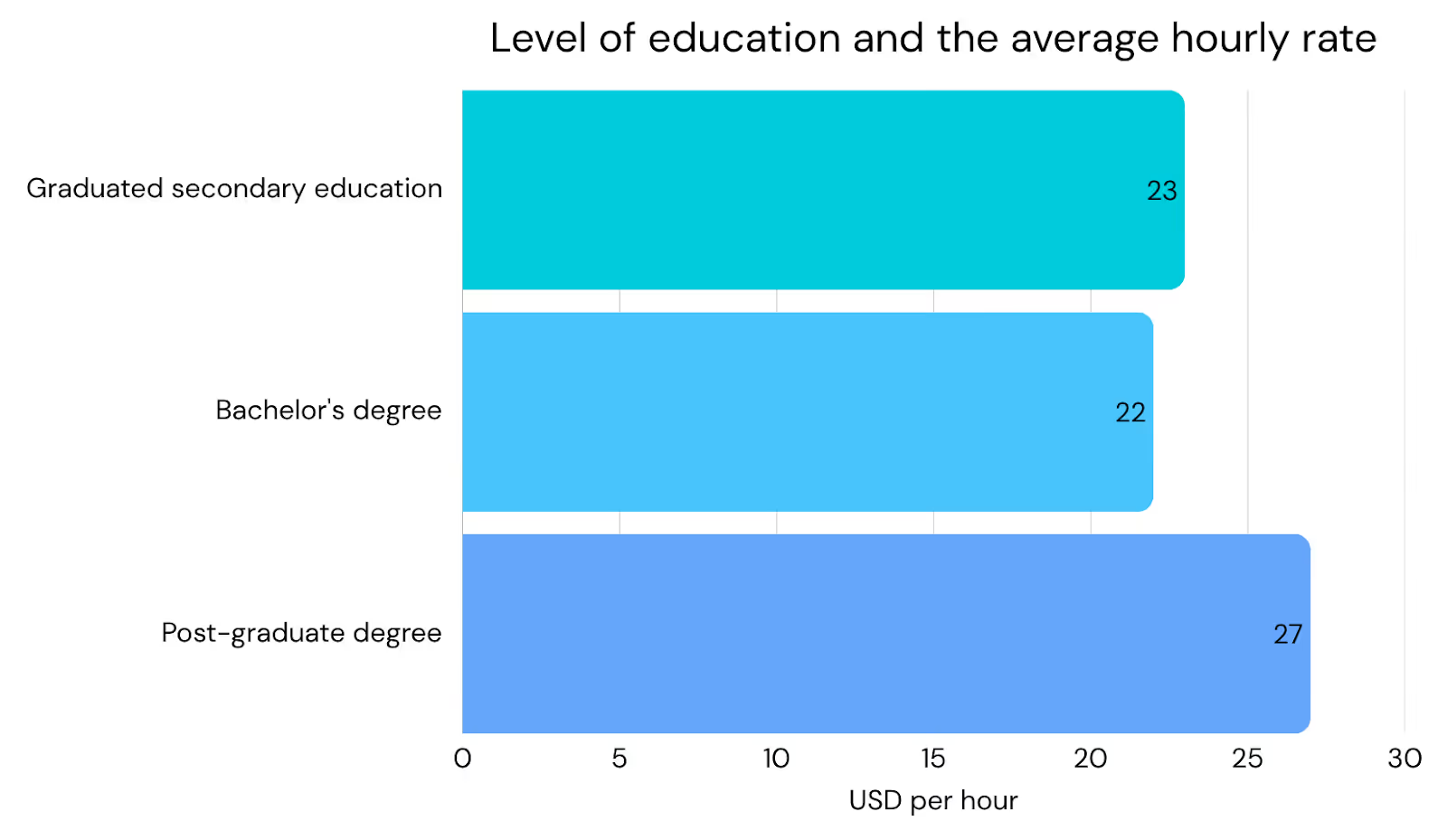
Although degree holders clearly earn more, freelancing experience has a bigger influence on the rates than education. So don’t be discouraged if you lack formal training — it doesn’t stop you from earning a living!
How freelancers actually charge: hourly, project, or retainer
Hourly rates are the most talked-about number in freelancing, but they're not the only way — or always the best way — to get paid. Most experienced freelancers use a mix of pricing models depending on the client and the type of work. Here's how the three main options compare.
1. Hourly pricing
You charge a set rate for every hour worked, then bill based on tracked time.
Best for:
- Open-ended work where the scope can shift (ongoing edits, consulting calls, troubleshooting)
- Clients who want flexibility to add or remove tasks
- Situations where you genuinely don't know how long something will take
Pros: Simple to quote. You always get paid for the time you put in. Easy to start with as a beginner.
Cons: Your income is capped by the hours in your day. Working faster actually pays you less. Clients sometimes push back on hours or ask for detailed breakdowns.
2. Project-based pricing (fixed fee)
You quote one price for the entire project, regardless of how long it takes you.
Best for:
- Clearly defined deliverables (a logo, a website, a 2,000-word article, a launch campaign)
- Work where you can predict the scope with reasonable confidence
- Clients who want budget certainty up front
Pros: You get paid for value, not time — so working faster increases your effective rate. Easier for clients to approve a single number. Rewards experience and efficiency.
Cons: Scope creep can wreck your margins if you don't define boundaries clearly. Underestimating the work means eating the cost yourself.
3. Retainer pricing
The client pays a recurring fee (usually monthly) for a set scope of ongoing work or a guaranteed amount of your time.
Best for:
- Long-term client relationships
- Ongoing services like content, SEO, social media, design support, or advisory work
- Freelancers who want predictable income
Pros: Stable monthly revenue. Less time spent chasing new projects. Deeper client relationships and better work because you actually understand the business.
Cons: Requires trust on both sides — usually you need to prove yourself first with a project. Can become "always-on" if boundaries aren't clear.
Freelancer vs. full-time salary: what the numbers really mean
A $60,000 freelance year and a $60,000 salaried year are not the same thing. On paper they look identical — in practice, they're often thousands of dollars apart in either direction.
This section breaks down what actually changes when you compare the two, and why a lot of freelancers are surprised by the math when they finally run the numbers.
What a salary quietly includes
When you're employed, a chunk of your real compensation is invisible. Your employer covers a long list of things you only notice once you have to pay for them yourself:
- Health insurance (often partially or fully subsidized)
- Paid vacation, sick days, and holidays
- Retirement contributions or pension matches
- Half of your payroll taxes (in most countries)
- Equipment, software, and workspace
- Training, courses, conferences
- Bonuses, stock, or profit sharing
Depending on the country and role, these benefits can add 20–40% on top of the listed salary. A "$60,000 job" often costs the employer closer to $75,000–$85,000 — and that gap is essentially what disappears when you go freelance.
What freelancers have to cover themselves
The same line items don't go away just because you're independent — they shift onto you:
- Health insurance and any other benefits you want
- Time off (every unworked day is unpaid)
- Self-employment taxes (often nearly double what an employee pays)
- Equipment, software subscriptions, internet, workspace
- Accountant, legal help, contracts
- Marketing, portfolio site, platform fees
- Slow months, gaps between contracts, late-paying clients
A useful rule of thumb: freelancers need to earn roughly 25–40% more than a salary to end up with the same take-home and benefits.
How to increase your freelancer's hourly rate?
Want to raise your rates? Follow these tips:
- Work on your profile and personal branding. Position yourself as an expert and clearly show your unique value proposition (UVP). For example, if you’re a social media marketer, your specialization could be storytelling in Reels or sourcing user-generated content.
- Get industry certifications. Find training and courses that can boost your expertise. Add them to your list of qualifications to show that your price is justified. Pay attention to popular services and their courses.
- Expand your services and gain a wider expertise. Seek out and complete projects that you hadn’t previously worked on. This will allow you to diversify and position yourself as a skilled professional.
If you’re looking for more tips, check out this helpful video:
What most freelancers actually earn in their first year
The honest answer: less than you'd hope, and that's normal.
Most beginners earn somewhere between $10,000 and $30,000 in their first year of freelancing, often while working part-time or alongside another job. Hourly rates typically sit in the $15–$35 range. Some months bring in solid income; others bring in almost nothing. That inconsistency is one of the hardest parts of year one, and almost no one talks about it openly.
Why the first year looks the way it does
A few realities shape early earnings, and none of them mean you're doing something wrong:
- You don't have a portfolio yet. Lower rates are how you trade money for proof. Every testimonial, case study, and "before/after" you collect now becomes leverage later.
- You're still figuring out your offer. Beginners often take on anything that pays. Specialization — and the higher rates that come with it — usually emerges after you've tried a few directions and noticed what you're actually good at.
- A lot of your time is unpaid. Writing proposals, posting on LinkedIn, refining your portfolio, learning new tools, dealing with admin — none of that bills, but all of it is part of the job.
- Client flow is unpredictable. You might land three projects in a week and then go a month with nothing. Pipelines take time to build.
- You're learning how to run a business. Pricing, contracts, scoping, taxes, follow-ups — these aren't taught anywhere, and getting them wrong costs money.
What "good progress" actually looks like in year one
Income is a lagging indicator. Most of the real progress in your first year shows up in ways that don't appear on a tax return:
- You stop underquoting and start charging what the work is worth
- You can scope a project without panicking
- You have 2–3 testimonials or finished pieces you're genuinely proud of
- You've found one or two clients who want to work with you again
- You know which types of projects to say no to
If you have those by month twelve, you're set up well — even if the income still looks modest.
A realistic year-one trajectory
For a lot of freelancers, the first 12 months look something like this:
- Months 1–3: First small projects, often through your existing network. Rates are low. You're mostly learning how clients communicate and what "done" looks like.
- Months 4–6: You land a few paid gigs from cold outreach or a platform. You start figuring out which work you actually enjoy.
- Months 7–9: Your first repeat client or referral shows up. You quietly raise your rates for new clients.
- Months 10–12: Income starts to stabilize — not big yet, but more predictable. You have a clearer sense of who you want to work with going forward.
The freelancers who break through to mid-level income in year two are usually the ones who treated year one as tuition, not failure.
Our general recommendation is to follow these three steps:
- Start by reflecting on your needs. How much money do you need to support your lifestyle? What’s your salary goal? How many hours can you work?
- Check the industry averages for your services. As we’ve established, this depends on your niche, location, experience, and more. Evaluate your rates against these numbers, considering your expertise and the demand for your services.
- Next, set up your desired annual income, accounting for taxes and expenses like insurance and freelancing tools. Make sure to also cover vacation and sick days.
If you need an hourly rate, use our freelance hourly rate calculator.
Starting out slowly might be a good idea; however, you always need to have security in case of emergencies. Freelance virtual assistant Kharla Denura’s experience proves this point well:
The biggest factor that impacts freelancer rates is the level of value and consistency you bring to your clients. When I started in 2022, I accepted lower-paying projects just to gain experience and build a portfolio. As I grew more confident in bookkeeping, accounting, and backlink building, I realized that skill improvement and client trust have more influence on rates than formal education alone. After my year-long health break in 2024 due to a serious medical condition, I reassessed how I priced my services and shifted from hourly to value-based packages. This allowed me to cover expenses, save for taxes, and account for unpaid time spent on client acquisition or reporting. My advice is to start with rates that sustain your needs, then gradually increase them as your expertise deepens and results speak for themselves. Clients respect fair pricing when they see professionalism, reliability, and measurable impact.
{{Kharla Denura}}
Conclusion
The average amount freelancers make depends on many factors, like country, skill level and education, industry, services, and profession. Knowing what others charge for similar projects can help you stay competitive and establish yourself as a viable pick.
FAQ



I’m an editor and copywriter working with SaaS and e-commerce companies to create engaging and effective content. With a background in journalism and creative writing, I value both storytelling and sound logic.
Learn moreI am a freelance virtual assistant based in the Philippines who specializes in bookkeeping, legal accounting, and backlink building. I began my freelance career in 2022 while balancing client work with my final year of college. Since then, I have supported international businesses by updating and organizing their accounting and bookkeeping records while also providing SEO services to help them strengthen their online visibility and search engine rankings.
We are here to ease your working routine
Whether you're freelancing or a full-time contractor, we simplify the working process, putting you in control.
Try it free

Gusto and Deel both help companies manage payroll and HR, but they serve different business needs. Gusto is a better fit for US-based small and midsize businesses that need simple payroll, tax filing, benefits, onboarding, and basic HR tools. Deel is better for companies hiring internationally, managing global contractors, or using Employer of Record services. This comparison breaks down their key differences in payroll, compliance, pricing, integrations, benefits, contractor management, pros and cons, and best use cases to help businesses choose the right platform in 2026.

Compare the best Deel alternatives for global hiring, payroll, EOR, and contractor payments. See pricing, coverage, pros, cons, and best use cases.
Running payroll for one employee still means tax calculations, filings, forms, and deadlines — so the cheapest option isn't always the best value. This guide compares affordable payroll services for a one-person business, breaking down real monthly costs, what's included, and which choice fits how you actually pay your worker.
