
Hybrid vs Remote Work: Pros, Cons, and How to Choose the Best Schedule for You
Hybrid or remote? It’s not an easy choice for some — read our guide if you’re struggling.
May 26, 2026

Hybrid vs remote work has become one of the most debated workplace topics since the pandemiс. Let’s explore the pros and cons of hybrid and remote work, and learn how to choose the best option for you.
Which Is Better: Hybrid or Remote Work?
Remote work gives you maximum flexibility, independence, and access to global opportunities — but requires strong self-discipline and hybrid work offers better collaboration and structure — but comes with less freedom and added commuting.
The right choice depends on your role, lifestyle, and how you work best.
According to Zoom, ninety-five percent of business leaders say their organization has become more flexible over the past two years, and 82% have plans to make it more flexible over the next two years.
Remote work is a full work-from-home schedule when you don’t have to or even physically can’t be present at a workplace. This schedule is popular among:
- international companies of all sizes with staff members all over the world
- digital startups and small companies that don’t have enough budget to rent an office
- full-time workers employed by a company from another country
- freelancers and digital nomads
- employees with disabilities, especially those limiting mobility
On the contrary, hybrid work is a schedule that requires attending the workplace, although not on a full-time basis. It depends on the employer — some require returning to the office on certain days of week, others may ask you to spend a fixed number of days a month at the office or only commute when it’s actually needed. Still more flexibility compared to in-office work!
Hybrid work is more common among staff workers and it can hardly be considered the future of freelancing. However, it’s quite popular — according to Forbes, 28% of employees worked like this by 2023, compared to 12% of remote workers. In 2026, one in five workers are working remotely. This schedule is particularly favored by:
- IT and digital companies, and people who work in the digital fields from software developers to marketers and copywriters
- senior-level managers and department leads who come to the office on demand for managing other employees
Remote work: what’s the cost of freedom?
Now that we have clear definitions, let’s discuss the pros and cons of each schedule — starting with the pandemic staple, the remote work.
Pros of remote work
Thanks to the 2020s, remote work has been demystified, and people no longer think of hipsters with Macbooks sipping cocktails on the beach while coding for a Web3 startup. However, even though remote work almost never looks like this, it has its perks like:
- work-life blend opportunities. Instead of the classic 9-5 work-life balance situation, remote workers can integrate these aspects and end up doing more both for themselves and their employers. Picture this: instead of spending a 9-5 strictly working or doing nothing when you have no tasks, you do some work, then go for a walk, spend some time on a creative hobby you like, do some household chores, then work again… This level of flexibility is particularly vital for employees with side hustles, pet projects, and other extracurricular activities.
- a higher income. If you’re working remotely, you don’t have to spend money on public transit/gasoline every day, food in the office cafeteria, new clothes if your workplace enforces a strict dress code, and other offline work expenses. Also, most remote positions are in relatively new digital fields, so you may end up with a higher paycheck compared to offline positions. Finally, many people successfully work on two and more part-time positions on the remote schedule — you can even cram it all into a standard 8-hour workday, so more money for the same load!
- less health concerns. Remote workers are less likely to catch an airborne disease like COVID-19 or even your good old average influenza — they don’t use public transit, don’t mingle in crowds, and interact with less people in general. It’s especially relevant to immunocompromised folks. Also, less ill workers — more productivity!
- better accessibility. Employees with various chronic illnesses, disabilities, including mental disorders and neurodivergence, may struggle with commuting every day and maintaining the office worker lifestyle. Remote work allows these groups of people to keep a full-time job, make their own living, and build thriving careers.
- more flexibility. Remote work doesn’t have to be from home — you can work from anywhere as long as you have decent Internet connection. The remote schedule gives employees a lot of opportunities for changing the scenery: from working in a coffee shop to seeing the whole world without taking a sabbatical.
Cons of remote work
Despite all the brownie points we mentioned, 64% of employers claim that remote work causes mental health problems in their employees. Why so? It happens due to a bunch of stressors specific to working from home, such as:
- productivity and work-life balance issues. Unless you have enough discipline to reinforce boundaries on yourself, you may struggle with the entire day becoming your workday. It often works like: you slept in, turned on your laptop at 11 AM, had no lunch break, didn’t actually start working on your tasks until 4 PM… And you find yourself still working around midnight. That will affect your productivity and lead to burnout!
- socializing issues outside work. Many people claim that remote work made them more socially awkward and even less outgoing and extroverted compared to the periods they worked offline.
- less effective collaboration. In the office, you can just walk over to a colleague and discuss an issue. In a remote team, however, you can tag someone on Jira, PM them on Slack, send an email, or even reach out to their private messenger… and still get ghosted over an important issue that blocks your own tasks.
- physical health effects. If you don’t intentionally exercise or at least go for walks on weekends and in your free time, be ready for weight gain and other consequences of hypodynamia.

Hybrid work: the best of both worlds?
A hybrid work seems like a feasible solution that eliminates at least some drawbacks of the fully remote schedule both for employers and workers.
About 64% of leaders report that their companies use a hybrid model. Larger organizations, in particular, are more likely to adopt remote work models. This is often because they need a wide range of specialized skills and must recruit from a broader geographic area.
Pros of hybrid work
Here are some of the advantages of the hybrid schedule worth considering:
- better communication. With at least some of the employees present in the office, there will be less communication issues — at least you’ll have a couple days a week to confront a colleague in person about their ghosting!
- better productivity in meetings. Not everything can be resolved via Zoom. Some group meetings like brainstorming are way more effective in person — a FigJam board loses the competition against an actual white board and a pen. Also, some meetings can be eliminated completely. If everyone is at the office, why not ask your colleagues about the current task statuses in person?
- less isolation. When you have to do small talk and stuff at least a couple days a week, you’re keeping yourself in shape and feeling less lonely — maybe you’ll even make friends at work!
- more variety. Some employees with ADHD, according to this Reddit thread, can’t focus while working from home and appreciate the flexibility and variety of the hybrid schedule. But even if you don’t have attention deficiency, you can benefit from working at a dedicated place at least some days a week.
- freedom. While you get some benefits of in-office work like being around other employees, you can still enjoy all the perks of remote work like more hours to sleep and an opportunity to do your laundry on company time.
Cons of hybrid work
Despite all the brownie points, hybrid work is not perfect either — here’s some food for thought:
- health concerns. You go to the office two days a week, a coworker near you coughs and sneezes, you get infected and pass it on to your flatmates — or just get infected on the subway.
- not always possible. Even if you want to go hybrid, in some cases, it’s not feasible — maybe a commute is too long, or the jobs in your place of residence don’t offer as much money as you’d like to.
- more stress for some. Some hybrid workers on Reddit dread in-office days due to stressful commuting, losing an hour or two of sleep, the aforementioned health risks, and other problems that come with going to the office.
- not enough flexibility as it may seem. According to Meta’s former director of remote work, the hybrid schedule is not the future of IT or any other industry — in fact, it’s “the illusion of choice”. She claims that even one day of in-person work a week forces employees to restructure their whole lives and routines around that one trip to the office — and she’s not wrong!
How to choose between remote and hybrid schedules
Choosing between remote and hybrid schedules is often not really the employees’ choice — it depends on employers, and it’s up to you to accept or reject the offer. But let’s say your employer provides some room for negotiations or you’re stuck choosing between two or more potential workplaces. In such situations, our tips on decision-making may come in handy!
Tip #1: Think of your values
Your personal values, ideally, act as the main factor in your decision-making in all fields — choosing a work schedule is not an exception! If you’re struggling with figuring your values on your own, use exercises like value card sort alone or with your therapist if you have one.

If musing over deep stuff is too much for you right now, here’s an easier way. Instead, think of important occupations you have in life that you can’t compromise in the name of work. Here are two examples for your inspiration:
- Andrew is a guitarist and a songwriter in a band, and he needs a lot of alone time for inspiration and guitar practice. Also, his rehearsal schedule is often quite unstable — he might need to go AFK for that in the middle of the work day. Going hybrid will take away his freedom and the ability to build his side career in music. So, the fully remote schedule with enough flexibility for the work-life blend lifestyle is a better way to go for Andrew.
- Andrew’s bandmate Finn takes inspiration from long walks and train trips where he entertains himself by observing other people. He also likes listening to music, but he mostly does it during the daily commute — his job requires too much talking to other employees to turn on something to play in the background. So, the fully remote schedule makes Finn incapable of listening to music and takes away his precious little commute routine. The hybrid schedule is the way to go!
Tip #2: Reflect on your past work experience
By your past work experience we don’t mean the specific career field but what you liked or disliked about your previous jobs. Here are some questions to ponder on:
- Did you like feeling very involved in the team affairs and processes?
- How important is it for you to make friends at your workplace?
- Are you easily distracted in noisy and crowded environments?
- If you had both offline and online working experience, which one did you like better? Why?
For example, if you don’t like being too involved in work affairs, the fully remote schedule is a better choice for you — it makes your general experience more detached.

Alt=Helly R. from Severance angrily showing that she wrote “LET ME OUT” on her forearms
Tip #3: Think of your position at work
Aside from your personal preferences and values, the specifics of your position are worth considering as well. We’re not talking about just your career occupation here but a particular position at a certain company. Does your position require a lot of face-to-face communication with fellow employees because Zoom calls are inefficient? Do you need special equipment at least for some work tasks? Does your job involve a lot of management and communication with other departments or even third parties?
Here’s an example. Ashley and Anya are two graphic designers. Ashley creates social media content and corporate blog illustrations, and most of her work processes involving other employees unravel in Figma comments. Meanwhile, Anya works on printed products like posters and merch. While she makes all her designs digitally, printing involves a lot of testing different materials and techniques — so, she can’t just submit the Adobe Illustrator files and roll with it.
Despite the fact that Ashley and Anya do the same thing for money, their work specifics require different schedules. Ashley can do the fully remote schedule just fine, but it will be detrimental to productivity at Anya’s workplace.
Hybrid vs Remote Work for Employers
While employees often choose between hybrid and remote work based on lifestyle, for employers this decision is far more strategic. It impacts productivity, hiring, costs, and long-term company positioning.
Productivity: Control vs Outcomes
Remote work shifts the focus from hours worked to results delivered. For many companies, this leads to higher efficiency — especially in roles that require deep, uninterrupted focus. However, it also demands mature processes, clear KPIs, and strong self-management from employees.
Hybrid models, on the other hand, offer more visibility into daily operations. In-person time can improve alignment, speed up decision-making, and make collaboration feel more natural. But it can also create uneven productivity — with some employees doing their best work at home and others relying on office structure.
In reality, productivity is less about the format and more about how well the system is designed.
Hiring: Global Access vs Local Strength
Remote work removes geographical barriers. Companies can hire globally, access a wider talent pool, and often optimize salary costs. This is especially valuable for startups and digital-first businesses competing for niche talent.
Hybrid work narrows that pool to a specific location or commuting distance. However, it can strengthen team cohesion and make onboarding smoother — particularly for junior roles or positions that require hands-on guidance.
Employers choosing hybrid are often prioritizing cultural alignment and long-term retention over maximum reach.
Company Strategy: Flexibility vs Structure
Remote-first companies tend to build their entire infrastructure around flexibility: async communication, documentation, and distributed decision-making. This makes them more resilient and scalable, but also requires a strong internal culture and clear communication standards.
Hybrid companies operate in a more traditional framework, blending remote flexibility with office-based routines. This can feel safer and more familiar, especially for larger organizations — but may limit how fast the company can adapt or expand geographically.
Ultimately, the choice between hybrid and remote work is not just about where people work. It’s about what kind of company you’re building — and how you want it to grow.
Hybrid vs Remote Work: Key Differences
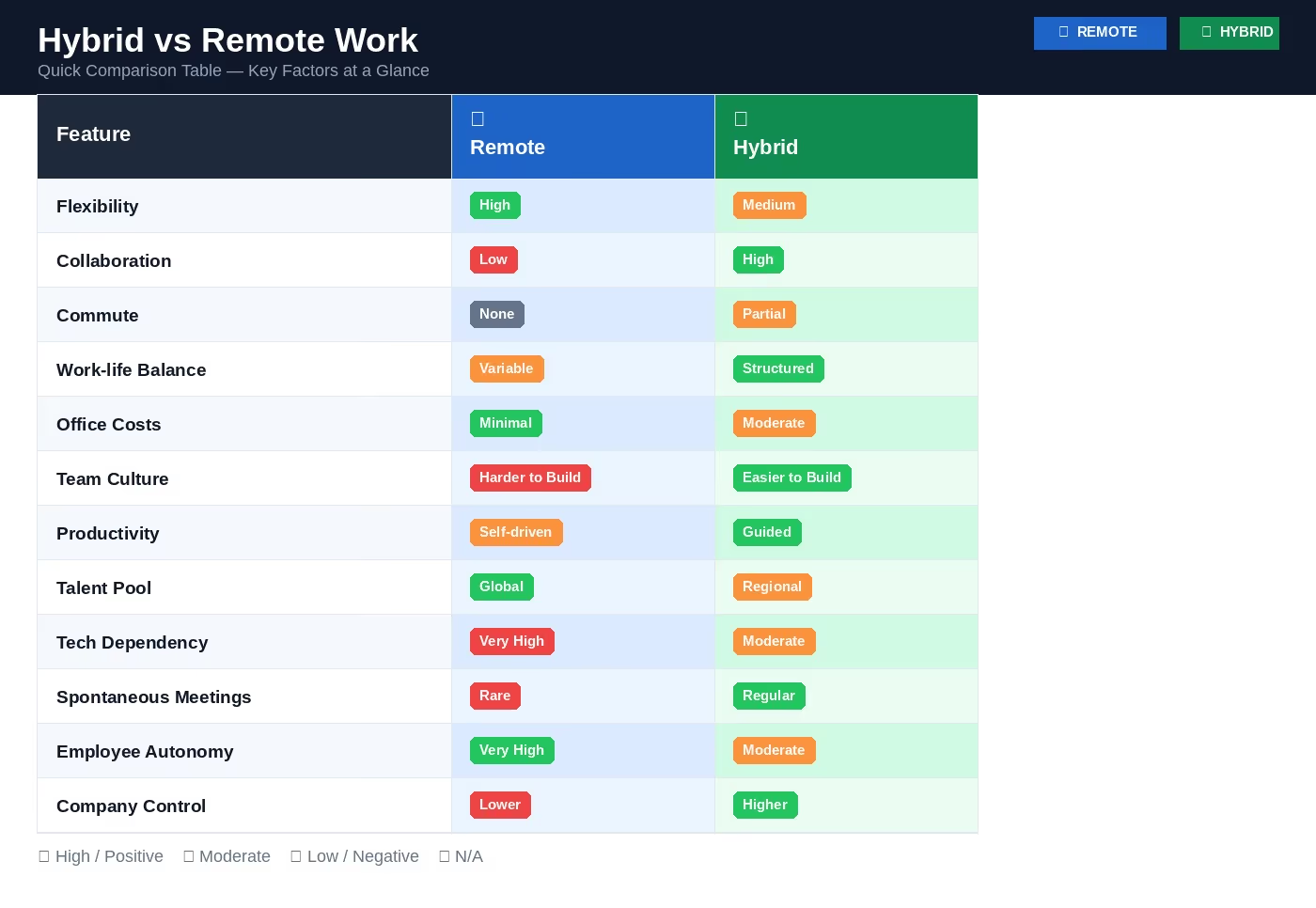
Wrapping Up
We hope this extensive guide will help you choose the perfect schedule that won’t leave you burned-out and hating your job. To reiterate, here’s a summary on when to choose remote or hybrid work.
Opt for remote work if you:
- have a lot of side projects or hustles
- value your alone or family time
- don’t like being too involved in work affairs
- work at a position that doesn’t require a lot of collaboration
- don’t like a long commute
- want to work for a company in a large city or another country because they offer more money
Opt for hybrid work if you:
- feel isolated, lonely, or bored when you only work from home
- yield better results with IRL collaboration
- need special equipment to get stuff done
- сan’t focus well enough for deep work at home due to your housing situation or other factors
- need to feel like you’re a team member working on a common purpose with your coworkers
FAQ

While most of my career has been in marketing copy, I view myself as an educator, focused on making complex ideas easy to understand. Even when writing SEO content, I prioritize real people over algorithms.
Learn moreWe are here to ease your working routine
Whether you're freelancing or a full-time contractor, we simplify the working process, putting you in control.
Try it free

Gusto and Deel both help companies manage payroll and HR, but they serve different business needs. Gusto is a better fit for US-based small and midsize businesses that need simple payroll, tax filing, benefits, onboarding, and basic HR tools. Deel is better for companies hiring internationally, managing global contractors, or using Employer of Record services. This comparison breaks down their key differences in payroll, compliance, pricing, integrations, benefits, contractor management, pros and cons, and best use cases to help businesses choose the right platform in 2026.

Compare the best Deel alternatives for global hiring, payroll, EOR, and contractor payments. See pricing, coverage, pros, cons, and best use cases.

Running payroll for one employee still means tax calculations, filings, forms, and deadlines — so the cheapest option isn't always the best value. This guide compares affordable payroll services for a one-person business, breaking down real monthly costs, what's included, and which choice fits how you actually pay your worker.
